By Daniela Pelliccia · Updated April 2026 · 22 min read
Buying property in Luxembourg is one of the most significant financial decisions you will ever make. With average apartment prices above EUR 7,500 per square metre nationally and well above EUR 10,000 in the capital, the margin for error is razor-thin. A single avoidable mistake can cost you tens of thousands of euros — or worse, trap you in a property that does not fit your life for the next decade. In my years of working as a real estate professional in Luxembourg, I have witnessed every one of these mistakes first-hand, and I have seen the very real consequences they carry.
What frustrates me is that most of these errors are entirely preventable. They stem not from bad intentions but from a lack of local knowledge, emotional decision-making, or simply not asking the right questions at the right time. Luxembourg's property market operates differently from markets in France, Germany, Belgium, or the UK. The tax structures are different. The buying process has unique steps. The mortgage landscape has its own rules. And the supply-demand dynamics are unlike almost anywhere else in Europe.
This guide is the article I wish every one of my clients had read before they started their property search. I have compiled the top 10 mistakes buyers make in the Luxembourg property market — drawn from real cases I have encountered, conversations with notaries and bankers, and the patterns I see repeating year after year. For each mistake, I will explain what it is, give you a realistic scenario showing how it plays out, quantify the financial impact, and — most importantly — tell you exactly how to avoid it. Whether you are a first-time buyer, a seasoned investor, or an expat navigating Luxembourg real estate for the first time, this article will save you money, stress, and regret.
For broader context on the current state of the market, I recommend reading our complete 2026 market analysis alongside this guide.
Mistake 1: Not Getting Mortgage Pre-Approval Before Searching
This is, without question, the most common and most damaging mistake I see buyers make in Luxembourg. They fall in love with a property, rush to make an offer, and only then discover that the bank will not lend them what they need — or that the terms are far worse than they expected. By the time the financing falls through, the property is gone, and weeks or months of effort have been wasted.
What many buyers do not realise is that mortgage pre-approval in Luxembourg is free, non-binding, and can be obtained in as little as five to ten business days. Yet the majority of first-time buyers I work with start visiting properties before they have spoken to a single bank. This is like going to an auction without knowing your spending limit.
A Real Scenario
I worked with a couple who found a beautiful two-bedroom apartment in Bonnevoie listed at EUR 620,000. They had combined net savings of EUR 90,000 and a joint household income of approximately EUR 9,500 per month. They assumed this would be sufficient for a 15% down payment plus transaction costs. They signed the compromis de vente with a financing clause and then approached three banks. The result? Two banks declined outright because the couple had an existing car loan that pushed their debt-to-income ratio above 40%. The third offered financing but required a 25% down payment — EUR 155,000 — which they simply did not have. The deal collapsed, and the couple lost both the property and over EUR 2,000 in early valuation and legal review costs.
The Financial Impact
| Cost of Not Getting Pre-Approval | Estimated Amount |
|---|---|
| Wasted valuation / survey fees | EUR 300–800 |
| Legal review costs (if engaged early) | EUR 500–1,500 |
| Opportunity cost (missed better properties during delay) | Potentially EUR 10,000+ |
| Emotional cost and time lost (2–4 months typical) | Significant |
| Total direct financial loss | EUR 1,000–2,500+ |
How to Avoid This Mistake
Before you visit a single property, contact at least two or three banks in Luxembourg. Provide them with your income statements, employment contract, savings proof, and any existing loan documentation. Ask for a written accord de principe (agreement in principle) that specifies the maximum loan amount, the interest rate, the required down payment, and any conditions. This document gives you a concrete budget and makes you a far more attractive buyer to sellers, because they know your financing is already in place. In Luxembourg, the main mortgage providers include Spuerkeess (BCEE), BIL, BGL BNP Paribas, ING, and Raiffeisen. Each has different criteria and rates, so shopping around is essential. For a complete guide on navigating mortgage options, see our Luxembourg mortgage guide.
What this means for you: Start with the banks, not with the property portals. Know your exact budget — including all fees and down payment requirements — before you fall in love with a property you cannot afford.

Getting mortgage pre-approval before searching is the most important step buyers can take in Luxembourg
Mistake 2: Ignoring the Total Cost of Buying (Notary Fees 7–10%, Registration Tax, and More)
When buyers in Luxembourg look at a property listed at EUR 700,000, most think they need EUR 700,000 plus a down payment. In reality, the total acquisition cost can be anywhere from EUR 712,000 to EUR 770,000 — or even higher — once you add notary fees, registration duties, transcription fees, bank fees, and various administrative costs. From what I see in the market right now, underestimating transaction costs is the second most common reason deals fall apart or buyers end up financially stretched from day one.
Luxembourg's transaction costs are among the highest in Europe, typically ranging from 7% to 10% of the purchase price for resale properties. The exact percentage depends on whether you qualify for the Bellegen Akt first-time buyer tax credit and whether you are purchasing a new-build (VEFA) or a resale property.
Complete Breakdown of Buying Costs
| Cost Component | Resale Property | With Bellegen Akt (First-Time) | New-Build (VEFA) |
|---|---|---|---|
| Registration duty (droit d'enregistrement) | 6% of price | Reduced by up to EUR 40,200/person | 6% on land only |
| Transcription fee | 1% of price | Covered by Bellegen Akt credit | 1% on land only |
| Notary fees | 1.0–1.5% | 1.0–1.5% | 1.0–1.5% |
| Mortgage registration fee | 0.3–0.5% | 0.3–0.5% | 0.3–0.5% |
| Bank arrangement fee | 0.2–0.5% | 0.2–0.5% | 0.2–0.5% |
| Valuation fee | EUR 300–800 | EUR 300–800 | Often waived |
| Total approximate % | 8.5–10% | 2–3.5% | 3–5% |
A Real Scenario
A client of mine — a single professional — was purchasing a resale apartment in Gasperich for EUR 550,000. He was not a first-time buyer, so he did not qualify for the Bellegen Akt credit. He had budgeted EUR 120,000 for his down payment and expected perhaps EUR 10,000 in additional fees. The actual transaction costs came to approximately EUR 49,500. Combined with the 20% down payment of EUR 110,000, he needed EUR 159,500 in cash — not the EUR 130,000 he had planned for. He had to scramble to secure a family loan to cover the shortfall, which added stress and delay to the entire process.
How to Avoid This Mistake
Always calculate the full acquisition cost before making an offer. Use this simple formula: Purchase price + 10% (resale, non-first-time) or Purchase price + 3% (first-time buyer with Bellegen Akt). Build a detailed budget that includes the down payment, all transaction costs, a moving fund, and an emergency reserve of at least three months of mortgage payments. What I always tell my clients is that if you cannot comfortably afford the total cost — not just the deposit — you are not ready to buy at that price point. For a step-by-step walkthrough of every cost involved, read our complete buying process guide.
What this means for you: On a EUR 600,000 property, a non-first-time buyer should budget EUR 48,000–60,000 for transaction costs alone — on top of the down payment. Never confuse the listed price with the total price you will pay.
Not Sure What You Can Really Afford? Let's Calculate Together
Avoid the most expensive mistake in Luxembourg real estate. I will help you calculate your true budget — including every hidden cost — so you know exactly where you stand before you start searching. Free, no-obligation consultation.
📊 Free Consultation 💬 WhatsApp DanielaMistake 3: Skipping the Compromis de Vente Review
The compromis de vente (preliminary sales agreement) is arguably the most important legal document in the entire Luxembourg property purchase process. Once both parties sign it, it becomes a legally binding contract. Yet an alarming number of buyers sign this document without reading it thoroughly, without understanding the clauses, and without having it reviewed by an independent professional. In my experience, this is where some of the most expensive mistakes are made — mistakes that cannot be undone.
Unlike in some other countries, the compromis de vente in Luxembourg is not a simple letter of intent. It is a comprehensive contract that sets out the purchase price, the payment schedule, the conditions suspensives (contingency clauses), the completion timeline, and a range of obligations for both buyer and seller. If you fail to include a critical suspensive condition — for example, a financing clause — and your mortgage falls through, the seller can legally demand a penalty of 10% of the purchase price. On a EUR 700,000 property, that is EUR 70,000.
A Real Scenario
I know of a case where a buyer signed a compromis de vente for an apartment in Kirchberg without including a clause related to the building's technical inspection. After signing, the buyer discovered that the building's facade required major renovation work — estimated at EUR 85,000 in total, of which the buyer's share would be approximately EUR 12,000. Because the compromis contained no clause allowing the buyer to withdraw based on previously undisclosed building works, the buyer was legally obligated to proceed with the purchase or forfeit the 10% penalty deposit. They went through with the purchase and immediately faced an unexpected EUR 12,000 bill on top of their already-stretched budget.
Key Clauses You Must Verify in Every Compromis de Vente
- Clause suspensive de financement: This must specify the exact loan amount, maximum interest rate, and a realistic deadline for obtaining financing (typically 6–8 weeks). Without it, if your mortgage is refused, you lose 10% of the purchase price.
- Description of the property: Verify the exact surface area, cadastral reference, parking spaces, cellars, and any annexes. Errors here can lead to disputes after closing.
- Building charges and co-ownership situation: The compromis should disclose the annual charges, the state of the reserve fund, and any pending or planned major works.
- Completion date: Ensure the deadline for the final notarial deed (acte notarie) is realistic — typically 3–4 months from signing the compromis.
- Penalty clauses: Understand what happens if either party withdraws. The standard penalty is 10% of the purchase price.
- Seller's declarations: The seller must declare any known defects, ongoing disputes, easements, or planned construction in the vicinity.
How to Avoid This Mistake
Never sign a compromis de vente on the spot. Take the document home, read it in full, and have it reviewed by either a notary (you are entitled to choose your own notary in Luxembourg) or a real estate professional who understands Luxembourg property law. I always insist that my clients take at least 48 hours to review the compromis before signing. This small delay can prevent mistakes worth tens of thousands of euros.
What this means for you: Always insist on a minimum 48-hour review period. Have the document checked by your own notary or a qualified real estate advisor. The cost of professional review (often free via your notary) is negligible compared to the risk of signing a flawed contract.
Mistake 4: Not Understanding the 2026 Tax Incentives for First-Time Buyers
Luxembourg offers some of the most generous first-time buyer incentives in Europe, yet a surprising number of eligible buyers fail to take full advantage of them. In some cases, buyers do not even know these incentives exist until after they have already purchased — at which point it is too late. From what I see in the market right now, the single most expensive version of this mistake occurs when buyers purchase their second property without realising they never properly used their first-time buyer credit on a previous purchase, effectively wasting up to EUR 80,400 in potential tax savings.
Key 2026 Tax Incentives for First-Time Buyers
| Incentive | Benefit | Eligibility |
|---|---|---|
| Bellegen Akt (registration duty credit) | Up to EUR 30,000/person (EUR 60,000/couple) credit against registration duty and transcription fees | First-time buyer, property used as primary residence |
| Increased Bellegen Akt (2024+ update) | Credit increased to EUR 40,200/person for properties purchased from 2024 onwards | First-time buyer, primary residence |
| Mortgage interest deduction | Deduct up to EUR 2,000/person/year (higher in first 5 years: EUR 2,000 + bonus) | All owners with a mortgage on primary residence |
| Capital gains tax exemption | Zero capital gains tax if property is primary residence owned for 2+ years | All owners selling primary residence |
| Reduced VAT on new builds | 3% super-reduced VAT (instead of 17%) on primary residence, up to EUR 50,000 benefit | First or main residence, application required |
A Real Scenario
I had a client couple — both first-time buyers — who purchased an apartment for EUR 680,000. They were not aware of the Bellegen Akt credit and proceeded through the purchase process without flagging their first-time buyer status to their notary. The notary, unfortunately, did not proactively ask. They paid the full 7% in registration and transcription fees: approximately EUR 47,600. Had they claimed the Bellegen Akt credit (EUR 40,200 per person, up to EUR 80,400 for a couple), their registration costs would have been reduced to approximately zero, plus notary fees of around EUR 8,000. The difference? Nearly EUR 40,000 left on the table. I only learned of this case when they came to me to sell the property three years later.
How to Avoid This Mistake
If you have never owned property in Luxembourg (or in some cases, have not owned property globally, depending on the specific provision), inform your notary and your bank immediately that you are a first-time buyer. The Bellegen Akt credit is not automatically applied — it must be claimed. Verify your eligibility with the Administration de l'enregistrement, des domaines et de la TVA. If you are buying with a partner, check whether each of you qualifies individually, as the credits are applied per person. Additionally, if purchasing a new-build, apply for the super-reduced 3% VAT rate before the notarial deed is signed.

Understanding Luxembourg's tax incentives can save first-time buyers up to EUR 80,400 per couple
What this means for you: If you are a first-time buyer, this is the most valuable tax advantage you will ever receive in Luxembourg. Declare your first-time buyer status early, verify your eligibility, and ensure your notary applies every credit you are entitled to.
Mistake 5: Buying Based on Emotion Instead of Data
I understand the temptation. You walk into a beautifully staged apartment with floor-to-ceiling windows, a modern kitchen, and a terrace overlooking the Petrusse valley, and your heart starts racing. You can already picture yourself having coffee on that balcony. You tell your partner, "This is the one." And just like that, rational analysis goes out the window.
Emotional buying is one of the most expensive mistakes in any property market, but in Luxembourg — where the average property costs upwards of half a million euros — the financial consequences are magnified. What I always tell my clients is this: fall in love with the numbers first. The property can win your heart later.
A Real Scenario
A client fell in love with a renovated house in Belair priced at EUR 1,350,000. The house was beautifully presented, had a charming garden, and was on a quiet street. The client offered the full asking price within 24 hours — without checking comparable sales, without negotiating, and without a thorough inspection. After closing, two things became apparent. First, comparable houses on adjacent streets had sold for EUR 1,180,000–1,250,000 in the preceding six months. The client had overpaid by approximately EUR 100,000–150,000. Second, the heating system (an old oil-based system) needed replacement within two years, adding another EUR 25,000–35,000 in costs that were not factored into the purchase decision.
The Data Points You Should Check Before Every Offer
- Price per square metre: Compare the asking price per m2 with recent sales in the same area. STATEC and the Observatoire de l'Habitat publish quarterly data. If the property is 15–20% above comparable sales, you have a strong negotiation position.
- Time on market: Properties that have been listed for 60+ days often have flexibility on price. Properties that receive offers within the first week may be priced fairly or even under market value.
- Energy performance certificate (CPE): An apartment rated G or H will cost significantly more to heat and will likely require energy upgrades. Factor this into the true cost.
- Building age and condition: Older buildings (pre-1990) may have hidden issues — asbestos, outdated wiring, insufficient insulation. A professional inspection costs EUR 500–1,000 and can save you tens of thousands.
- Neighbourhood trajectory: Is the area improving or declining? Are there planned infrastructure projects (tram extensions, new schools) that could boost value? For a deep dive into the best areas, read our neighbourhood guide.
How to Avoid This Mistake
Create a property evaluation checklist before you start visiting. Rate each property on at least 10 objective criteria: price per m2 versus market average, energy class, building age, transport links, proximity to schools and amenities, condition of common areas, natural light, noise levels, orientation, and parking. Score each criterion from 1 to 5 and compare properties side by side. This does not mean you should ignore your gut feeling entirely — but your gut should be just one data point among many, not the only one.
Mistake 6: Overlooking Energy Class and Renovation Costs
Energy performance has become one of the most critical factors in Luxembourg real estate, and it is only going to become more important. The energy performance certificate (certificat de performance energetique, or CPE) rates properties from A (most efficient) to I (least efficient). What many buyers fail to understand is that the energy class directly impacts not just your monthly utility bills, but also the long-term value of the property, your ability to rent it out, and the cost of mandatory upgrades that may be required under future EU regulations.
In my experience working with clients, I have seen buyers purchase F-rated or G-rated apartments thinking they were getting a bargain — only to discover that bringing the property up to a reasonable standard costs EUR 30,000–80,000 in renovations. What initially seemed like a great deal ends up being more expensive than buying a better-rated property in the first place.
Energy Class Impact on Property Value and Costs
| Energy Class | Typical Annual Energy Cost | Price Discount vs Class B | Estimated Renovation Cost to Class C |
|---|---|---|---|
| A–B | EUR 600–1,200/yr | Baseline | Not needed |
| C–D | EUR 1,200–2,000/yr | 5–10% | EUR 5,000–15,000 |
| E–F | EUR 2,000–3,500/yr | 10–20% | EUR 20,000–50,000 |
| G–I | EUR 3,500–6,000+/yr | 15–30% | EUR 40,000–100,000+ |
A Real Scenario
A young couple purchased a 90m2 apartment in Bonnevoie rated energy class G for EUR 480,000, attracted by the lower price compared to similar apartments rated C or D in the same area (which were priced at EUR 540,000–570,000). They saved approximately EUR 60,000–90,000 on the purchase price. However, within the first year, they spent EUR 4,200 on energy bills (versus EUR 1,500 for a Class C equivalent). They then decided to renovate — new windows, insulation, and a heat pump — which cost EUR 55,000 even after government subsidies. Their total cost was EUR 535,000 plus the ongoing higher bills during the first year. They would have been better off buying the Class C apartment at EUR 560,000 from the start.
How to Avoid This Mistake
Always request the CPE before making an offer. Calculate the true cost of ownership by adding energy costs over 10 years and any necessary renovation costs to the purchase price. Factor in government renovation subsidies (Luxembourg offers generous grants through Klimabonus and other programmes), but do not assume they will cover everything. If you are considering a property rated E or below, get professional renovation quotes before you commit. And remember: energy class is increasingly affecting resale values. A property rated G today will be even harder to sell in five years when regulations tighten further.
What this means for you: Always calculate the "total 10-year cost" of a property: purchase price + transaction costs + 10 years of energy bills + renovation costs. This is the only fair way to compare properties at different price points and energy classes.
Mistake 7: Not Checking the Building's Syndic and Co-Ownership Situation
When you buy an apartment in Luxembourg, you are not just buying four walls and a roof. You are buying into a copropriete (co-ownership) structure — a legal entity that owns and manages the common parts of the building. This includes the entrance hall, stairwells, lifts, roof, facade, basement, parking areas, and any shared gardens or amenities. The quality of this co-ownership — how it is managed, how much it costs, and what major works are planned — can dramatically affect your experience and your finances.
From what I see in the market right now, at least one in five buyers fails to investigate the co-ownership situation before purchasing. They sign the compromis, move in, and then discover that the building has EUR 150,000 in planned facade works, that the reserve fund is empty, or that the syndic (building management company) is unresponsive and disorganised.
A Real Scenario
A client purchased a two-bedroom apartment in a 1980s building in Luxembourg-Gare for EUR 520,000. The price seemed fair for the area. What the client did not check were the minutes of the last three assemblees generales (general meetings of co-owners). Had he done so, he would have discovered that the building had voted to undertake major roof renovation and lift replacement works totalling EUR 280,000. His share, based on the milliemes (ownership fraction), was EUR 18,500 — due within 12 months of the vote. On top of his regular monthly charges of EUR 350, this was a significant and entirely unexpected financial hit. The seller was legally required to disclose this, but the information was buried in the last AG minutes — which the buyer never requested.
What to Check Before Buying Any Co-Owned Property
- Minutes of the last 3 assemblees generales: These reveal any planned or voted works, disputes between co-owners, financial issues, and management concerns.
- Annual building charges: Request a breakdown. High charges (above EUR 4 per m2/month) may indicate an inefficient building or poor management.
- Reserve fund status: A healthy building should have a reserve fund of at least EUR 500–1,000 per unit. An empty or near-empty reserve fund is a red flag — it means any major work will require special contributions from owners.
- Planned major works: Ask the syndic directly whether any major works are planned, voted, or under discussion. Facade renovation, lift replacement, roof repair, and garage waterproofing are the most common — and most expensive — items.
- Outstanding debts: Check whether any co-owners are delinquent on their charges. A high default rate can lead to financial instability for the entire building.
- Quality of the syndic: Is the building managed by a professional syndic company or by a volunteer co-owner? Professional management is generally more transparent and reliable.
How to Avoid This Mistake
Before signing the compromis de vente, request all co-ownership documentation from the seller or the syndic. Luxembourg law gives prospective buyers the right to this information. Review it carefully — or better yet, have your real estate advisor review it for you. If the seller or syndic is slow to provide documents, treat this as a warning sign. A well-managed building has nothing to hide.
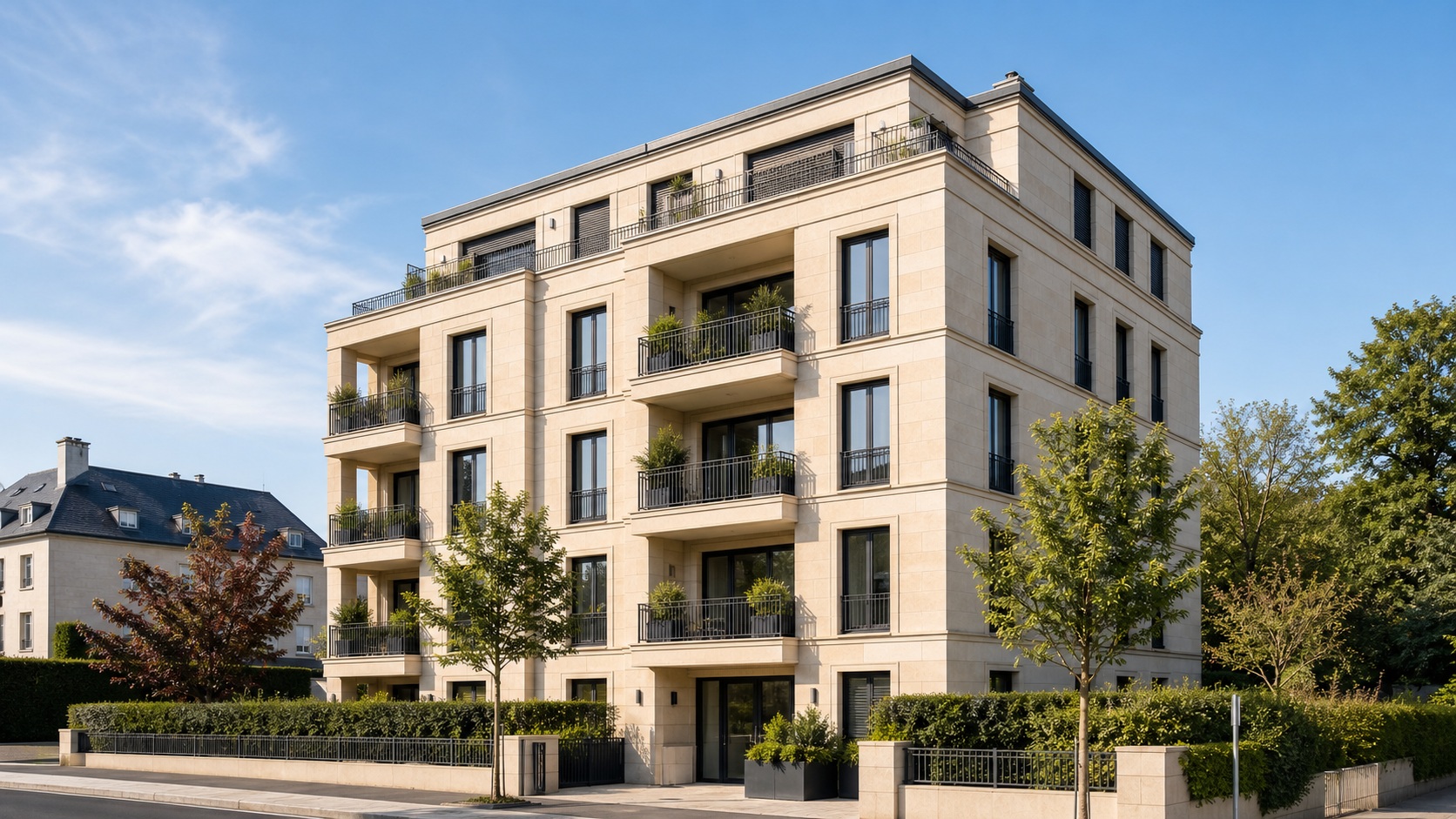
A well-managed building with a healthy reserve fund protects your investment long-term
What this means for you: Always request the last three years of AG minutes, the annual charge breakdown, and the reserve fund statement before signing anything. This 30-minute review can save you five figures.
Mistake 8: Timing the Market Wrong — Waiting for a Crash That Will Not Come
This is the mistake that costs the most money over time, yet it never appears on a bank statement or an invoice. It is the cost of inaction. Every year, I meet buyers who tell me they are "waiting for prices to drop further" or "waiting for the crash." They have been waiting since 2019. Or 2021. Or 2023. And while they wait, rents increase, mortgage rates fluctuate, and the properties they were eyeing either sell or appreciate.
Let me be very direct about this: Luxembourg is not going to experience a property market crash in any meaningful sense. The structural undersupply of housing, the continued population growth, the limited land area, the AAA economy, and the growing demand from cross-border workers and EU institutions create a floor under property prices that simply does not exist in most other markets. The 2022–2023 correction of 12–15% was the exception that proves the rule — and even that correction has now largely stabilised, with prices showing 2–4% annual growth in 2025–2026.
The Cost of Waiting: A 5-Year Comparison
| Scenario | Buy in 2026 | Wait Until 2028 | Difference |
|---|---|---|---|
| Purchase price (2-bed, Bonnevoie) | EUR 550,000 | EUR 594,000 (+4%/yr) | +EUR 44,000 |
| Mortgage rate | 3.2% | Unknown (could be higher) | Rate risk |
| Rent paid while waiting (2 years) | EUR 0 | EUR 48,000 | +EUR 48,000 |
| Equity built in 2 years of ownership | ~EUR 30,000 | EUR 0 | -EUR 30,000 |
| Total cost of waiting | — | — | EUR 92,000–122,000 |
A Real Scenario
A couple contacted me in early 2024 about buying a two-bedroom apartment in Bonnevoie. They had their sights on a property listed at EUR 520,000. I recommended they proceed — the price per m2 was fair, the building was well-managed, and their financial situation was solid. Instead, they decided to wait "another six to twelve months" because they read online that prices might fall further. They continued renting at EUR 2,000 per month. By the time they came back to me in mid-2025, that apartment had sold for EUR 535,000 to another buyer. Comparable apartments in the area were now listed at EUR 545,000–560,000. They had spent EUR 32,000 in rent over 16 months, and the properties they were interested in now cost EUR 25,000–40,000 more. Their total cost of waiting: approximately EUR 57,000–72,000. That is a number that should keep any fence-sitter awake at night.
How to Avoid This Mistake
Stop trying to time the bottom. Instead, focus on time in the market rather than timing the market. If your financial situation supports buying — stable income, sufficient savings, plans to stay in Luxembourg for 3+ years — then the best time to buy is when you are ready. Waiting for a 10% crash while paying EUR 2,000/month in rent and missing out on 3–4% annual appreciation is a losing strategy in Luxembourg. The math simply does not support it. For a detailed analysis of current market conditions, see our 2026 market outlook.
Stop Waiting. Start Building Wealth in Luxembourg Real Estate
Every month you wait, you pay someone else's mortgage through rent while property prices edge higher. Let me help you find the right property, secure the best mortgage rate, and avoid every mistake on this list. Your first consultation is free.
📊 Free Consultation 💬 WhatsApp DanielaMistake 9: Choosing the Wrong Mortgage Type — Fixed vs Variable
The mortgage structure you choose will determine how much you pay for your property over the next 20–30 years. It is arguably the most important financial decision within the buying process — yet many buyers spend more time choosing kitchen tiles than evaluating their mortgage options. In my experience, the wrong mortgage type can cost a buyer EUR 30,000–80,000 over the life of the loan compared to the right choice for their situation.
In Luxembourg, the main mortgage options are fixed-rate, variable-rate, and mixed/split mortgages. Each has distinct advantages and risks, and the right choice depends on your financial profile, your risk tolerance, and your outlook on interest rates.
Mortgage Types Compared (2026 Conditions)
| Feature | Fixed Rate (25-Year) | Variable Rate | Mixed (10 Fixed + Variable) |
|---|---|---|---|
| Current typical rate (2026) | 3.0–3.5% | 2.4–2.9% | 2.8–3.2% (initial period) |
| Monthly payment (EUR 500K loan) | ~EUR 2,370 | ~EUR 2,180 | ~EUR 2,270 (initially) |
| Payment predictability | 100% — never changes | Changes every 3–12 months | Fixed for initial period, then variable |
| Risk if rates rise by 2% | None | +EUR 480/month | None initially; +EUR 480/month after fixed period |
| Total interest paid (25 years, rates stable) | ~EUR 211,000 | ~EUR 154,000 | ~EUR 181,000 |
| Best for | Risk-averse, long-term owners, families | Short-term holders, financially flexible | Medium-term owners, moderate risk tolerance |
A Real Scenario
In 2021, a client chose a variable-rate mortgage at 1.3% over a fixed rate of 1.8%, reasoning that rates had been low for years and would stay low. His monthly payment on a EUR 450,000 loan was EUR 1,740 — about EUR 110 less per month than the fixed option. By mid-2023, his variable rate had climbed to 4.1%. His monthly payment jumped to EUR 2,340 — an increase of EUR 600 per month. Over two years, the total additional cost compared to the fixed-rate alternative was approximately EUR 8,400, and the rate remained elevated through 2024. Had he locked in the fixed rate, he would have paid the same EUR 1,850 every single month regardless of ECB decisions. The savings from the first 18 months of lower variable payments were completely wiped out — and then some.
How to Avoid This Mistake
There is no universally "right" mortgage type — it depends entirely on your situation. However, here are the guidelines I give my clients. If you are planning to stay in the property for 10+ years and you value payment stability, take the fixed rate. The premium you pay over the variable rate is essentially insurance against rate increases. If you plan to sell within 5–7 years and have financial reserves to absorb rate increases, a variable or mixed mortgage can save you money. Whatever you choose, always stress-test your budget: if your variable rate increased by 2%, could you still comfortably afford the payments? If not, you cannot afford the variable rate. For a complete breakdown of mortgage options, read our 2026 mortgage guide.
What this means for you: Always stress-test your budget: if your variable rate rose by 2%, could you still comfortably afford payments? If the answer is no, the fixed rate is the safer and ultimately cheaper choice for you.
Mistake 10: Not Using a Local Real Estate Expert
I will be straightforward — as a real estate professional, I have an obvious interest in this point. But I include it because I have seen the consequences of going it alone so many times that I would be doing you a disservice not to mention it. The Luxembourg property market is small, opaque, and operates with local customs and practices that are not obvious to outsiders. Many of the best properties never appear on public portals. Negotiation dynamics differ significantly from larger markets. And the legal, tax, and financial complexities can be overwhelming for buyers who are unfamiliar with the system.
In my experience working with clients, buyers who work with an experienced local agent save an average of 3–7% on the purchase price through better negotiation, access to off-market properties, and avoidance of overpriced listings. On a EUR 600,000 property, that is EUR 18,000–42,000 — far more than any agency fee.
A Real Scenario
An expat client came to me after attempting to purchase an apartment independently. He had found a property on Immotop listed at EUR 495,000. He offered the full asking price, which the seller accepted immediately — which should have been a warning sign. When I reviewed the property details, I found that comparable apartments in the same building had sold for EUR 440,000–460,000 in the past year. The property had been on the market for 97 days — well above the average of 45–60 days for that area — suggesting it was overpriced. Additionally, the energy class was F, and the building's reserve fund was nearly empty. Had this client worked with a local expert from the beginning, he would have either negotiated the price down by EUR 35,000–55,000 or been steered towards a better-value property entirely.
What a Good Local Expert Provides
- Market knowledge: Understanding of fair prices per m2 by neighbourhood, street, and even building. This prevents overpaying.
- Off-market access: In Luxembourg's tight market, many properties are sold before they are publicly listed. A well-connected agent gives you access to these opportunities.
- Negotiation skill: Knowing the seller's motivation, the property's time on market, and comparable sales allows for informed negotiation that saves thousands.
- Due diligence: Reviewing the co-ownership documents, energy certificates, building condition, and legal situation before you commit.
- Process guidance: Navigating the compromis de vente, coordinating with the notary, timing the mortgage application, and managing the closing process.
- Tax optimisation: Ensuring you claim every tax benefit you are entitled to, from the Bellegen Akt credit to mortgage interest deductions.
- Multilingual support: Luxembourg operates in French, German, Luxembourgish, and English. Having an advisor who can navigate all four languages — and the cultural nuances that come with them — is invaluable.
How to Avoid This Mistake
Work with a real estate professional who specialises in the Luxembourg market, has a verifiable track record, and is willing to act as your advisor throughout the process — not just someone who shows you listings. Ask for references, check their knowledge of your target area, and ensure they are transparent about their fees and how they are compensated. A good agent pays for themselves many times over through better deals, avoided mistakes, and access to opportunities you would never find on your own.

Working with a local Luxembourg real estate expert saves buyers an average of 3–7% on purchase price
What this means for you: The cost of not using an expert is almost always higher than the cost of using one. A knowledgeable local agent provides market intelligence, negotiation power, due diligence, and access to off-market properties that you simply cannot get from property portals alone.
Summary: All 10 Mistakes at a Glance
Here is a quick reference of every mistake covered in this article, along with the potential financial impact and the single most important action to avoid it:
| # | Mistake | Potential Cost | Key Prevention |
|---|---|---|---|
| 1 | No mortgage pre-approval | EUR 1,000–10,000+ | Get accord de principe before viewing |
| 2 | Ignoring total buying costs | EUR 20,000–60,000 | Budget purchase price + 10% for costs |
| 3 | Skipping compromis review | EUR 12,000–70,000 | 48-hour review + independent notary |
| 4 | Missing tax incentives | EUR 30,000–80,000 | Declare first-time buyer status early |
| 5 | Emotional buying | EUR 50,000–150,000 | Compare price/m2 with sales data |
| 6 | Ignoring energy class | EUR 20,000–100,000 | Calculate 10-year energy + renovation cost |
| 7 | Not checking co-ownership | EUR 10,000–30,000 | Request last 3 years AG minutes |
| 8 | Waiting for a crash | EUR 92,000–122,000 | Focus on time in market, not timing |
| 9 | Wrong mortgage type | EUR 30,000–80,000 | Stress-test budget with +2% rate scenario |
| 10 | No local expert | EUR 18,000–42,000 | Work with an experienced local agent |
Frequently Asked Questions: Property Buying Mistakes in Luxembourg
What is the biggest mistake first-time buyers make in Luxembourg?
The single biggest mistake is not getting mortgage pre-approval before starting the property search. Without knowing your exact budget — including all transaction costs, down payment requirements, and monthly affordability limits — you risk falling in love with properties you cannot afford, wasting time on fruitless searches, or having deals collapse after signing the compromis de vente. Pre-approval is free, takes less than two weeks, and gives you a concrete budget to work within. The second most costly mistake for first-time buyers specifically is failing to claim the Bellegen Akt tax credit, which can save up to EUR 80,400 per couple.
How much should I budget for transaction costs when buying property in Luxembourg?
For a resale property without first-time buyer credits, budget approximately 8.5–10% of the purchase price for all transaction costs, including registration duty (6%), transcription fee (1%), notary fees (1–1.5%), and bank-related fees (0.5–1%). For a EUR 600,000 property, this means EUR 51,000–60,000 in addition to your down payment. First-time buyers using the Bellegen Akt credit can reduce total transaction costs to approximately 2–3.5%, as the credit covers most or all of the registration duty and transcription fee. For new-build properties (VEFA), registration duty applies only to the land portion, which typically represents 20–30% of the total price, further reducing upfront costs.
Should I choose a fixed or variable mortgage rate in Luxembourg in 2026?
In 2026, with fixed rates around 3.0–3.5% and variable rates around 2.4–2.9%, the choice depends on your situation. Choose fixed if you plan to stay 10+ years, prefer payment certainty, or would be financially stressed by a rate increase. Consider variable if you plan to sell within 5–7 years, have significant financial reserves, and can absorb a potential payment increase of EUR 400–600/month. A mixed mortgage (e.g., 10 years fixed then variable) is a good compromise for medium-term owners. The key test: if rates rose 2% tomorrow, could you still comfortably afford your payments? If the answer is no, take the fixed rate. For a detailed analysis of current mortgage options, consult our 2026 mortgage guide.
What should I check in the compromis de vente before signing?
Before signing the compromis de vente, verify the following: (1) The financing clause (clause suspensive de financement) specifies the exact loan amount, maximum interest rate, and a realistic deadline of 6–8 weeks. (2) The property description matches reality — surface area, cadastral reference, parking, cellar, and annexes. (3) The co-ownership situation is disclosed, including annual charges, reserve fund status, and any planned or voted major works. (4) The completion deadline is realistic (typically 3–4 months). (5) The seller's declarations cover any known defects, disputes, easements, or nearby construction. (6) Penalty clauses are understood — the standard penalty for withdrawal is 10% of the purchase price. Always take at least 48 hours to review the document and have it checked by your own notary.
Is it worth waiting for Luxembourg property prices to drop further?
For most buyers, the answer is no. Luxembourg's property market has already corrected by 12–15% from the 2022 peak and has stabilised with 2–4% annual growth in 2025–2026. The structural factors that support prices — severe housing undersupply (30,000+ unit deficit), strong population growth (+1.6%/year), AAA economy, and high household incomes — remain firmly in place. Waiting for a further correction while paying rent (EUR 1,500–2,500/month for most buyers) and missing out on equity accumulation is a losing strategy. Our analysis shows that waiting two years typically costs EUR 92,000–122,000 when you factor in higher future prices, rent paid during the wait, and lost equity. For the full market analysis, see our 2026 market outlook.
How important is the energy class when buying property in Luxembourg?
Energy class is increasingly one of the most important factors in Luxembourg real estate. A property rated G or H can cost EUR 3,500–6,000+ per year in energy bills compared to EUR 600–1,200 for a Class A or B property — a difference of up to EUR 4,800 annually. Over 10 years, that is EUR 48,000 in additional running costs. Furthermore, bringing a G-rated property up to a reasonable standard (Class C or D) typically costs EUR 40,000–100,000 in renovations. Energy class also increasingly affects resale values: properties rated E or below are already selling at 10–30% discounts compared to equivalent properties with better ratings. With EU energy regulations tightening, this discount is likely to widen. Always request the CPE (certificat de performance energetique) before making an offer, and factor the 10-year energy cost plus any necessary renovation costs into your total budget.
Conclusion: Buy Smart, Buy Informed, Buy with Confidence
Buying property in Luxembourg is a significant commitment, but it does not have to be a stressful or risky one. Every mistake on this list — from skipping pre-approval to ignoring transaction costs, from emotional buying to choosing the wrong mortgage — is entirely preventable with the right preparation and the right guidance.
Let me summarise the core message of this article: knowledge is your most valuable asset in the Luxembourg property market. The buyers who succeed — who get the best prices, avoid hidden costs, and build long-term wealth — are the ones who take the time to understand the system before they commit their money. They get pre-approved. They budget for the full cost. They read the compromis. They check the building. They compare data. And they work with local experts who know the market inside and out.
In my years of working in Luxembourg real estate, the most rewarding part of my job is seeing clients go from anxious and overwhelmed to confident and excited. The difference is almost always the same: information. When you understand what you are doing, who you are dealing with, and what to expect at every step, the entire process becomes manageable — even enjoyable.
If you are currently looking to buy in Luxembourg, or if you are still in the early stages of thinking about it, I encourage you to use this guide as your reference. Save it. Come back to it before every major decision. And if you have questions that this article does not answer, or if you want to discuss your specific situation, please do not hesitate to reach out. I am always happy to help.
For more in-depth guidance on specific topics, explore the following resources:
- Is 2026 a Good Time to Buy Property in Luxembourg? — Full market analysis with latest data
- Best Areas to Buy Property in Luxembourg 2026 — Neighbourhood-by-neighbourhood guide
- Luxembourg Mortgage Guide 2026 — Rates, types, and how to get the best deal
- The Luxembourg Buying Process Step by Step — From first viewing to final deed
- Property Investment Strategy Luxembourg 2026 — Yields, areas, and wealth-building tactics
- Renting vs Buying in Luxembourg 2026 — Complete cost comparison with real numbers
Ready to Buy Smart in Luxembourg? Let Daniela Guide You
Every property purchase in Luxembourg has pitfalls — but none of them are inevitable. With expert guidance, local market knowledge, and a clear strategy, you can avoid every mistake on this list and find the right property at the right price. Your first consultation is free and completely without obligation.
📊 Free Consultation 🏠 Browse Properties 💬 WhatsApp DanielaSources: STATEC, Observatoire de l'Habitat, Chambre Immobiliere du Grand-Duche de Luxembourg, Administration de l'enregistrement des domaines et de la TVA, European Central Bank, CSSF. All figures are estimates based on publicly available market data and professional experience as of April 2026. Individual results may vary based on specific property, location, financing terms, and market conditions. This article is for informational purposes and does not constitute financial or legal advice.