If I could give one piece of advice to every property buyer in Luxembourg in 2026, it would be this: before you fall in love with the kitchen or the view, look at the energy class. That single letter on the Certificat de Performance Energetique — ranging from A (outstanding) to I (dreadful) — will determine how much you pay in heating bills every winter, how easily you can resell the property in five or ten years, what mortgage rate your bank will offer you, and whether the government will eventually force you to renovate before you can legally rent the place out. In a market where a two-class difference in energy rating can mean a EUR 40,000 to EUR 80,000 swing in property value, understanding the CPE is not optional. It is essential.
I have helped hundreds of clients buy and sell property across Luxembourg, and I have watched the energy conversation go from a footnote to a headline. Five years ago, most buyers would glance at the energy class on the listing, shrug, and move on to negotiating the price. Today, sophisticated buyers use the energy class as a negotiating lever, a cost-planning tool, and an investment filter. Banks are adjusting their mortgage terms based on energy performance. The government is tightening minimum standards for rental properties. And the European Union's Energy Performance of Buildings Directive is pushing Luxembourg toward a future where low-energy-class properties simply cannot be sold or rented without major renovation. This is not a trend — it is a structural shift in how property is valued.
This guide covers everything you need to know about energy classes and property values in Luxembourg in 2026. I will explain what the CPE is and how to read it, break down each energy class from A to I with real-world cost implications, show you the price premium and discount data by class, walk you through renovation options and government subsidies, and help you decide whether it makes more sense to buy a high-class property or buy low and upgrade. Whether you are a first-time buyer, a seasoned investor, or a homeowner thinking about selling, this article will change how you look at every property listing from now on. For broader market context, I recommend starting with our complete 2026 Luxembourg market analysis.
What Is the CPE (Certificat de Performance Energetique)?
The Certificat de Performance Energetique, or CPE, is Luxembourg's official energy performance certificate for buildings. It is the equivalent of the EPC in the United Kingdom, the DPE in France, or the Energieausweis in Germany. Every residential property in Luxembourg that is sold, rented, or newly constructed must have a valid CPE. This is not a recommendation — it is a legal requirement under Luxembourg's modified law of 5 August 1993 on the rational use of energy, updated most recently to align with EU Directive 2010/31/EU and its 2024 recast.
The CPE evaluates two separate dimensions of a building's energy performance. The first is energy efficiency, which measures how much primary energy the building consumes per square metre per year (kWh/m2/year). This is expressed as a letter grade from A (extremely efficient) to I (extremely inefficient). The second is thermal insulation, which measures the quality of the building envelope — walls, roof, windows, and floors — also graded from A to I. Both ratings appear on the certificate, but it is the energy efficiency class that gets the most attention from buyers, banks, and regulators.
A CPE is prepared by a certified energy assessor (conseiller en energie) who inspects the property, reviews construction plans, and uses standardised calculation software to model the building's energy performance. The certificate is valid for ten years and must be presented to potential buyers or tenants at the earliest opportunity — ideally in the property listing itself. In practice, every serious real estate listing in Luxembourg now includes the energy class prominently, and buyers have the legal right to request the full CPE report before making an offer.

A typical Luxembourg CPE certificate displays both the energy efficiency class (left scale) and the thermal insulation class (right scale), each ranging from A to I.
How to Read and Interpret a CPE Report
When you receive a CPE report, here is what to focus on. The front page shows two coloured arrow scales — one for energy efficiency, one for thermal insulation. Your property's class is highlighted on each scale. Below that, you will find the specific kWh/m2/year figure for energy consumption and the specific W/m2K figure for thermal insulation. These numbers matter because they tell you exactly where within a class the property falls. A property rated D with 201 kWh/m2/year is barely a D — it is almost an E. A property rated D with 151 kWh/m2/year is a strong D, close to upgrading to C with relatively modest improvements.
The report also includes a breakdown of energy consumption by category: heating, hot water, ventilation, and — in newer assessments — cooling. This breakdown is valuable because it tells you where the biggest energy losses are occurring. If 80 percent of the energy consumption comes from heating, the building envelope (insulation, windows) is probably the issue. If hot water is disproportionately high, the boiler or water heating system may be outdated. I always advise my clients to read this breakdown carefully, because it directly informs the renovation strategy and budget if you decide to improve the energy class after purchase.
Finally, the CPE includes recommendations for energy improvements. These are generic suggestions based on the assessment — things like "replace single-glazed windows" or "add roof insulation" — but they give you a starting point for discussions with energy consultants and renovation contractors. For a thorough understanding of all costs associated with buying, including the energy dimension, see our step-by-step buying guide.
Energy Classes A Through I: What Each Means in Practice
Luxembourg uses a nine-class energy rating system. Each class corresponds to a range of primary energy consumption per square metre per year. Understanding what each class means in practical, everyday terms — not just abstract numbers — is critical for making informed buying decisions. Here is the complete breakdown.
| Energy Class | kWh/m2/year | Typical Building Type | Annual Heating Cost (100 sqm) |
|---|---|---|---|
| A | 0 – 45 | Passive house, near-zero energy new builds | EUR 200 – 500 |
| B | 46 – 90 | High-performance new builds, deep renovations | EUR 500 – 1,000 |
| C | 91 – 150 | Good new builds, well-renovated older buildings | EUR 1,000 – 1,700 |
| D | 151 – 225 | Standard new builds pre-2017, partial renovations | EUR 1,700 – 2,500 |
| E | 226 – 300 | Buildings from the 1990s–2000s, basic insulation | EUR 2,500 – 3,400 |
| F | 301 – 400 | Buildings from the 1970s–1980s, minimal upgrades | EUR 3,400 – 4,500 |
| G | 401 – 500 | Post-war buildings, poor insulation, old heating | EUR 4,500 – 5,700 |
| H | 501 – 600 | Unrenovated pre-war buildings, single glazing | EUR 5,700 – 6,800 |
| I | 601+ | Historic buildings, no insulation, obsolete systems | EUR 6,800+ |
Note: Annual heating cost estimates are based on average Luxembourg gas and electricity prices as of Q1 2026 for a 100 sqm property. Actual costs vary depending on fuel type, tariff structure, occupant behaviour, and local climate conditions.
Class A: The Gold Standard
A Class A property in Luxembourg is essentially a passive house or near-zero energy building. These properties consume less than 45 kWh per square metre per year — which, for a 100 sqm apartment, translates to annual heating costs of roughly EUR 200 to EUR 500. To put that in perspective, that is less than what many Luxembourg residents spend on restaurant meals in a single month. Class A buildings achieve this through a combination of exceptional insulation (typically 20 to 30 cm of high-performance insulation in walls and roof), triple-glazed windows, mechanical ventilation with heat recovery, heat pumps, and often solar panels. In Luxembourg, you will find Class A ratings almost exclusively in new-build developments constructed after 2017, when the regulatory requirements for new buildings were significantly tightened. A growing number of deep-renovation projects also achieve Class A, though this requires substantial investment.
Class B: Excellent Performance
Class B properties consume between 46 and 90 kWh/m2/year. This is the sweet spot for many buyers — still very efficient, with annual heating costs of EUR 500 to EUR 1,000 for a 100 sqm unit, but typically available at a lower premium than Class A. You will find Class B in high-quality new builds, recent VEFA (Vente en Etat Futur d'Achevement) projects, and ambitious renovation projects. Many of the better apartment developments in Luxembourg City's Kirchberg, Gasperich, and Ban de Gasperich districts achieve Class B.
Class C: Good, Above Average
Class C (91 to 150 kWh/m2/year) represents good energy performance. This is what you can expect from competently built new constructions from the 2010s and well-renovated older buildings where insulation, windows, and heating have all been upgraded. Annual costs run EUR 1,000 to EUR 1,700 for 100 sqm. In my experience, Class C is often the realistic target for buyers renovating an older property — achieving Class B or A from a starting point of F or G requires very significant investment, while reaching C is often achievable with a focused renovation programme.
Class D and E: The Market Average
Classes D and E (151 to 300 kWh/m2/year) represent the bulk of Luxembourg's existing housing stock. If you are looking at apartments built in the 1990s or 2000s, or houses from the same era with partial renovations, you are most likely looking at a D or E rating. Annual heating costs of EUR 1,700 to EUR 3,400 for 100 sqm are manageable but not insignificant — over a 25-year mortgage term, a Class E property will cost you roughly EUR 50,000 to EUR 85,000 in heating alone, compared to EUR 12,500 to EUR 25,000 for a Class A or B. That difference is a small apartment deposit.
Classes F, G, H, and I: The Energy Drain
Classes F through I (above 300 kWh/m2/year) represent properties with serious energy performance issues. These are typically older buildings — from the 1960s, 1970s, or earlier — with inadequate insulation, single or early double-glazed windows, and outdated heating systems running on fuel oil or old gas boilers. A Class G or H property of 100 sqm can easily cost EUR 5,000 to EUR 7,000 per year in energy, and a Class I property can exceed that. Beyond the direct cost, these properties face growing regulatory and market headwinds. The EU's Energy Performance of Buildings Directive will eventually require minimum energy standards for all buildings, and several Luxembourg banks already apply stricter mortgage terms to properties rated F or below. I always caution my clients that buying a Class G, H, or I property without a concrete renovation plan and budget is a risky proposition in 2026.
What this means for you: Always calculate the total cost of ownership, not just the purchase price. A cheaper property with a poor energy class may cost you far more in the long run.
How Energy Class Impacts Property Prices in Luxembourg
Energy class does not just affect your running costs — it directly affects the purchase price. In Luxembourg's market in 2026, energy performance has become a genuine price differentiator, and the spread between high-class and low-class properties is widening every year. Here is what the data shows.
Price Premium and Discount by Energy Class
Based on my analysis of transaction data across Luxembourg in 2024 and 2025, and corroborated by studies from the Observatoire de l'Habitat and the European Commission's Building Stock Observatory, the following price adjustments apply relative to a Class D baseline (which represents the market average for existing stock).
| Energy Class | Price Premium/Discount vs Class D | Impact on EUR 600,000 Property | Market Trend (2024-2026) |
|---|---|---|---|
| A | +15% to +20% | EUR 690,000 – 720,000 | Premium increasing |
| B | +10% to +15% | EUR 660,000 – 690,000 | Premium increasing |
| C | +3% to +7% | EUR 618,000 – 642,000 | Stable premium |
| D (baseline) | 0% (reference) | EUR 600,000 | Baseline |
| E | -3% to -7% | EUR 558,000 – 582,000 | Discount widening |
| F | -8% to -14% | EUR 516,000 – 552,000 | Discount widening |
| G | -15% to -22% | EUR 468,000 – 510,000 | Discount widening significantly |
| H / I | -20% to -30% | EUR 420,000 – 480,000 | Deep discount, fewer buyers |
These numbers tell a powerful story. A Class A apartment that might sell for EUR 720,000 would sell for only EUR 468,000 to EUR 510,000 if it were rated G — a difference of EUR 210,000 to EUR 252,000. Of course, the comparison is not perfectly apples-to-apples, because Class A and Class G properties tend to differ in age, location, and general condition. But the energy class premium is measurable even when controlling for these factors. A 2024 study by the Luxembourg Institute of Socio-Economic Research (LISER) found that each one-class improvement in energy rating was associated with a 3 to 5 percent increase in transaction price, holding location, size, and building age constant.

Price premium and discount by energy class relative to Class D baseline. The gap between high-performance and low-performance properties continues to widen in 2026.
Why the Gap Is Widening
Three forces are driving the growing price spread between energy classes in Luxembourg. First, energy costs have risen substantially since the 2021-2022 energy crisis. Even though prices have stabilised from their peaks, Luxembourg's gas and electricity rates remain significantly higher than pre-crisis levels, making energy efficiency a more visible and urgent concern for buyers. Second, regulatory pressure is increasing. The EU's revised Energy Performance of Buildings Directive, transposed into Luxembourg law, signals a future where low-class properties face restrictions on sale and rental. Buyers are pricing in this regulatory risk. Third, bank lending practices are shifting. Several major Luxembourg banks now factor energy class into their mortgage risk assessment, offering preferential rates for Class A and B properties and applying stricter conditions to Class F and below. I will cover the banking angle in detail below.
For investors looking at how energy performance fits into a broader portfolio strategy, I recommend reading our investment strategy guide for Luxembourg in 2026.
Not Sure What Your Target Property's Energy Class Means for Value?
I will analyse the CPE, estimate the true cost of ownership including energy, and advise you on whether the asking price reflects the energy performance — or whether there is room to negotiate. Free, no-obligation consultation.
WhatsApp Daniela Free Property ValuationHow Energy Class Affects Mortgage Conditions in Luxembourg
This is a dimension that many buyers overlook until they sit down with their banker, and then it can be a genuine surprise. In Luxembourg's lending market in 2026, several major banks have introduced what are commonly called "green mortgage" products or energy-adjusted lending terms. The logic is straightforward: a property with good energy performance represents lower financial risk for the bank, because the borrower faces lower running costs (reducing default risk) and the property is likely to hold its value better over time (reducing collateral risk).
Here is how energy class typically affects mortgage conditions in Luxembourg as of early 2026.
| Energy Class | Typical Rate Adjustment | LTV (Loan-to-Value) Offered | Additional Conditions |
|---|---|---|---|
| A or B | -0.10% to -0.20% on standard rate | Up to 100% for qualifying buyers | Fastest approval, no energy-related requirements |
| C or D | Standard rate | Up to 90-100% depending on profile | Standard conditions |
| E or F | Standard rate or +0.05% | Up to 80-90% | Some banks request renovation plan |
| G, H, or I | +0.05% to +0.15% or case-by-case | Up to 70-80% | May require renovation commitment, higher deposit |
Let me put this in concrete terms. On a EUR 500,000 mortgage over 25 years, a rate reduction of 0.15 percentage points (which is what some banks offer for Class A or B properties) saves you approximately EUR 11,500 over the life of the loan. That is not a fortune, but it is meaningful — and it stacks on top of the lower energy bills and higher resale value you are already benefiting from. Conversely, buying a Class G property might mean paying a higher rate and putting down a larger deposit, which reduces your purchasing power and your return on equity.
The banks that currently offer the most favourable green mortgage terms in Luxembourg include BGL BNP Paribas, Spuerkeess (BCEE), and ING Luxembourg, though the specific conditions change frequently. For a comprehensive comparison of current mortgage products and rates, I recommend reading our complete mortgage guide for Luxembourg in 2026.
What this means for you: Factor the mortgage advantage into your comparison when weighing a higher-priced Class A property against a cheaper Class F. The financing cost difference partially offsets the price premium.
Renovation Costs to Improve Energy Class
If you are considering buying a property with a lower energy class and renovating to improve it, you need realistic cost estimates. In my experience, buyers consistently underestimate renovation costs — and just as consistently overestimate how much improvement a single measure will deliver. Energy renovation is not one big fix; it is a system of interconnected improvements that work together. Replace the windows without improving the insulation, and you will be disappointed. Install a heat pump without addressing air tightness, and it will run inefficiently. The properties that achieve the biggest class improvements are those where the renovation is planned holistically.
Here is what the main renovation measures cost in Luxembourg in 2026, and the typical class improvement each delivers.
| Renovation Measure | Cost Range (100 sqm property) | Typical Class Improvement | Notes |
|---|---|---|---|
| Exterior wall insulation (ETICS) | EUR 15,000 – 30,000 | 1 to 2 classes | Biggest single impact; 14-20 cm mineral wool or EPS |
| Roof / attic insulation | EUR 8,000 – 18,000 | 0.5 to 1.5 classes | Critical for houses; less relevant for mid-floor apartments |
| Window replacement (triple glazing) | EUR 10,000 – 22,000 | 0.5 to 1 class | Replace single/old double with triple-glazed; improves comfort significantly |
| Heating system replacement (heat pump) | EUR 15,000 – 30,000 | 1 to 2 classes | Air-source or ground-source; replaces oil/gas boiler |
| Ventilation with heat recovery (VMC) | EUR 6,000 – 12,000 | 0.5 to 1 class | Essential for air-tight renovations; recovers 80-90% of heat |
| Solar panels (photovoltaic) | EUR 8,000 – 16,000 | 0.5 to 1 class | 5-10 kWp system; reduces primary energy consumption |
| Floor / basement insulation | EUR 4,000 – 10,000 | 0.3 to 0.5 class | Often overlooked; reduces heat loss through ground floor |
| Comprehensive deep renovation (all of the above) | EUR 60,000 – 120,000 | 3 to 5 classes | Can bring G/H to B/C; requires professional energy audit first |
A few important caveats. First, these are gross costs before subsidies — the government grants I discuss in the next section can cover 30 to 50 percent of these figures. Second, class improvements are cumulative but not perfectly additive. You cannot simply add up individual class improvements to predict the total improvement, because the measures interact. An energy consultant can model the combined effect using the same software used for the CPE. Third, for apartments in co-ownership (copropriete), some measures — particularly exterior insulation and roof work — require a decision by the co-owners' assembly (assemblee generale), which can be slow and politically difficult. I always advise buyers to check what renovation decisions the copropriete has already taken or is planning before committing to a purchase.
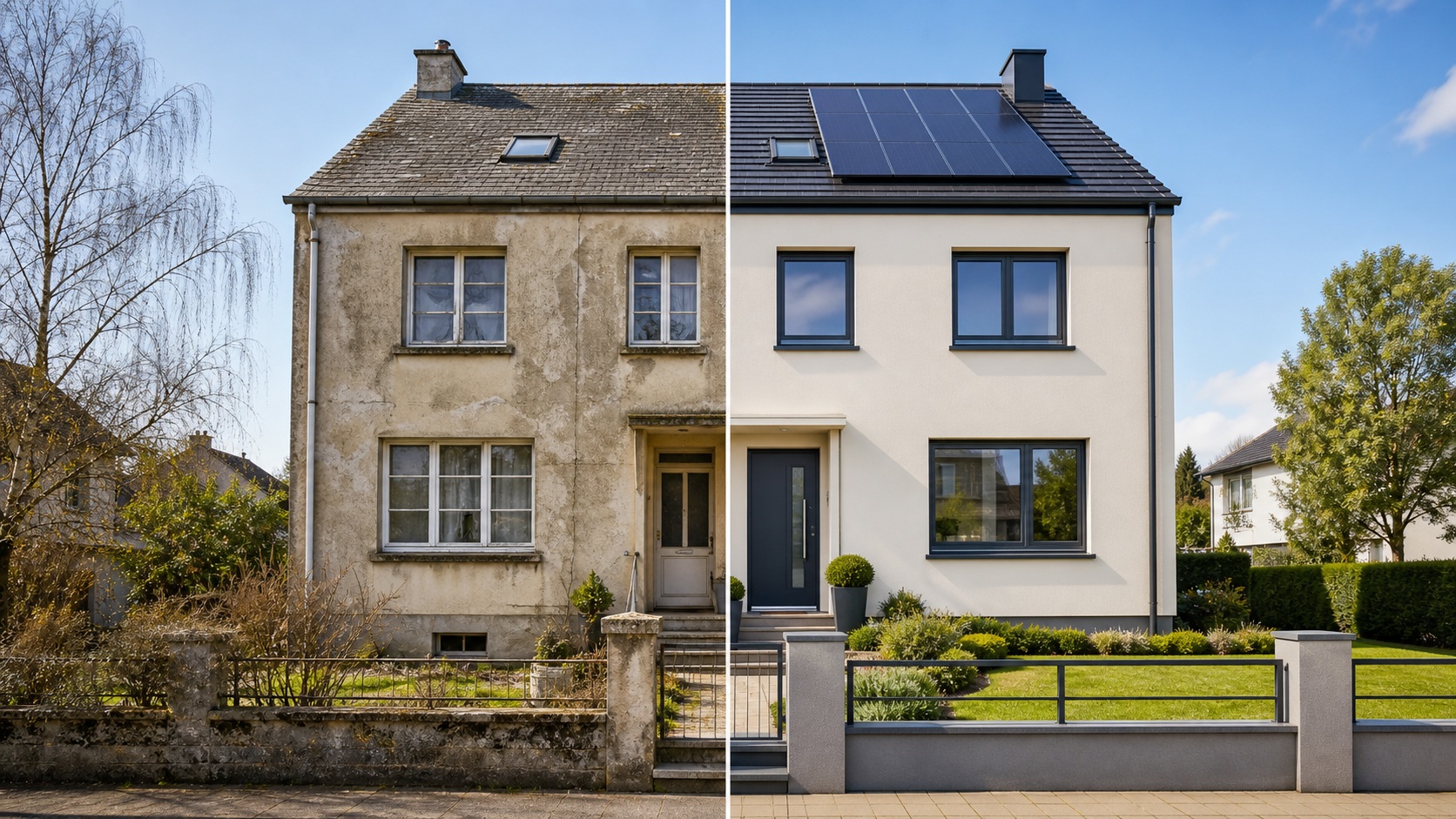
A typical deep renovation in Luxembourg: exterior insulation, triple-glazed windows, heat pump, and solar panels can transform a Class G house into a Class B, reducing energy costs by 70-80 percent.
Government Subsidies and Grants: PRIMe House and Climate Bonus
Luxembourg offers some of the most generous energy renovation subsidies in Europe. If you are planning to improve a property's energy class, these grants can significantly reduce your net investment — in some cases covering 30 to 50 percent of the total renovation cost. The two main programmes are PRIMe House and the Klimabonus (Climate Bonus).
PRIMe House Programme
PRIMe House is Luxembourg's flagship subsidy programme for sustainable construction and renovation. Administered by MyEnergy (the national agency for sustainable energy) and funded by the Ministry of the Environment, Climate and Sustainable Development, PRIMe House provides direct grants for energy efficiency improvements in residential buildings. The programme was significantly updated in 2024 and the current version applies through to at least 2027.
Here are the key PRIMe House subsidies available in 2026.
| Measure | PRIMe House Subsidy | Maximum Amount | Key Conditions |
|---|---|---|---|
| Thermal insulation (walls, roof, floor) | EUR 30 – 60 per sqm of insulated surface | Up to EUR 15,000 per building element | Minimum U-value requirements must be met |
| Window replacement | EUR 100 – 200 per sqm of window surface | Up to EUR 10,000 | Triple glazing required (Uw ≤ 1.0 W/m2K) |
| Heat pump installation | EUR 5,000 – 12,000 flat grant | EUR 12,000 (ground-source) | Must replace fossil fuel system; COP requirements |
| Ventilation with heat recovery | EUR 2,000 – 4,000 flat grant | EUR 4,000 | Minimum heat recovery rate of 80% |
| Solar panels (photovoltaic) | EUR 200 – 500 per kWp | Up to EUR 5,000 | Feed-in tariff also available for surplus electricity |
| Energy audit / consulting | EUR 500 – 1,000 | EUR 1,000 | Must use certified energy consultant |
| Comprehensive renovation (class improvement) | Bonus of EUR 6,000 – 12,000 | EUR 12,000 | Must achieve minimum 2-class improvement in energy rating |
Klimabonus (Climate Bonus)
In addition to PRIMe House, Luxembourg's Klimabonus programme provides an annual climate bonus payment to all residents, partially funded by the carbon pricing mechanism. While the Klimabonus is not directly tied to property renovation, homeowners who invest in energy improvements benefit doubly: they reduce their energy consumption (lowering their carbon footprint and energy costs) while continuing to receive the Klimabonus payment. Furthermore, the carbon pricing mechanism means that fossil fuel heating (gas, oil) will become progressively more expensive, strengthening the financial case for switching to heat pumps and other renewable energy sources.
How to Maximise Your Subsidy
In my experience helping clients navigate the subsidy landscape, here are the most important rules to follow. First, always apply before you start the work. PRIMe House requires pre-approval — if you begin renovation before the application is processed, you risk losing the subsidy entirely. Second, hire a certified energy consultant before anything else. The EUR 500 to EUR 1,000 you spend on a professional energy audit (which is itself partially subsidised) will save you thousands by identifying the most cost-effective combination of measures. Third, bundle measures for the comprehensive renovation bonus. If you are doing insulation and windows anyway, adding a heat pump and ventilation system may qualify you for the additional EUR 6,000 to EUR 12,000 comprehensive renovation bonus, which can make the marginal measures nearly free after subsidies. Fourth, check commune-level subsidies. Many Luxembourg communes offer additional grants on top of the national PRIMe House programme — Esch-sur-Alzette, Differdange, and Luxembourg City all have supplementary schemes.
What this means for you: If you are buying a lower-class property with renovation plans, factor the subsidies into your budget from day one. They can reduce a EUR 80,000 renovation to an effective cost of EUR 45,000 to EUR 55,000.
The EU Energy Performance of Buildings Directive: What It Means for Luxembourg
The revised EU Energy Performance of Buildings Directive (EPBD), agreed in 2024 and now being transposed into national law, is the single most important piece of legislation affecting property values in Luxembourg for the next decade. Here is what every buyer and property owner needs to understand.
The directive establishes the principle that all buildings in the EU should reach zero-emission status by 2050. To get there, it sets intermediate targets and minimum standards that member states must implement. For Luxembourg, the key implications are as follows.
Minimum Energy Performance Standards (MEPS): The directive requires member states to establish minimum energy performance standards for existing buildings. The worst-performing 15 percent of the building stock must be renovated first. In Luxembourg, this means that properties currently rated H or I — and eventually G and F — will face mandatory renovation requirements within defined timelines. The exact timeline for Luxembourg's transposition is still being finalised, but the direction is clear: low-energy-class properties will not be sellable or rentable in their current state indefinitely.
Ban on fossil fuel boilers: The directive phases out subsidies for standalone fossil fuel boilers from 2025 and aims for a complete phase-out of fossil fuel heating in buildings by 2040. In Luxembourg, this means that buying a property with an oil-fired boiler or even an old gas boiler carries an implicit future cost: you will need to replace the heating system within the next 10 to 15 years regardless of whether the boiler is still functioning.
Solar energy obligations: The directive introduces requirements for solar energy installations on new buildings and major renovations. Luxembourg has already moved ahead of the EU minimum here, with strong incentives for photovoltaic installations through the PRIMe House programme and feed-in tariffs.
Building Renovation Passports: The directive introduces the concept of a Building Renovation Passport — a long-term, step-by-step renovation roadmap for each building, showing how to reach zero-emission status by 2050. Luxembourg is expected to implement this alongside the CPE system, giving every property a clear path to improvement.
What does this mean for property values? In a word: polarisation. Properties that are already at Class A, B, or C will see their value supported and potentially enhanced as they are already compliant or close to compliant with future requirements. Properties at Class G, H, or I will face increasing market pressure as the regulatory deadline for minimum standards approaches. The smartest buyers in 2026 are those who are pricing in these future regulations now, rather than waiting for them to hit and finding themselves holding a property that cannot be sold or rented without costly upgrades.
Minimum Energy Requirements for Rental Properties
If you are buying a property as an investment with the intention to rent it out, the energy class dimension is even more critical. Luxembourg is progressively tightening the minimum energy standards that rental properties must meet, and the trend is only going in one direction.
As of 2026, there is no absolute prohibition on renting out a low-energy-class property in Luxembourg — unlike in some other EU countries where Class G properties are already banned from the rental market. However, several factors are already constraining the rental market for low-class properties.
Tenant expectations: Luxembourg's tenant pool is heavily international, well-educated, and environmentally conscious. In my experience, properties rated F or below receive significantly fewer enquiries and take longer to rent. Tenants increasingly ask for the CPE upfront and factor energy costs into their total housing budget. A Class G property with EUR 400 per month in energy costs is effectively EUR 400 more expensive per month than a Class B property with EUR 80 in energy costs — and tenants know this.
Future regulatory risk: Luxembourg is expected to implement minimum energy performance standards for rental properties as part of its transposition of the EU EPBD. While the exact timeline is uncertain, the expectation among market participants is that properties rated G, H, or I will face rental restrictions by 2028-2030, with F properties following by 2032-2034. If you buy a Class G investment property today without renovating, you may find yourself unable to legally rent it within five years.
Insurance and liability: Some insurance companies are beginning to differentiate premiums based on building condition, including energy performance. A property with an outdated oil heating system and poor insulation may carry higher insurance costs and, in the worst case, face coverage exclusions for certain types of damage related to the building's condition.
For a detailed analysis of rental yields across Luxembourg's regions and how property characteristics affect returns, see our guide to rental yields by area in Luxembourg.
Real Examples: Buying Class D and Upgrading vs Buying Class A
This is the question I get asked most often by clients: "Should I buy a well-located older property with a poor energy class and renovate it, or should I pay more upfront for a new-build with a high energy class?" The answer depends on your budget, your risk tolerance, your timeline, and the specific properties available. But let me walk you through two real-world scenarios to illustrate the trade-offs.
Scenario 1: Buy Class D, Upgrade to B
Maria and Thomas, a dual-income couple with a combined household income of EUR 120,000, are looking for a three-bedroom apartment of approximately 90 sqm in Bonnevoie, Luxembourg City. They find a well-located apartment built in 2002, currently rated Class D (180 kWh/m2/year), listed at EUR 560,000.
| Cost Component | Amount | Notes |
|---|---|---|
| Purchase price | EUR 560,000 | Class D apartment, Bonnevoie, 90 sqm |
| Registration fees and notary (approx 7%) | EUR 39,200 | Standard acquisition costs |
| Renovation (windows, insulation, heat pump, VMC) | EUR 55,000 | Gross cost before subsidies |
| Less: PRIMe House subsidies | - EUR 22,000 | Insulation + windows + heat pump + comprehensive bonus |
| Net renovation cost | EUR 33,000 | After subsidies |
| Total all-in cost | EUR 632,200 | Purchase + fees + net renovation |
| Estimated value after renovation (Class B) | EUR 660,000 – 690,000 | 10-15% premium over Class D equivalent |
| Annual energy cost (Class B, 90 sqm) | EUR 500 – 900 | Down from EUR 1,500 – 2,200 at Class D |
In this scenario, Maria and Thomas spend approximately EUR 632,200 all-in and end up with a property worth EUR 660,000 to EUR 690,000 — creating EUR 28,000 to EUR 58,000 in immediate equity gain. They also reduce their annual energy costs by approximately EUR 1,000 to EUR 1,300, and they benefit from a property that is future-proofed against upcoming energy regulations. The catch: they need to manage a renovation project, live with disruption for two to four months, and accept some execution risk. Not every renovation goes smoothly or stays on budget.
Scenario 2: Buy New-Build Class A
Jean-Pierre, a single professional earning EUR 95,000, is looking at new-build apartments in Gasperich (Cloche d'Or). He finds a two-bedroom VEFA apartment of 75 sqm, rated Class A, priced at EUR 712,000.
| Cost Component | Amount | Notes |
|---|---|---|
| Purchase price | EUR 712,000 | Class A VEFA, Gasperich, 75 sqm |
| Registration fees (reduced for new-build, approx 3%) | EUR 21,360 | Reduced rate for VEFA (TVA at 3% super-reduced) |
| Renovation cost | EUR 0 | Move-in ready, no works needed |
| Total all-in cost | EUR 733,360 | Purchase + fees |
| Annual energy cost (Class A, 75 sqm) | EUR 150 – 375 | Minimal heating and hot water costs |
| Green mortgage advantage | 0.15% rate reduction | Saves approx EUR 13,000 over 25-year term |
Jean-Pierre pays more upfront — EUR 733,360 versus EUR 632,200 in Scenario 1 — but he avoids all renovation hassle, moves in immediately, enjoys the lowest possible energy costs from day one, benefits from a green mortgage rate, and has a property that is fully compliant with all current and foreseeable future regulations. His property also comes with a ten-year structural guarantee (garantie decennale), which eliminates major repair risk in the first decade of ownership.
Which Strategy Is Better?
In my experience, both strategies can work excellently — but for different buyer profiles. The buy-and-renovate strategy works best for buyers who have time, renovation management experience (or a trusted contractor), and a willingness to accept short-term disruption for long-term value creation. It also works best in locations where existing stock is available at a genuine discount and where the copropriete supports renovation. The buy-new strategy works best for buyers who want simplicity, certainty, and the lowest possible running costs, and who can afford the higher entry price. What I always tell my clients is this: do the maths on both options for the specific properties you are considering, and do not let emotions drive the decision. If you want help running these numbers for a specific property, I am happy to do it — just reach out.

Total cost of ownership comparison: Buy and renovate (Class D to B) versus buy new (Class A). Both strategies are viable, but the right choice depends on your individual circumstances, budget, and risk tolerance.
Need Help Deciding: Renovate or Buy New?
I will run a full cost-of-ownership comparison for your specific situation — purchase price, renovation estimates, subsidy eligibility, mortgage conditions, and projected value. No guesswork, just data.
WhatsApp Daniela Free Property ValuationFuture-Proofing Your Investment: Why Energy Class Matters More Each Year
If the data and analysis above have not convinced you that energy class is a critical factor in property buying, let me lay out the trajectory as I see it from my position in the Luxembourg market.
Energy prices will not return to pre-2021 levels. Luxembourg's electricity and gas tariffs have stabilised but remain 30 to 50 percent above pre-energy-crisis levels. The EU's Emissions Trading System (ETS2), which extends carbon pricing to buildings and transport from 2027, will add further upward pressure to fossil fuel heating costs. Every year that passes makes the operating cost gap between a Class A and a Class G property wider.
Regulations will tighten, not loosen. The EU's climate targets are legally binding. Luxembourg's national climate targets require a 55 percent reduction in greenhouse gas emissions by 2030 compared to 2005 levels. Buildings account for approximately 10 percent of Luxembourg's direct emissions and a much larger share when electricity generation is included. There is no scenario in which building energy standards become less stringent. The only question is how quickly the new minimum standards are implemented and enforced.
Buyer and tenant preferences are shifting permanently. The generation entering the property market now — millennials and early Gen Z — has grown up with climate awareness as a core value. In my experience, these buyers are significantly more likely to filter property searches by energy class, to negotiate aggressively on low-class properties, and to pay a premium for high-class ones. This is not a temporary fashion; it is a generational shift in how property is evaluated.
Institutional investors are leading the way. Luxembourg's institutional property investors — pension funds, insurance companies, real estate investment funds — are already applying ESG (Environmental, Social, and Governance) criteria to their portfolios. Properties that do not meet minimum energy standards are being divested or earmarked for renovation. When institutional money moves, private market values follow.
The conclusion is straightforward: every year that passes, the price premium for high-energy-class properties will increase, and the discount for low-class properties will deepen. Buying a Class A or B property today is not just a comfort choice — it is a strategic investment decision. And if you buy a lower-class property, having a clear, funded renovation plan is not optional — it is essential for protecting your investment's value.
Where to Find a Property's Energy Class Before Buying
Knowing how important energy class is means very little if you cannot easily access the information. Here are all the ways to find a property's energy class in Luxembourg before making a purchase decision.
Property listings: By law, every property listing in Luxembourg must display the energy class. This applies to listings on real estate portals (atHome.lu, Immotop.lu), agency websites, print advertisements, and window displays. If you see a listing without an energy class, that is a red flag — either the seller has not obtained a CPE (which is illegal for marketed properties) or the agent is hiding a poor rating. In either case, ask for the CPE immediately.
Direct request to the seller or agent: You have the legal right to request the full CPE report at any time before signing the compromis de vente. Do not accept vague assurances like "it is about a D" — ask for the actual certificate. The specific kWh/m2/year figure and the detailed breakdown are far more informative than the letter grade alone.
MyEnergy database: Luxembourg's MyEnergy agency maintains records of CPE certificates issued. While the database is not fully publicly searchable by address, you can contact MyEnergy to verify whether a valid CPE exists for a specific property.
Notary verification: At the compromis de vente stage, the notary is required to verify that a valid CPE exists and to include the energy class in the sales documentation. However, I strongly advise checking the energy class long before you reach the notary — ideally at the first viewing stage, so you can factor it into your offer and negotiation strategy.
Your agent (that is where I come in): As part of my service to buyers, I always obtain and analyse the full CPE report for every property we are considering. I go beyond the letter grade to assess what the numbers actually mean for your costs, your renovation options, and the property's long-term value. This is one of the many reasons why working with a knowledgeable local agent gives you a significant advantage. For a complete overview of how the buying process works and where the CPE fits in, see our step-by-step buying guide.
What this means for you: If a listing does not show an energy class, do not ignore it — ask for it immediately. And if the seller or agent cannot produce a valid CPE, walk away or negotiate a significant price reduction to account for the uncertainty.
Frequently Asked Questions: Energy Class and Property Value in Luxembourg
1. Is a CPE mandatory for all property sales in Luxembourg?
Yes. A valid Certificat de Performance Energetique is legally required for every residential property sale in Luxembourg. The seller must obtain the CPE before marketing the property and must present it to potential buyers. The energy class must also appear in all property advertisements. Failure to provide a CPE can result in fines and can give the buyer grounds to renegotiate or withdraw from the sale. The only exceptions are certain protected heritage buildings where energy improvements would compromise the architectural character, but even these require a simplified assessment.
2. How much does a CPE cost and who pays for it?
A CPE assessment typically costs between EUR 800 and EUR 1,500 in Luxembourg, depending on the size and complexity of the property. The cost is borne by the property owner — for a sale, this means the seller; for a rental, the landlord. The certificate is valid for ten years. If you are buying a property and the existing CPE is more than five years old, I recommend requesting a new assessment as part of your negotiation, particularly if any energy-related work has been done since the original assessment. The cost of the energy audit can be partially subsidised through the PRIMe House programme.
3. Can I negotiate a lower price based on a poor energy class?
Absolutely — and you should. A poor energy class is one of the most effective negotiation levers in the Luxembourg property market. If a property is listed at what appears to be a fair market price but carries a Class F or G rating, you can and should present the seller with a detailed analysis of the renovation cost required to bring the property to an acceptable standard. In my experience, buyers who present this analysis professionally and back it with contractor estimates can negotiate discounts of 5 to 15 percent beyond what the market discount for the energy class already reflects. This is one of the situations where having an experienced agent on your side makes a measurable financial difference.
4. Does improving the energy class always increase the property value by more than the renovation cost?
Not always, but in most cases in the current Luxembourg market, yes. The key variable is the starting class and the target class. Improving from G to D is typically value-accretive because the renovation costs are moderate and the market discount for G is severe. Improving from D to A is more expensive and the incremental value gain per class is smaller at the higher end. The sweet spot — where the return on renovation investment is highest — is typically improving from E/F/G to B/C. Going all the way to A from a low starting point requires disproportionately expensive measures (like complete envelope overhaul and ground-source heat pump) that may not fully pay back in immediate value increase, though they will pay back through lower running costs over time.
5. How does energy class affect property tax in Luxembourg?
As of 2026, Luxembourg's property tax (impot foncier) is not directly linked to energy class. However, the ongoing reform of property taxation in Luxembourg — which aims to modernise a system based on 1941 unit values — is expected to eventually incorporate building condition and energy performance into the assessment. More immediately, the commune-level property tax surcharge for unoccupied or poorly maintained buildings, which some communes have introduced, may be applied more aggressively to properties with very poor energy performance. While the direct tax impact is currently minimal, the indirect financial impact through energy costs, insurance, mortgage terms, and resale value is substantial.
6. I am buying an apartment in a copropriete. Can I improve the energy class on my own?
This depends on which measures are needed. Interior improvements — replacing your own windows (if permitted by the copropriete rules), installing a more efficient heating unit within your apartment, or improving interior insulation — can typically be done by individual owners. However, the measures that deliver the biggest energy class improvements — exterior wall insulation, roof insulation, building-wide heating system replacement, and solar panel installation — are common-area works that require approval by the general assembly of co-owners (assemblee generale). This means you need a majority vote, which can be difficult to achieve in buildings with many owners or where some owners are not interested in investing. Before buying an apartment with renovation plans, I always advise checking the copropriete's recent assembly minutes to understand the attitude toward energy renovation and whether any building-wide works are already planned or budgeted.
Conclusion: Make Energy Class Part of Every Property Decision
Energy class is no longer a secondary consideration in Luxembourg real estate — it is a primary value driver that affects your purchase price, your running costs, your mortgage terms, your rental income potential, your regulatory compliance, and your long-term resale value. In 2026, the buyers who come out ahead will be those who understand the CPE system, who factor energy performance into every property evaluation, and who have a clear strategy for either buying high or buying low and upgrading.
Let me summarise the key principles I apply in my own practice when advising clients on energy class.
First, always look at the full CPE, not just the letter grade. The specific kWh/m2/year figure, the thermal insulation rating, and the breakdown by energy use category give you a much richer picture than the letter alone. A "strong D" at 155 kWh is a very different proposition from a "weak D" at 220 kWh.
Second, calculate total cost of ownership over your planned holding period. A Class F property that looks EUR 80,000 cheaper than a Class B equivalent may actually cost the same or more over a 15 to 20 year ownership period when you factor in energy costs, renovation needs, lower mortgage rates for the B, and the B's superior resale value trajectory.
Third, if you buy a low-class property, have a concrete renovation plan and budget before you sign the compromis. Know what you will renovate, what it will cost, what subsidies you qualify for, and what class improvement you expect to achieve. Do not buy hoping to "figure it out later" — by then, the contractor quotes may come in higher than expected, the copropriete may resist, or the subsidies may have changed.
Fourth, keep one eye on the regulatory horizon. The EU Energy Performance of Buildings Directive is not aspirational — it is law. Luxembourg will implement minimum energy standards for buildings. The properties that will be affected first are those rated G, H, and I. If you buy in that range without renovating, you are accepting a real risk that the property's usability and value will be constrained within the next five to ten years.
In my years of working in the Luxembourg property market, I have seen too many buyers learn these lessons the hard way — discovering after purchase that their Class G house costs EUR 6,000 per year to heat, or finding that the copropriete will not approve the exterior insulation they need, or realising that the "cheap" property they bought is actually more expensive than the "expensive" Class B next door when all costs are counted. My goal with this guide is to make sure you are not one of those buyers.
If you are evaluating a property in Luxembourg and want expert guidance on how energy class affects its true value — or if you want help negotiating a better price based on energy performance — I am here for you. Reach out anytime.
Ready to Make a Smart Property Decision in Luxembourg?
Whether you are buying your first home, evaluating an investment opportunity, or planning an energy renovation, I will give you the data and guidance you need to make the right call. Free consultation — no pressure, just expert analysis.
Free Property Valuation Search Properties WhatsApp DanielaFurther Reading
Explore more expert guides to help you navigate the Luxembourg property market with confidence:
- Is 2026 a Good Time to Buy Property in Luxembourg? Complete Market Analysis
- Best Areas to Buy Property in Luxembourg in 2026
- Buying Property in Luxembourg: Step-by-Step Guide
- Property Investment Strategy Luxembourg 2026
- Mortgage Guide Luxembourg 2026: Rates, Banks, and Strategies
- Luxembourg Property Prices per Square Metre by Area (2026 Update)
- Rental Yield by Area in Luxembourg 2026
Sources and methodology: Data and analysis in this article are based on publicly available information from the Observatoire de l'Habitat (Ministry of Housing), the Luxembourg Institute of Socio-Economic Research (LISER), MyEnergy (Agence nationale pour la promotion de l'utilisation rationnelle de l'energie), the European Commission's Building Stock Observatory, EU Energy Performance of Buildings Directive (2024 recast), PRIMe House programme documentation, and proprietary market data collected by Daniela Pelliccia through active participation in the Luxembourg property market. Price premiums and discounts by energy class are estimated based on transaction analysis and published research; actual values for individual properties may vary based on location, size, condition, and market conditions. Annual energy cost estimates assume average Luxembourg energy tariffs as of Q1 2026 and standard occupancy patterns. Renovation cost estimates reflect market rates for qualified contractors in Luxembourg; actual costs depend on property specifics, contractor availability, and scope of work. Subsidy amounts are indicative and subject to change; always verify current conditions with MyEnergy before applying. This article is for informational purposes and does not constitute legal, financial, or tax advice. For personalised guidance, please contact us for a free consultation.