Getting your mortgage approved in Luxembourg is the single most stressful part of buying a property. I have watched buyers lose dream homes because they assumed approval was a formality and only discovered weeks later that their application was missing a critical document or their debt-to-income ratio was a fraction too high. I have also watched buyers who did their homework — who prepared meticulously, who understood exactly what banks want — sail through approval in under three weeks while others waited months and were ultimately rejected. The difference between these two outcomes is not luck. It is preparation.
In 2026, Luxembourg mortgage approval is neither as easy as it was in 2020, when banks were practically handing out loans at 1.3 percent, nor as brutally difficult as it was in late 2023, when rates peaked at 4.5 percent and banks tightened their criteria to near-impossible levels. The market has normalised. Rates sit at approximately 3.0 to 3.4 percent for a 20-year fixed. Banks are lending again, but they are lending carefully. They want to see stability, documentation, and a clear financial picture. If you give them that, you will get approved. If you leave gaps, you will not.
This guide covers everything you need to know to get your Luxembourg mortgage approved faster in 2026. I will walk you through exactly what banks evaluate, what income thresholds you need to meet, how the debt-to-income ratio works with real-number examples, what documents you need to prepare, how your contract type affects your chances, what cross-border workers need to know, ten specific things you can do to improve your approval odds, how to compare bank offers intelligently, the typical timeline from application to approval, and what to do if you are rejected. This is not theory — this is what I tell my clients every week, based on years of working alongside Luxembourg banks and mortgage brokers. For the broader mortgage landscape including current rates and bank comparisons, start with our complete 2026 mortgage guide.
What Luxembourg Banks Evaluate When You Apply for a Mortgage
Before we get into tactics, you need to understand how banks think. A Luxembourg mortgage application is not assessed by a single person glancing at your payslip. It goes through a structured evaluation process that examines multiple dimensions of your financial life. Understanding these dimensions — and what weight each one carries — is the foundation for everything else in this guide.
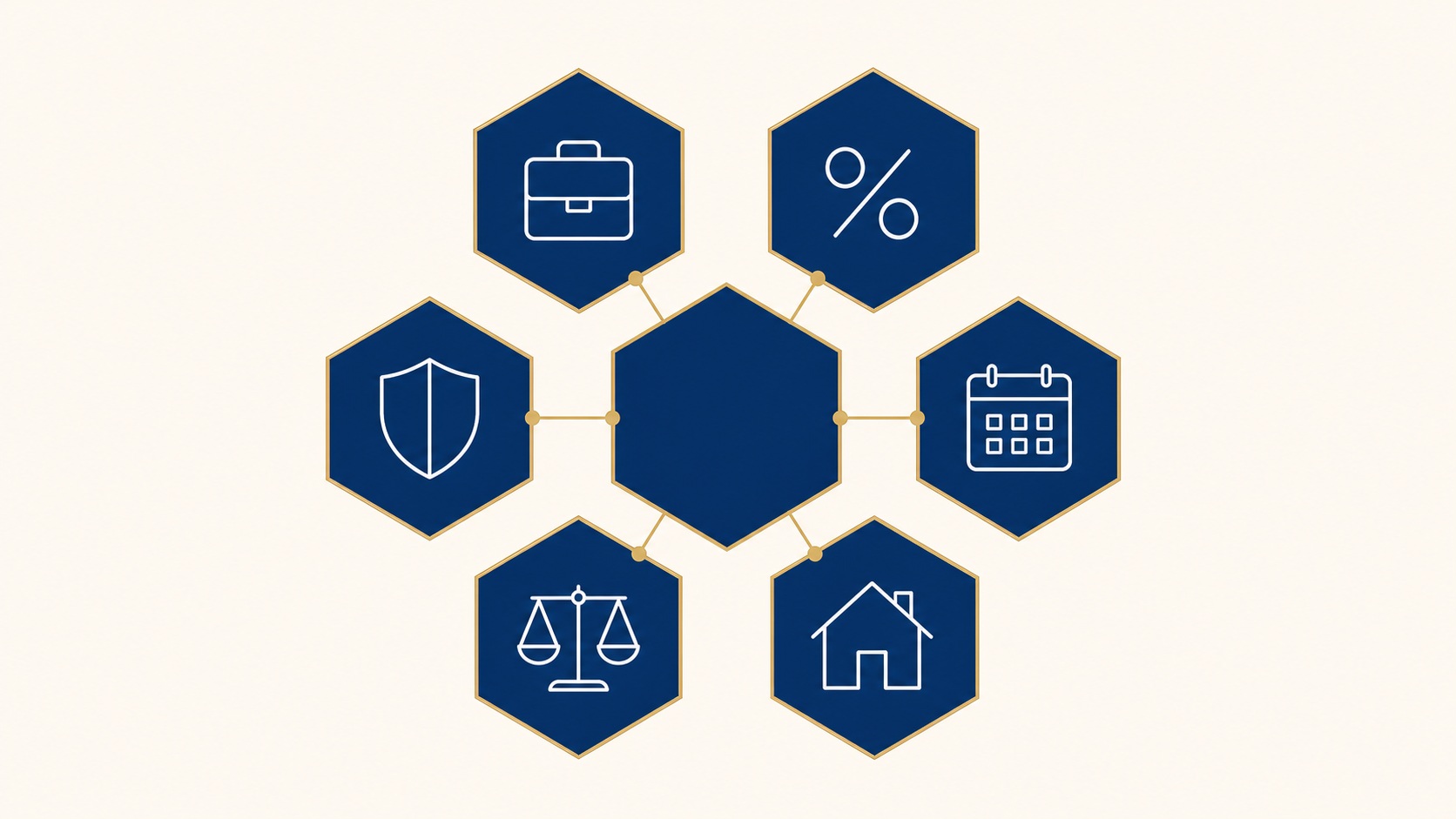
Luxembourg banks evaluate mortgage applications across six primary criteria. Each one can independently sink an application, even if the other five are strong. Here is how they break down.
The Six Pillars of Mortgage Evaluation
| Evaluation Criterion | What Banks Look For | Weight in Decision | Common Red Flags |
|---|---|---|---|
| Income Stability | Consistent, verifiable earnings over 12-24 months | Very High | Recent job change, income fluctuations, gaps in employment |
| Employment Type | CDI preferred; CDD and freelance face additional scrutiny | High | CDD with less than 6 months remaining, new freelance activity |
| Debt-to-Income Ratio | Total monthly debt payments below 35-40% of net income | Very High | Car loans, personal loans, existing credit card debt |
| Deposit / Equity | Minimum 10-20% of purchase price plus notary fees | High | Deposit entirely borrowed, no savings history |
| Residency Status | Luxembourg resident or cross-border worker with stable employer | Medium | Non-EU nationals without long-term residency, recent arrivals |
| Credit History | Clean record with no defaults, late payments, or overindebtedness filings | Very High | BIL/CSSF negative filings, unpaid debts, multiple active consumer loans |
Let me expand on each of these because the details matter enormously.
Income stability is the bedrock. Banks want to see that your income is consistent and likely to continue. This means they will look at your last 3 to 6 payslips, your most recent tax declaration (or two), and your employment contract. They are not just checking the amount — they are checking for patterns. Is your income growing, stable, or declining? Have you received bonuses consistently, or is this year an outlier? Have you been with your employer for at least 12 months, ideally longer? The longer and more stable your income history, the more confidence the bank has that you will be able to make payments for the next 20 to 30 years.
Employment type is closely linked to income stability but deserves its own discussion because in Luxembourg, the distinction between a CDI (contrat a duree indeterminee, or permanent contract), a CDD (contrat a duree determinee, or fixed-term contract), and freelance or self-employed status is absolutely critical. I will cover this in detail in a dedicated section below, but the short version is: CDI holders have a massive advantage. CDD holders can get approved but face stricter conditions. Freelancers need two to three years of accounts and typically need a larger deposit.
The deposit is your skin in the game. Banks require you to contribute your own funds to the purchase — typically 10 to 20 percent of the purchase price, plus notary fees (approximately 7 percent on resale properties, 1 to 3 percent on new builds). The deposit serves two purposes: it reduces the bank's exposure if property values fall, and it demonstrates that you have the financial discipline to accumulate savings. A buyer who shows up with a 25 percent deposit is viewed very differently from one who can barely scrape together 10 percent. For detailed strategies on building your deposit and understanding what you need, see our comprehensive deposit guide for Luxembourg.
Residency status matters more than many people expect. Luxembourg residents — whether Luxembourg nationals, EU citizens, or non-EU nationals with valid residency permits — are evaluated on broadly similar terms. However, cross-border workers from France, Belgium, or Germany, who commute into Luxembourg but live abroad, face specific additional considerations that I will detail in the cross-border section. Non-EU nationals who have recently arrived may need to demonstrate longer residency or provide additional guarantees.
Credit history in Luxembourg is not assessed through a FICO-style credit score system like in the United States or the United Kingdom. Instead, banks check the Centrale des Credits aux Particuliers (maintained by the Banque Centrale du Luxembourg) for any existing loan registrations, and they may also check with the Commission de Surveillance du Secteur Financier (CSSF) for any filings related to overindebtedness. A clean record here is essential. Even a single late payment on a consumer loan can raise questions, and a formal overindebtedness filing is effectively disqualifying for mortgage approval.
What this means for you: Do not assume that a high salary alone will guarantee approval. Banks look at the full picture. A person earning EUR 120,000 per year with a car loan, a personal loan, and a recent job change may be rejected while someone earning EUR 70,000 with a clean balance sheet and a CDI of three years sails through.
Income Requirements: What You Need to Earn by Bank
One of the first questions every buyer asks me is: "How much do I need to earn to get a mortgage in Luxembourg?" The honest answer is that there is no single minimum income threshold that applies across all banks. Each bank sets its own criteria, and those criteria interact with your deposit size, your existing debts, your contract type, and the property price. However, I can give you the practical benchmarks that I see applied consistently in 2026.
The following table shows the approximate minimum income levels that Luxembourg's major banks typically require for mortgage approval, based on a standard 20-year loan, 80 percent loan-to-value (meaning you have a 20 percent deposit), and no other significant debts. These are not published figures — banks do not publicise minimum income thresholds — but they reflect what I observe in practice from working with mortgage brokers and banks on behalf of my clients.
Approximate Minimum Income Requirements by Bank (2026)
| Bank | Min. Household Net Income (EUR/month) | Typical Max LTV | Notes |
|---|---|---|---|
| Spuerkeess (BCEE) | 4,500 – 5,000 | 80-90% | State-owned, most flexible for residents, competitive rates for first-time buyers |
| BIL (Banque Internationale) | 5,000 – 5,500 | 80% | Strong for expats, good cross-border experience, premium service |
| BGL BNP Paribas | 5,000 – 5,500 | 80% | Competitive rates, strong French cross-border network |
| ING Luxembourg | 5,500 – 6,000 | 80% | Stricter criteria, excellent digital tools, good for higher earners |
| Raiffeisen | 4,500 – 5,000 | 80-85% | Cooperative bank, good for local residents, flexible for rural properties |
| POST Finance | 4,000 – 4,500 | 80% | Accessible entry point, good for first-time buyers with smaller budgets |
Let me put these numbers in context with a real example. Suppose you are looking to buy a two-bedroom apartment in Bonnevoie for EUR 650,000. With a 20 percent deposit of EUR 130,000 (plus approximately EUR 45,000 in notary fees for a resale property), you need a mortgage of EUR 520,000. At a 3.2 percent fixed rate over 20 years, your monthly payment would be approximately EUR 2,930. For a bank applying a 35 percent debt-to-income cap, you would need a net household income of at least EUR 8,370 per month — well above the minimum thresholds in the table, because the relevant constraint at this price point is the ratio, not the absolute income floor.
The minimum income figures in the table apply to smaller loan amounts. If you are buying a property for EUR 350,000 with a 20 percent deposit, the monthly payment on a EUR 280,000 mortgage at 3.2 percent over 20 years is approximately EUR 1,580. At a 35 percent ratio, that requires a net income of at least EUR 4,515 — which aligns closely with the minimums shown. The key insight is that the income threshold is dynamic: it depends on the loan amount, the rate, the term, and your existing debts. The numbers in the table are the floor, not the ceiling.
What I always tell my clients is this: do not approach a bank without first calculating your own numbers. Know your net monthly income, know your existing monthly debt payments, and calculate the approximate mortgage payment for the property you want to buy. If your ratio exceeds 35 percent, you either need a bigger deposit, a cheaper property, a longer term, or a plan to pay off existing debts before applying. For a detailed breakdown of how much deposit you need and strategies to build one faster, see our deposit guide for Luxembourg.
The Debt-to-Income Ratio: The 35-40% Rule Explained
If there is one number that determines whether your Luxembourg mortgage gets approved or rejected, it is the debt-to-income ratio — known in French as the taux d'endettement. This is the percentage of your net monthly income that goes towards servicing all your debts, including the proposed mortgage payment. In Luxembourg in 2026, the critical threshold is 35 to 40 percent, depending on the bank and your overall profile.
Here is how it works in practice. The bank takes your total net monthly household income (after taxes and social contributions). Then it adds up all your monthly debt obligations: the proposed mortgage payment, any existing car loan payments, personal loan payments, student loan payments, credit card minimum payments, and even alimony or child support obligations. It divides the total monthly debt by the total net income. If the result exceeds 35 to 40 percent, the application is typically declined or subject to additional conditions.
Debt-to-Income Ratio Examples
| Scenario | Net Monthly Income | Monthly Debts (All) | Debt-to-Income Ratio | Likely Outcome |
|---|---|---|---|---|
| Couple, CDI, no other debts | EUR 9,000 | EUR 2,800 (mortgage only) | 31.1% | Approved (comfortable margin) |
| Single buyer, CDI, car loan | EUR 5,500 | EUR 1,800 (mortgage) + EUR 350 (car) | 39.1% | Borderline — may need to pay off car loan first |
| Couple, one CDI + one CDD | EUR 7,500 | EUR 2,500 (mortgage) + EUR 200 (personal loan) | 36.0% | Possible but scrutinised — CDD income may be discounted |
| Single buyer, freelance | EUR 6,000 (avg. 3 years) | EUR 2,200 (mortgage) | 36.7% | Difficult — bank may use lower income estimate, pushing ratio above 40% |
| Couple, high income, multiple loans | EUR 14,000 | EUR 3,500 (mortgage) + EUR 600 (car) + EUR 400 (personal) + EUR 300 (credit line) | 34.3% | Technically within limits but bank may flag complexity of debt structure |
There are several nuances that the simple percentage does not capture. First, some banks apply the ratio to net income while others use gross income. Using gross income gives a lower ratio because the denominator is larger, which means that banks calculating on gross may appear more generous — but they are typically also applying a stricter threshold (for example, 28 to 30 percent of gross versus 35 percent of net). Always clarify which basis a bank is using when they discuss your ratio.
Second, banks may "discount" certain types of income. If you have a variable component — bonuses, commissions, overtime — the bank may only count 50 to 80 percent of it in their calculation. If one partner has a CDD rather than a CDI, some banks will only count 50 to 70 percent of that person's income. This effective discounting can push your calculated ratio above the threshold even if your actual cash flow is comfortable.
Third, the "reste a vivre" or residual income test is applied alongside the ratio. Even if your ratio is below 35 percent, the bank will check that your remaining monthly income after all debt payments is sufficient to cover basic living expenses. In Luxembourg, the commonly applied minimum reste a vivre is approximately EUR 1,200 to 1,500 per adult and EUR 300 to 500 per dependent child per month. A single person earning EUR 4,000 net with a EUR 1,400 mortgage payment has a 35 percent ratio — just within the threshold — but a reste a vivre of EUR 2,600, which is adequate. However, if they also had EUR 500 in other debt payments, their reste a vivre drops to EUR 2,100, which is still workable but tighter.
Fourth, and this is something many people do not realise: banks include your current rent payment in the ratio calculation during the period between mortgage approval and moving into the new property. If you are paying EUR 1,800 per month in rent and your new mortgage will be EUR 2,500 per month, the bank may temporarily count both obligations if there is an overlap period. This is why timing your move carefully — and potentially negotiating a break clause in your rental contract — can make a meaningful difference to your application.
What this means for you: Calculate your own ratio before approaching any bank. Add up every monthly debt payment, divide by your net household income, and see where you stand. If you are above 33 percent, take action to reduce debt before applying. Every EUR 200 per month you eliminate from existing debts adds approximately EUR 35,000 to your borrowing capacity.
Required Documents: Your Complete Mortgage Application Checklist
One of the simplest ways to speed up your Luxembourg mortgage approval is to submit a complete, well-organised document package from day one. Incomplete applications are the number one cause of delays in my experience. Banks do not process partial applications — they wait until everything is in place, and every missing document adds days or weeks to your timeline.
Here is the complete document checklist I give to every client before they approach a bank. I have organised it by category, with notes on what banks specifically look for in each document.
Identity and Residency Documents
| Document | Details | Why Banks Need It |
|---|---|---|
| Valid passport or national ID card | Both applicants if joint application | Identity verification (KYC compliance) |
| Proof of Luxembourg residency | Certificat de residence (less than 3 months old) or registration certificate | Confirms legal residency status |
| Marriage/PACS certificate or divorce decree | If applicable — determines joint liability and marital regime | Legal basis for joint application, alimony obligations |
| Family composition certificate | Number of dependents | Used in reste a vivre calculation |
Employment and Income Documents
| Document | Details | Why Banks Need It |
|---|---|---|
| Employment contract | Current contract — CDI, CDD, or civil servant status | Verifies employment type, salary, and job security |
| Last 3 to 6 payslips | Consecutive months, most recent available | Confirms actual income, overtime, bonuses |
| Last 2 tax declarations (Modele 100) | 2024 and 2025 declarations | Verifies total annual income, deductions, consistency |
| Employer certificate / attestation | Letter confirming position, salary, start date, contract type | Additional income verification, confirms ongoing employment |
| For freelancers: 2-3 years of financial statements | Bilan, profit and loss, tax returns | Establishes income stability and average earnings |
| For civil servants: most recent appointment decree | Confirms permanent public sector status | Civil servants have the highest job security, which banks view very favourably |
Financial Documents
| Document | Details | Why Banks Need It |
|---|---|---|
| Last 3 months of bank statements | All accounts — current, savings, investment | Shows spending patterns, savings capacity, existing debts |
| Proof of deposit / equity | Savings account statements, gift letters, investment portfolio | Confirms you have the required own funds |
| Existing loan statements | Car loan, personal loan, student loan — showing balance and monthly payment | Calculates total debt for ratio assessment |
| Credit card statements | Last 3 months | Identifies revolving credit obligations |
| Life insurance or death-in-service benefit details | Existing policies | May reduce insurance requirements attached to mortgage |
Property Documents
| Document | Details | Why Banks Need It |
|---|---|---|
| Signed compromis de vente or reservation contract | Preliminary sales agreement with all terms | Defines purchase price, conditions, timeline |
| Property floor plan and description | Surface area, number of rooms, parking, storage | Confirms property value relative to loan amount |
| Energy performance certificate (CPE) | Required for all property sales in Luxembourg | Assesses long-term property value and potential renovation costs |
| For new builds: VEFA contract and construction plans | Developer contract, payment schedule, completion guarantee | Structures phased loan disbursements |
A practical tip from years of doing this: create a single digital folder with every document in PDF format, clearly labelled with a consistent naming convention (for example, "01_Passport_JohnSmith.pdf", "02_Employment_Contract.pdf", and so on). When a bank asks for your documents, you send the entire folder. This shows organisation and seriousness, and it eliminates the back-and-forth that slows most applications. I have seen well-prepared clients receive a preliminary approval within five business days of submitting a complete package. I have also seen disorganised applicants wait three months because the bank kept requesting documents one at a time.
One more important note on documents: do not assume that a document from six months ago is still valid. Banks want recent documents. Payslips should be from the most recent months. Bank statements should cover the most recent three-month period. Your certificat de residence should be less than three months old. Submitting outdated documents forces the bank to request updated versions, adding delay. Check expiry and recency before you submit.

CDI vs CDD vs Freelance: How Your Contract Type Affects Mortgage Approval
In Luxembourg, your employment contract type is one of the most influential factors in mortgage approval. The difference between a CDI and a CDD is not a minor detail — it fundamentally changes how a bank perceives your risk profile and can determine whether your application succeeds or fails.
CDI (Permanent Contract): The Gold Standard
A CDI, or contrat a duree indeterminee, is the gold standard for mortgage applications in Luxembourg. It signals to the bank that your employer has committed to you indefinitely, that terminating your employment requires legal process and severance, and that your income stream is as secure as employment income can be. If you hold a CDI and have been in your current position for at least 12 months (ideally 24 months or more), you are in the strongest possible position.
Most banks will lend up to 80 percent LTV to CDI holders as standard, with some banks — particularly Spuerkeess and Raiffeisen — willing to go to 85 or even 90 percent for strong profiles with long employment histories and clean balance sheets. If you are a CDI holder with at least two years of tenure, your mortgage approval is primarily a function of your debt-to-income ratio and deposit size. The CDI itself is not in question.
A special note on civil servants and fonctionnaires: if you work for the Luxembourg state, an EU institution, or an international organisation based in Luxembourg, banks view your employment as even more secure than a standard CDI. Some banks offer preferential rates or relaxed conditions for civil servants because the risk of job loss is near zero. If this applies to you, make sure to highlight it in your application.
CDD (Fixed-Term Contract): Possible but Harder
A CDD, or contrat a duree determinee, creates additional challenges. Banks view fixed-term contracts as inherently less stable than CDI contracts because there is no guarantee of renewal. However, CDD holders absolutely can get mortgage approval in Luxembourg — it is not a disqualifier. The conditions are typically stricter.
What I see in practice is the following: banks will generally approve a CDD holder if the contract has at least 6 to 12 months remaining, the applicant has been working continuously (either in the same CDD or consecutive CDDs) for at least 2 years, the debt-to-income ratio is comfortably below 33 percent (not just below 35 percent), and there is a larger deposit of at least 20 percent. Some banks will also ask for a letter from the employer confirming the intention to renew or convert the CDD to a CDI.
The most common situation I encounter is a couple where one partner has a CDI and the other has a CDD. In this case, most banks will approve the application but may only count 50 to 70 percent of the CDD-holder's income in their ratio calculation. This means the couple needs to ensure the numbers work even with the discounted income. I recently worked with a couple where the CDI-holding partner earned EUR 5,800 net and the CDD partner earned EUR 4,200 net. The bank counted only 60 percent of the CDD income (EUR 2,520), giving a combined assessed income of EUR 8,320 rather than the actual EUR 10,000. This pushed their ratio from a comfortable 28 percent to a tighter 34 percent — still approvable, but with far less margin than they expected.
Freelance and Self-Employed: The Toughest Path
Freelancers and self-employed professionals face the most challenging mortgage approval process in Luxembourg. Banks view self-employment as the highest-risk income category because there is no employer guarantee, income can fluctuate significantly, and business failure is an ever-present possibility. That said, Luxembourg has a large and growing freelance community, and banks have developed processes to accommodate self-employed borrowers.
The typical requirements for freelancers are: at least 2 to 3 years of business activity (some banks require 3 full years), two to three years of audited or certified financial statements, tax returns for the corresponding years, a deposit of at least 20 to 25 percent, and a debt-to-income ratio calculated on the average of the two or three lowest annual incomes (not the highest). This last point is critical — if your income over three years was EUR 60,000, EUR 80,000, and EUR 70,000, some banks will use EUR 60,000 as the basis, not the average of EUR 70,000. This conservative approach can significantly reduce your borrowing capacity.
My advice to freelancers who plan to buy in Luxembourg is to start preparing at least 18 to 24 months before they intend to apply. Keep your accounts clean, minimise business expenses that reduce reported income (yes, there is a tension between tax optimisation and mortgage eligibility), build a strong savings history, and pay off any consumer debts. The better your financial documentation looks over a sustained period, the more confidence a bank will have in your application.
What this means for you: If you are on a CDD and planning to buy, ask your employer about conversion to CDI — even a letter of intent can strengthen your application. If you are freelance, start building your financial documentation trail now, well before you plan to apply. And if you are on a CDI, do not take that for granted — make sure your tenure is solid and your ratio is strong.
Cross-Border Workers: Special Considerations for FR/BE/DE Commuters
Luxembourg's economy depends heavily on cross-border workers — approximately 210,000 people commute daily from France, Belgium, and Germany to work in Luxembourg. Many of these cross-border workers want to buy property in Luxembourg, either as a primary residence (planning to relocate) or as an investment. Banks in Luxembourg are experienced with cross-border applications, but there are specific considerations you need to be aware of.
French cross-border workers (frontaliers) make up the largest group, with approximately 120,000 people commuting from Lorraine and other border regions. They are generally well-served by Luxembourg banks, particularly BGL BNP Paribas, which has extensive cross-border experience through its French parent. The main considerations for French residents are: income is typically paid in euros and taxed in Luxembourg (advantageous for higher earners thanks to Luxembourg's progressive but relatively moderate tax rates), but the bank may require proof of French tax obligations if you also have French-source income. You will need to provide French bank statements and French tax returns (avis d'imposition) in addition to Luxembourg payslips. Some banks may ask for a French notary to confirm any existing property ownership in France.
Belgian cross-border workers face similar considerations, with approximately 50,000 daily commuters. Income is paid in Luxembourg and taxed in Luxembourg, but banks may request Belgian tax documents and bank statements. BIL and BGL BNP Paribas both have strong Belgian cross-border experience. One specific issue for Belgian residents is the potential impact of Belgian wealth taxes or inheritance planning considerations on the mortgage structure — this is an area where professional advice is particularly valuable.
German cross-border workers from the Trier and Saarland regions form a group of approximately 50,000 commuters. German-source documentation is sometimes required in addition to Luxembourg employment documents. Language can occasionally be a practical issue — while most Luxembourg banks operate in French, English, and Luxembourgish, German-language documentation may need translation for some banks' internal processes. Spuerkeess and Raiffeisen tend to handle German documentation more smoothly than some other banks.
The key challenge for all cross-border workers buying property in Luxembourg is that you may be subject to different loan-to-value restrictions than Luxembourg residents. Some banks cap LTV at 70 to 80 percent for non-residents purchasing in Luxembourg, compared with 80 to 90 percent for residents. This means you may need a larger deposit. Additionally, the legal framework for mortgage enforcement differs for non-resident borrowers, and some banks build this risk into their pricing through slightly higher rates (typically 0.1 to 0.2 percentage points above resident rates).
Another consideration specific to cross-border buyers is currency risk — or rather, the lack of it. Since France, Belgium, Germany, and Luxembourg all use the euro, there is no currency mismatch between your income and your mortgage payments. This is a significant advantage compared with cross-border buyers in other markets (for example, Swiss franc mortgages for euro-earning borrowers, which caused enormous problems in the past). Luxembourg banks appreciate this stability and it simplifies the risk assessment.
My strong recommendation to cross-border workers is to work with a bank that has specific cross-border expertise rather than approaching a bank that primarily serves Luxembourg residents. The difference in processing speed and approval likelihood is significant. I regularly connect my cross-border clients with the right banking contacts — feel free to reach out if you need guidance on this.
Cross-Border Worker? Need Help Navigating Luxembourg Mortgage Approval?
I work with cross-border buyers from France, Belgium, and Germany every week. Let me connect you with the right bank and guide you through the specific documentation requirements for your situation. Free initial consultation, no obligations.
WhatsApp Daniela Book Free Consultation10 Actionable Tips to Improve Your Mortgage Approval Chances
Now that you understand what banks evaluate and why, let me give you the ten specific actions that I recommend to every client before they submit a mortgage application. These are not abstract advice — each one addresses a concrete aspect of the evaluation process and can genuinely move the needle on your approval odds.
1. Pay Off Consumer Debts Before Applying
This is the single highest-impact action most buyers can take. Every EUR 200 per month you eliminate from your debt obligations increases your borrowing capacity by approximately EUR 35,000 to 40,000 on a 20-year term. If you have a car loan with EUR 350 per month remaining, paying it off before applying could allow you to borrow an additional EUR 60,000 to 70,000. That is the difference between affording a two-bedroom and a three-bedroom apartment in many parts of Luxembourg. I have seen clients who were initially told they could not qualify restructure their debts over three to six months and then secure approval with no difficulty.
2. Build a Savings History of at Least 6 Months
Banks do not just look at your current savings balance — they look at how you built it. A deposit of EUR 80,000 that appeared suddenly via a single transfer looks very different from EUR 80,000 that accumulated over two years through regular monthly savings. The latter demonstrates financial discipline, which banks value highly. If your deposit comes from a gift from family (which is common and perfectly acceptable in Luxembourg), make sure you have a formal gift letter signed by the donor, and ideally have the funds in your account for at least three months before applying.
3. Avoid New Credit in the 6 Months Before Applying
Do not open new credit cards, take out personal loans, or finance a car purchase in the six months before your mortgage application. Each new credit enquiry is visible to banks, and recent borrowing signals financial stress or poor planning. Even a "zero percent" store financing arrangement for a laptop or furniture shows up as consumer credit. Keep your credit profile clean and stable in the run-up to your application.
4. Get Your Tax Affairs in Perfect Order
Ensure your Luxembourg tax declarations are filed, complete, and consistent with your payslips. Discrepancies between what your payslips show and what your tax returns declare will raise red flags. If you have not filed your most recent tax declaration, do it before applying. If you have any outstanding tax obligations, settle them. Banks occasionally request a certificat de non-dette from the Administration des Contributions Directes, and having this ready to provide demonstrates proactive preparation.
5. Request a Pre-Approval Before Property Hunting
A mortgage pre-approval (also called an "accord de principe" or "promesse de financement") is a preliminary agreement from a bank indicating the maximum amount they are willing to lend you, subject to the property meeting their criteria. This is enormously valuable for two reasons. First, it tells you exactly what you can afford, so you do not waste time viewing properties outside your budget. Second, it strengthens your negotiating position with sellers — a buyer with a pre-approval in hand is taken more seriously than one who says "I think I can get a mortgage." Most Luxembourg banks will provide a pre-approval within 5 to 10 business days of receiving a complete document package.
6. Apply to Multiple Banks Simultaneously
There is no rule that says you must apply to only one bank. In fact, I strongly recommend applying to at least two or three banks simultaneously. This serves two purposes: it gives you fallback options if one bank declines or imposes unfavourable conditions, and it gives you leverage to negotiate better rates by playing offers against each other. Banks expect this — it is standard practice in Luxembourg — and they will typically match or beat a competitor's offer if you bring them a written quote. For a detailed comparison of bank mortgage products, see our complete 2026 mortgage guide.
7. Choose the Right Loan Duration
A longer loan term reduces your monthly payment and therefore improves your debt-to-income ratio. If you are borderline at 20 years, extending to 25 years could bring your ratio below the threshold and secure approval. However, a longer term means more interest paid over the life of the loan. In 2026, the sweet spot for most buyers is 20 to 25 years. Going beyond 25 years is possible at some banks but typically comes with a rate premium of 0.1 to 0.3 percentage points. Consider your age as well — most banks want the loan to be repaid before you reach 65 to 70 years old.
8. Maximise Your Deposit
A larger deposit improves your application in three ways: it reduces the loan amount (and therefore the monthly payment and ratio), it reduces the bank's risk (lower LTV means the bank has more cushion if property values decline), and it demonstrates financial discipline. The jump from a 10 percent deposit to a 20 percent deposit is significant — it can reduce your rate by 0.2 to 0.4 percentage points and substantially improve your approval chances. For strategies to build your deposit faster, including government schemes available in Luxembourg, see our complete deposit guide.
9. Stabilise Your Employment Situation
If you are planning to buy property in the next 12 months, this is not the time to change jobs, go freelance, or switch from a CDI to a startup equity arrangement. Stability is what banks reward. If you have recently changed jobs, wait at least 6 to 12 months before applying so you can show payslips from your new employer. If you are on a CDD, explore whether conversion to CDI is possible — even beginning the process can be noted in your application. If you are freelance and considering going back to employment, that CDI offer could be the key that unlocks your mortgage.
10. Work with a Mortgage Broker
A mortgage broker (courtier en credit) knows every bank's criteria intimately and can steer your application to the bank most likely to approve it based on your specific profile. Brokers also negotiate rates and conditions on your behalf, and they often secure better terms than you could get walking into a bank branch directly. In Luxembourg, mortgage broker fees are typically 0.5 to 1 percent of the loan amount, but this cost is often offset by the rate improvement they negotiate. More importantly, a broker can save you weeks of time and the emotional energy of navigating the process alone. I work closely with several trusted mortgage brokers in Luxembourg and am happy to make introductions for my clients.
What this means for you: Start preparing 3 to 6 months before you plan to buy. Pay off small debts, build savings, stabilise employment, and get your tax documents in order. By the time you sign a compromis de vente, your application should be ready to submit the same week.
How to Compare Bank Offers: TAEG, Fixed vs Variable, and Early Repayment
Once you have multiple mortgage offers — which you should, if you follow tip number six above — you need to compare them properly. Comparing mortgage offers is not as simple as looking at the headline interest rate. In Luxembourg, the key metrics and terms you need to understand are the TAEG, the choice between fixed and variable rates, and early repayment conditions.
TAEG: The True Cost of Your Mortgage
The TAEG (Taux Annuel Effectif Global) is the annual percentage rate that includes not just the interest rate but all associated costs: arrangement fees, insurance premiums, notary costs related to the mortgage registration, and any recurring charges. Luxembourg law requires banks to provide the TAEG on all mortgage offers, and this is the number you should compare — not the nominal interest rate. Two banks might both quote a 3.2 percent nominal rate, but if one charges EUR 3,000 in arrangement fees and requires more expensive life insurance, its TAEG could be 3.35 percent versus 3.28 percent at the other bank. Over a 20-year, EUR 500,000 mortgage, that 0.07 percentage point difference amounts to approximately EUR 4,200 in additional cost. Always ask for the TAEG, always compare on TAEG, and be suspicious of any bank that tries to steer your attention back to the nominal rate.
Fixed vs Variable Rate in 2026
| Rate Type | Typical Rate (2026) | Best For | Risk |
|---|---|---|---|
| Fixed (20 years) | 3.0 – 3.4% | Buyers wanting payment certainty, risk-averse profiles | None — payment locked for entire term |
| Fixed (10 years then variable) | 2.8 – 3.1% | Buyers who may sell or refinance within 10 years | Rate resets after 10 years based on market conditions |
| Variable (annual revision) | 2.5 – 2.9% | Buyers with financial flexibility, expecting rates to fall | Monthly payment can increase if rates rise |
| Capped variable | 2.7 – 3.2% | Buyers wanting some rate benefit with downside protection | Rate can rise but only to a defined maximum (cap) |
In 2026, with ECB rates stabilised and moderate inflation expectations, I generally recommend fixed-rate mortgages for most buyers. The peace of mind of knowing your payment will not change for 20 years is worth the modest premium over a variable rate. The exception is for buyers with high financial flexibility — meaning they could absorb a significant payment increase without stress — and who have a strong conviction that rates will decline further. For most of my clients, the 0.3 to 0.5 percentage point saving on a variable rate is not worth the uncertainty, especially after what happened in 2022-2023 when rates rose far faster than anyone expected.
Early Repayment Conditions
Early repayment terms vary significantly between banks and between fixed and variable rate mortgages. Under Luxembourg law, borrowers have the right to repay their mortgage early, but banks can charge an indemnity fee (indemnite de remploi) for fixed-rate mortgages. This fee is typically capped at 6 months of interest on the amount repaid early, but the specific terms depend on your contract.
Variable rate mortgages in Luxembourg can generally be repaid early without penalty or with minimal fees. This is one of the genuine advantages of variable rates — if you receive a bonus, inheritance, or salary increase, you can pay down the mortgage faster without incurring charges.
When comparing offers, always ask about the early repayment terms explicitly. If there is any possibility you will sell the property, refinance, or make large lump-sum repayments within the first 10 years, the early repayment conditions could save or cost you thousands of euros. I have seen clients who chose a bank with a slightly higher rate but no early repayment penalty save EUR 15,000 when they sold and repaid the mortgage after 7 years, compared with what they would have paid in penalties at the lower-rate bank.
Timeline: From Application to Approval
Understanding the typical mortgage approval timeline in Luxembourg helps you plan your property purchase and avoid unnecessary stress. In 2026, the process typically takes 4 to 8 weeks from initial application to final approval, though well-prepared applications can move faster and problematic ones can take longer.
Typical Luxembourg Mortgage Approval Timeline (2026)
| Stage | Typical Duration | What Happens | How to Speed It Up |
|---|---|---|---|
| 1. Document preparation | 1-2 weeks | You gather all required documents | Start before you find a property — use the checklist above |
| 2. Application submission | 1 day | Submit complete package to one or more banks | Submit to 2-3 banks simultaneously |
| 3. Initial review | 3-5 business days | Bank reviews completeness, requests any missing items | Respond to any requests within 24 hours |
| 4. Credit analysis | 5-10 business days | Detailed financial analysis, ratio calculations, credit checks | Ensure documents are clear and consistent — contradictions slow this stage |
| 5. Property valuation | 3-7 business days | Bank may commission independent valuation of the property | Provide detailed property information including CPE, floor plans, photos |
| 6. Credit committee decision | 2-5 business days | Internal committee approves, conditionally approves, or declines | This stage is out of your control — wait patiently |
| 7. Offer issuance | 2-3 business days | Bank prepares formal written offer with all terms and conditions | Review carefully before signing — this is your contract |
| 8. Reflection period | 11 calendar days (minimum) | Mandatory cooling-off period under Luxembourg consumer protection law | Cannot be shortened — use the time to compare final offers from other banks |
| 9. Signing and notary | 1-2 weeks | Sign mortgage contract, notary registers mortgage on property | Coordinate with your notary early — busy periods cause delays |
The total timeline from document preparation to mortgage signing is typically 6 to 10 weeks. However, I have seen well-prepared clients with straightforward profiles complete the entire process in 4 weeks, and I have seen complex cases (freelance income, cross-border complications, unusual property types) take 12 weeks or more.
The most important thing you can control is the completeness and quality of your initial submission. In my experience, roughly 80 percent of the delays in mortgage processing are caused by incomplete documentation at stage three. If the bank has to request documents multiple times, each round of requests adds a week or more. If you submit everything cleanly on day one, you eliminate the most common source of delay.
One critical timeline note: your compromis de vente will include a clause suspensive giving you a deadline to secure financing, typically 45 to 60 days from signing. If you do not secure your mortgage within this period, you can withdraw from the purchase without penalty (assuming the clause suspensive is properly drafted). However, if you miss this deadline and the mortgage is not approved, you may lose your deposit — typically 10 percent of the purchase price. This is why I always tell my clients to have their documents ready before signing a compromis, not after. The clock starts ticking the moment you sign. For a detailed explanation of the compromis de vente and the entire buying process, see our step-by-step buying guide.
Another timing consideration: bank processing speeds vary seasonally. January and September tend to be busier periods as people act on New Year property resolutions and post-summer purchase decisions. If possible, submitting your application in quieter months (February-March, or November) can result in faster processing simply because the bank's internal teams are less stretched.
Common Rejection Reasons and How to Avoid Them
Mortgage rejection is more common than most people realise. In Luxembourg, I estimate that approximately 15 to 20 percent of initial applications are declined, and another 10 to 15 percent are approved only with conditions that the borrower cannot meet (such as a larger deposit requirement or the need to pay off existing debts). Understanding the most common reasons for rejection allows you to address potential issues before they become problems.
The Seven Most Common Rejection Reasons
1. Debt-to-income ratio too high. This is the number one reason by a significant margin. As I explained above, once your ratio exceeds 35 to 40 percent, most banks will decline. The most common culprits are car loans, personal loans, and existing rent payments that the bank factors into the calculation during the transition period. The fix: pay off consumer debts before applying, or reduce the loan amount by increasing your deposit or choosing a less expensive property.
2. Insufficient deposit. Banks that require a minimum 20 percent deposit will reject applicants who only have 10 or 15 percent. Even banks that technically accept lower deposits may decline if the rest of the profile is not exceptionally strong. The fix: either save more, seek a gift from family (with proper documentation), or approach a bank with lower deposit requirements like Spuerkeess or Raiffeisen. Be aware that the deposit must cover not just the percentage of the property price but also the notary fees and any other transaction costs.
3. Employment instability. Recent job changes (less than 6 months at current employer), CDD contracts with short remaining terms, or newly started freelance activity all raise red flags that can lead to rejection. The fix: wait until you have at least 12 months at your current employer, or until your CDD has been renewed at least once, before applying. For freelancers, accumulate at least 2 full years of financial statements.
4. Negative credit history. Any record of late payments, defaults, or overindebtedness filings in the central credit register will typically result in automatic rejection. This is a hard stop — banks have almost no flexibility on this criterion. The fix: check your own credit record before applying (you can request a copy from the Banque Centrale du Luxembourg), resolve any outstanding issues, and wait until negative entries expire or are corrected. This process can take 12 to 24 months, so check early.
5. Property valuation discrepancy. If the bank's independent valuation of the property comes in significantly below the purchase price (more than 5 to 10 percent below), the bank may decline to lend the full requested amount because the loan-to-value ratio exceeds their threshold based on their assessed value, not the purchase price. The fix: ensure you are not overpaying for the property (this is where professional guidance from someone like me becomes invaluable), and be prepared to cover any shortfall from your own funds.
6. Incomplete or inconsistent documentation. Discrepancies between payslips and tax returns, missing pages from bank statements, expired identity documents, or incomplete property documentation can all lead to rejection or indefinite delays that amount to a practical rejection. The fix: use the document checklist above, verify every document for completeness and consistency before submission, and ensure nothing is expired.
7. Age-related term restrictions. If you are 50 years old and applying for a 25-year mortgage that would end when you are 75, some banks will decline because their policies require the loan to be repaid before age 65 or 70. The fix: accept a shorter term (which increases the monthly payment and may worsen your ratio), make a larger deposit to reduce the loan amount, or approach a bank with more flexible age policies. Some banks will lend with a repayment age of up to 75, particularly if the borrower has a strong financial profile and substantial assets.
What this means for you: Treat rejection reasons as a checklist. Before submitting your application, verify that your ratio is below 33 percent (leaving margin), your deposit meets or exceeds the bank's minimum, your employment situation is stable, and your credit history is clean. If any of these are not solid, fix them first.
What to Do If Your Mortgage Is Rejected: Next Steps
If your mortgage application is rejected, do not panic. A rejection from one bank does not mean you cannot get a mortgage — it means that specific bank, with its specific criteria, did not approve your specific application at this specific time. Here is the structured approach I recommend to every client who receives a rejection.
Step 1: Understand the reason. Ask the bank for a clear, specific explanation of why your application was declined. Luxembourg banks are generally willing to provide this information, and understanding the reason is essential for your next steps. Was it the ratio? The deposit? The employment type? The property valuation? The credit history? Each reason has a different solution. Do not accept vague answers like "your profile does not meet our criteria" — push for specifics.
Step 2: Apply to another bank immediately. Different banks have different criteria, different risk appetites, and different strengths. A rejection from ING does not mean Spuerkeess will reach the same conclusion. If your profile is borderline, applying to a bank with slightly more flexible criteria can make the difference. This is where a mortgage broker adds enormous value — they know which banks are most likely to approve which types of profiles, and they can steer you to the right place without wasting more time.
Step 3: Address the specific issue. If the rejection was due to a high debt-to-income ratio, pay off the consumer debt that is pushing you over the threshold. If it was insufficient deposit, spend three to six months building savings or explore whether a family gift is possible. If it was employment instability, wait until you have a longer track record. Each issue has a concrete solution with a defined timeline. Be honest with yourself about which issues you can fix quickly and which require patience.
Step 4: Consider a co-borrower or guarantor. Adding a financially strong co-borrower (typically a parent or partner) can strengthen an application that is borderline on income or deposit. A guarantor (caution) provides additional security to the bank without necessarily being on the property title. This is a common and perfectly legitimate approach in Luxembourg, particularly for first-time buyers whose income does not yet match their property aspirations. The guarantor typically needs to demonstrate strong financial standing and may need to provide many of the same documents you submitted.
Step 5: Adjust your property target. If the rejection was fundamentally about affordability — your income simply cannot support the loan amount required for the property you want — the responsible answer is to adjust your target. Look at less expensive areas, smaller properties, or resale rather than new-build. A property that you can comfortably afford is infinitely better than a property that stretches you to the point of financial stress or a rejected application that leaves you with nothing. For a comprehensive look at where your budget goes furthest, see our guide to the best areas to buy in Luxembourg.
Step 6: Reapply in 3 to 6 months. If you need time to address the rejection reason — paying off debt, saving more, waiting for employment tenure — set a clear timeline and reapply when the issue is resolved. Banks do not hold a previous rejection against you if your circumstances have genuinely improved. In my experience, clients who take the rejection seriously, address the root cause, and come back with a strengthened profile have a very high approval rate on the second attempt.
Real Examples: Clients Who Improved Their Approval Odds
Theory is helpful, but real examples are better. Let me share three anonymised client cases from my recent practice that illustrate how preparation and strategy can transform a weak mortgage application into a successful one.
Case 1: The Car Loan That Almost Killed a Deal
Marc and Sophie, a dual-income couple both working in the financial sector, wanted to buy a three-bedroom apartment in Gasperich for EUR 780,000. Their combined net monthly income was EUR 11,500, which should have been more than sufficient. However, they had a car loan with 18 months remaining at EUR 480 per month and a personal loan (taken to furnish their current rental) at EUR 220 per month. Their total monthly debts including the proposed mortgage payment of EUR 3,510 came to EUR 4,210, giving them a debt-to-income ratio of 36.6 percent.
The first bank they approached declined, citing the ratio. When they came to me, I advised them to use EUR 8,500 from their savings to pay off the remaining personal loan balance immediately, and to ask their parents for a family gift of EUR 9,000 to pay off the car loan early (the early repayment fee was EUR 350). This eliminated EUR 700 per month from their debt obligations, dropping their ratio to 30.5 percent. They reapplied to a different bank two weeks later and were approved within 10 business days. The total cost of fixing the problem was the EUR 350 early repayment fee on the car loan. The apartment they bought has since appreciated by approximately EUR 25,000 in value.
Case 2: The Freelancer Who Planned Ahead
Anna, a freelance graphic designer who had been self-employed for four years, wanted to buy a one-bedroom apartment in Bonnevoie for EUR 420,000. Her average annual net income over three years was EUR 65,000 (approximately EUR 5,400 per month), but her lowest year was EUR 52,000 (EUR 4,330 per month). She had saved EUR 100,000 for a deposit — a strong 24 percent down payment.
When Anna first asked me about mortgage feasibility, I identified two potential issues: the bank would likely use her lowest income year for the ratio calculation, and her freelance status would face additional scrutiny regardless of how good her numbers were. I advised her to spend the next six months ensuring her current year's accounts were strong (she invoiced EUR 72,000 in that period), to pay off a small EUR 3,000 credit card balance that was creating unnecessary noise on her credit profile, and to have her accountant prepare a professional three-year financial summary with forward projections showing stable or growing income.
When she applied — to Spuerkeess, which has the most flexible approach to freelancers in my experience — the bank used an income figure of EUR 4,800 per month (a blend of her three-year average and lowest year). Her mortgage payment on EUR 320,000 over 25 years came to approximately EUR 1,680 per month, giving a ratio of 35 percent. She was approved with conditions — the bank required her to maintain professional income insurance — and completed the purchase successfully. The key was preparation: by the time she applied, her documentation was impeccable and her financial profile was the strongest version of itself.
Case 3: The Cross-Border Couple Who Needed the Right Bank
Thomas and Julie lived in Thionville, France, and both worked in Luxembourg City — Thomas in banking, Julie in a Big Four accounting firm. Combined net monthly income: EUR 13,000. They wanted to buy a house in Hesperange for EUR 950,000. Their financial profile was strong by any objective measure, but their first application to a Luxembourg bank with limited cross-border experience resulted in a frustrating four-week process that ended in a conditional approval requiring a 25 percent deposit instead of the 20 percent they had available.
I connected them with BGL BNP Paribas, which has dedicated cross-border mortgage specialists who understand the nuances of French-resident borrowers buying in Luxembourg. The application process was smoother from day one — BGL understood their French tax situation, accepted their French bank statements (including statements from Livret A savings accounts) without requiring translation, and applied standard 80 percent LTV terms rather than the restrictive conditions the first bank had imposed. They were approved at 80 percent LTV with a fixed rate of 3.15 percent over 20 years. The lesson: choosing a bank with the right expertise for your specific profile is as important as the strength of your financial numbers. The wrong bank can turn a strong application into a frustrating experience.
Need Personalised Mortgage Guidance for Your Situation?
Every client's situation is different. Whether you are a CDI holder, a freelancer, a cross-border worker, or a first-time buyer unsure where to start, I can help you navigate the Luxembourg mortgage process and connect you with the right bank and broker for your profile. No cost for the initial consultation, no obligation — just practical advice from someone who does this every day.
WhatsApp Daniela Book Free ConsultationFrequently Asked Questions: Luxembourg Mortgage Approval
1. How long does it take to get a mortgage approved in Luxembourg in 2026?
The typical timeline from application submission to formal approval is 4 to 8 weeks. Well-prepared applications with complete documentation can be processed in as little as 3 weeks. Complex cases involving freelance income, cross-border situations, or unusual property types can take 10 to 12 weeks. The single biggest factor you can control is the completeness of your initial document submission — incomplete applications routinely add 2 to 4 weeks to the process. After formal approval, there is a mandatory 11-day reflection period before you can sign the mortgage contract. For the full step-by-step process, see our complete buying guide.
2. What is the minimum deposit required for a mortgage in Luxembourg?
Most Luxembourg banks require a minimum deposit of 10 to 20 percent of the purchase price. In practice, 20 percent is the standard for most applicants. Some banks, particularly Spuerkeess (BCEE) and Raiffeisen, may accept deposits as low as 10 to 15 percent for very strong profiles (CDI with long tenure, excellent ratio, clean credit history). Importantly, you also need to budget for notary fees — approximately 7 percent for resale properties and 1 to 3 percent for new builds (benefiting from the reduced VAT super-reduced rate). So the total own funds required are typically 17 to 27 percent of the purchase price. For strategies to build your deposit, read our deposit guide.
3. Can I get a mortgage in Luxembourg as a non-resident or cross-border worker?
Yes. Luxembourg banks regularly approve mortgages for cross-border workers from France, Belgium, and Germany who work in Luxembourg. Non-resident investors can also obtain mortgages, though typically with stricter conditions — higher deposit requirements (often 25 to 30 percent), slightly higher rates (0.1 to 0.2 percentage points above resident rates), and more extensive documentation including proof of income and assets in the country of residence. The key is to choose a bank with cross-border experience. BGL BNP Paribas, BIL, and ING all have dedicated teams for cross-border mortgage applications. Working with a mortgage broker who specialises in cross-border transactions is also highly recommended.
4. Will a CDD contract prevent me from getting a mortgage in Luxembourg?
A CDD (fixed-term contract) does not automatically prevent mortgage approval, but it does make the process harder. Banks may discount your income by 30 to 50 percent in their ratio calculation, require a larger deposit (minimum 20 percent), or apply stricter ratio thresholds (33 percent instead of 35 percent). The strongest position for a CDD holder is to demonstrate at least 2 years of continuous employment (even across multiple CDDs), have at least 6 to 12 months remaining on the current contract, and provide evidence that conversion to CDI is likely (such as a letter from your employer). In a joint application where one partner has a CDI, the CDD partner's situation is much less of an obstacle.
5. What debt-to-income ratio do Luxembourg banks require for mortgage approval?
The standard threshold in Luxembourg is 35 to 40 percent of net household income. Most banks apply 35 percent as their primary benchmark, with some flexibility up to 40 percent for high-income earners with significant remaining disposable income (the "reste a vivre" test). The ratio includes all monthly debt payments: the proposed mortgage, car loans, personal loans, credit card payments, student loans, and alimony or child support obligations. Banks also check that you have a minimum of EUR 1,200 to 1,500 per adult and EUR 300 to 500 per child remaining after all debt payments for living expenses.
6. Can I improve my chances of mortgage approval after being rejected?
Absolutely. A rejection from one bank is not the end of the road. The most effective next steps are: understand the specific reason for rejection (ask the bank for detailed feedback), apply to a different bank with different criteria (different banks have different risk appetites), address the root cause (pay off debts to improve your ratio, increase your deposit, wait for employment stability), consider adding a co-borrower or guarantor for additional security, and if necessary adjust your property target to a price you can more comfortably finance. Most clients I work with who were initially rejected secure approval within 3 to 6 months after taking targeted corrective action. A mortgage broker can also significantly improve your chances by matching your profile to the most suitable bank.
Conclusion: Your Roadmap to Mortgage Approval in Luxembourg
Getting your mortgage approved in Luxembourg in 2026 is not about luck, connections, or tricks. It is about preparation, documentation, and understanding how banks think. The buyers who get approved fastest and on the best terms are those who approach the process like a project: they prepare their documents months in advance, they clean up their financial profile, they understand their own numbers, and they apply strategically to the right banks.
Let me summarise the core principles that run through this entire guide.
First, know your numbers before the bank does. Calculate your debt-to-income ratio, your deposit percentage, and your approximate monthly payment. If any of these are outside the acceptable ranges, take action before you apply. It is far better to spend three months paying off a car loan than to receive a rejection and lose the property you wanted.
Second, documentation is king. A complete, well-organised document package is the single most effective way to speed up the process. Use the checklist in this guide, prepare everything in advance, and submit it all on day one. Incomplete applications are the number one cause of delays and the number one source of frustration for both buyers and banks.
Third, the right bank matters. Not all banks are equal, and not all banks are right for your profile. A CDI holder with a clean balance sheet has different optimal bank choices than a freelancer or a cross-border worker. Apply to multiple banks, compare offers using the TAEG (not just the headline rate), and do not hesitate to negotiate. Banks compete for good clients — make them compete for you.
Fourth, your contract type is not destiny. CDI holders have an easier path, but CDD holders and freelancers can and do get approved every week in Luxembourg. The key is understanding how your contract type affects the evaluation, preparing accordingly, and choosing a bank that is experienced with your type of profile.
Fifth, get professional guidance. A mortgage broker, a knowledgeable real estate agent, or both can make the difference between a smooth approval and a rejected application. The Luxembourg mortgage market has specific rules, conventions, and informal practices that are not always obvious to someone navigating it for the first time. Investing in expert guidance is not a luxury — it is a strategic advantage that pays for itself many times over.
I have helped hundreds of clients navigate the Luxembourg mortgage process, from first-time buyers with modest budgets to high-net-worth investors purchasing multiple properties. The principles are the same regardless of the numbers: prepare thoroughly, document everything, choose the right partners, and approach the process with the seriousness it deserves. If you do that, you will get approved — and you will get approved faster than you expected.
Ready to Start Your Luxembourg Mortgage Application?
Whether you need help preparing your documentation, comparing bank offers, or finding the right property within your mortgage budget, I am here to guide you through every step. Start with a free consultation — no pressure, just practical expertise from someone who does this every day.
Free Property Consultation Search Properties WhatsApp DanielaFurther Reading
Explore more expert guides to help you navigate your Luxembourg property purchase with confidence:
- Is 2026 a Good Time to Buy Property in Luxembourg? Complete Market Analysis
- Mortgage Guide Luxembourg 2026: Rates, Banks, and Strategies
- How Much Deposit Do You Need to Buy in Luxembourg?
- Buying Property in Luxembourg: Step-by-Step Guide
- Best Areas to Buy Property in Luxembourg in 2026
- Luxembourg Property Prices per Square Metre by Area (2026 Update)
Disclaimer: This article provides general guidance on the Luxembourg mortgage approval process based on market conditions and banking practices as of Q1 2026. It does not constitute financial advice. Mortgage criteria, rates, and terms vary between banks and change over time. Individual circumstances differ, and approval is never guaranteed. Always consult directly with your bank or a licensed mortgage broker (courtier en credit) for advice specific to your situation. Income thresholds, ratio benchmarks, and timeline estimates cited in this article are based on the author's professional experience and publicly available market information — they are not official bank policies. For a personalised assessment of your mortgage eligibility, please contact us for a free consultation.
Last updated: April 2026. This article is reviewed and updated quarterly to reflect the latest mortgage market conditions and banking criteria in Luxembourg.