Every spring my phone starts to fill with the same conversation, told in a dozen accents. A family has accepted a role in Luxembourg — often in the financial sector, an EU institution, or one of the international companies that keep this small country punching so far above its weight — and the offer comes with a start date and a quiet, non-negotiable deadline nobody put in the contract: the children have to be settled in a school by September. Suddenly the housing decision, the neighbourhood decision, and the schooling decision are all knotted together, and they all have to be untangled in the same few months. In my thirteen years on the Luxembourg market I have walked a great many families through exactly this, and I can tell you the ones who arrive calm are not the ones with the biggest budgets — they are the ones who understood the sequence.
This guide is that sequence. It is written for the parent who has three tabs open — a rental portal, a school website in a language they half-read, and a map of a country they have visited twice — and who needs someone to say, in order, what actually matters. We will talk about why the school year, not the job start date, should anchor your timeline; how Luxembourg's genuinely unusual school system (public, European, and international, in three or four languages) shapes where you should live; why almost every family should rent before they buy; and what a realistic month-by-month checklist looks like when you are trying to move a household and enrol children at the same time. The 2026 market gives arriving families more room than the frantic years around the 2021 peak did, and knowing how to use that room is most of the advantage.
- Why the school calendar — not your employment start date — should set your relocation timeline
- How Luxembourg's public, European and international school tracks actually differ, and who each one suits
- Which neighbourhoods and cross-border communes pair best with which schools and commutes
- Why renting on arrival almost always beats buying in your first year — and when the exception applies
- A realistic month-by-month relocation checklist built around a September start
- The budget picture: rents, buying costs, and the hidden line items families forget
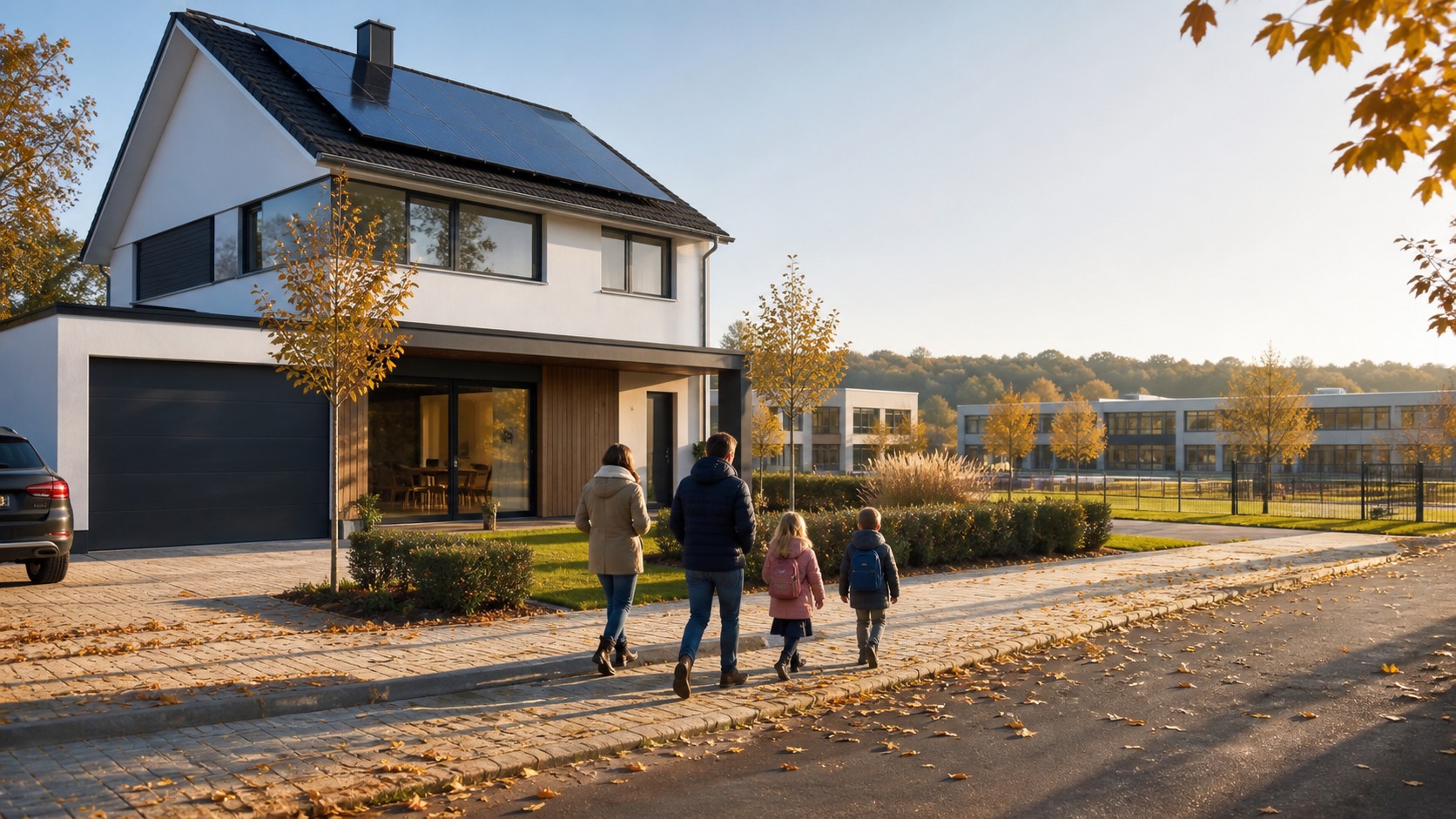
Why the School Year, Not the Job, Anchors Everything
The instinct of most relocating professionals is to build the move around the employment start date. That is the wrong anchor. Your employer can, in almost every case, accommodate a start in early September rather than mid-July; what no institution will accommodate is a child arriving in the middle of a school term, into a system and often a language they do not yet know, having missed the settling-in weeks when friendships and routines form. The Luxembourg school year runs, broadly, from mid-September to mid-July, with the long summer break in between. That single fact should sit at the centre of your planning, and everything else — the housing search, the removal, the administrative registrations — should be scheduled backwards from it.
What this means in practice is that the real deadline for most families is not "arrive by 1 September" but "have a confirmed school place and a signed lease by late spring." International and European schools in particular fill their popular year groups early, and the most sought-after public communes have limited flexibility once local enrolment closes. A family that begins the school conversation in February or March has genuine choice. A family that begins it in July is choosing from what is left. I have watched both, many times, and the difference in stress — and in outcome for the child — is not subtle.
The Three School Tracks: Public, European, and International
Luxembourg offers families a genuinely unusual choice, and understanding it is the single most important piece of the relocation puzzle, because it drives everything downstream — where you live, what you pay, and how your child's education will transfer if you move again in a few years. There are, broadly, three tracks.
The public school system is free, excellent, and profoundly multilingual — and that multilingualism is both its greatest gift and its steepest hurdle for arriving families. Traditional Luxembourgish public schools teach in Luxembourgish in the early years, introduce German as the language of literacy, and add French later. For a child who arrives at age five or six, this immersion is often a remarkable gift; for a twelve-year-old arriving with only English, the traditional track can be genuinely hard. Recognising this, the state has expanded a network of public international schools (often called the European public schools) across the country — in places such as Differdange, Junglinster, Clervaux, Mondorf, Esch-Belval, and elsewhere — which follow the European Baccalaureate framework, teach through English, French or German sections, and are free. These have transformed the options for internationally mobile families and are, for many, the ideal middle path: the rigour and portability of an international curriculum at no tuition cost.
The European Schools proper — the long-established institutions in Luxembourg City (Kirchberg) and Mamer serving the families of EU staff — deliver the European Baccalaureate in language-specific sections. Priority goes to children of EU institution employees; other families may access places where capacity allows, sometimes with fees. Finally, the private international schools — following the International Baccalaureate, the British curriculum, or others — offer instruction primarily in English, smaller cohorts, and the familiarity of a globally recognised system, at tuition that can run from roughly €15,000 to €30,000-plus per child per year. For a family expecting to move on again within a few years, that continuity can be worth every euro; for a family planning to stay, the free public and public-international tracks deserve a serious, unhurried look.
Matching Neighbourhoods to Schools and Commutes
Once you have a shortlist of schools, geography becomes a solvable problem rather than an overwhelming one — and this is exactly the order in which it should happen. Luxembourg is small, but its daily rhythms are dominated by traffic, and a commute that looks trivial on a map can eat an hour of a child's morning. The good news is that public transport across the entire country has been free since 2020, which genuinely widens the sensible catchment for a family willing to use train and tram.
Families drawn to the private international schools often cluster around the districts and communes with easy access to them — Strassen, Bertrange, Mamer, and the western approaches to the capital — where larger family houses and a settled, green, residential feel come at a premium but with short school runs. Those choosing the European School on Kirchberg weigh the plateau itself (modern, walkable, close to the institutions, but apartment-dominated) against greener communes a tram ride away. Families opting for a public international school gain the most geographic freedom of all: because these schools are distributed around the country, a family can choose to live near excellent, more affordable housing in the north or east — around Junglinster, Mersch, or the Nordstad — and still access a free, English-medium European Baccalaureate education. And many cross-border families settle just over the frontier in France, Belgium or Germany for markedly lower housing costs, accepting a longer commute in exchange.
The table below sketches how a few representative choices tend to line up. Treat the figures as realistic 2026 ranges for orientation, not quotes — actual rents vary widely by size, condition, and exact street.
| Area / commune | Best paired with | Typical family rental (3-bed) | Feel |
|---|---|---|---|
| Strassen / Bertrange | Private international schools | €2,800–€4,200 / month | Green, residential, short school runs |
| Kirchberg / Weimershof | European School Lux I | €2,600–€4,000 / month | Modern, walkable, apartment-led |
| Junglinster / Mersch / Nordstad | Public international schools | €1,900–€2,900 / month | Quieter, more space per euro |
| Esch-sur-Alzette / Belval | Public international (Belval) | €1,800–€2,700 / month | Urban south, university district |
| Cross-border (Arlon, Thionville, Trier) | Commute to any Lux school | €1,300–€2,100 / month | Lowest housing cost, longer commute |

Rent First, Buy Later — Almost Always the Right Call
This is the piece of advice I give most often to arriving families, and the one that most often surprises people who assume that buying immediately is the financially responsible thing to do. It usually is not — not in your first year. When you arrive, you do not yet know the country the way you will in twelve months. You do not know which commute genuinely works for your family versus which one looked fine on paper, how the school actually suits your child, whether you love the buzz of the plateau or crave the quiet of a village, or how the light falls in a neighbourhood in November as opposed to on a bright viewing day in June. Renting for the first year buys you the single most valuable thing in a relocation: reversible decisions.
There is a practical financing dimension too. Luxembourg banks assess mortgage applications more comfortably once you have a local employment history and a settled residency situation; arriving and immediately committing to a purchase can mean a less favourable borrowing position than waiting six to twelve months. Buying in Luxembourg also carries meaningful transaction costs — notary fees, registration duties and related charges typically add up to a significant percentage on top of the purchase price — which makes a quick buy-then-sell, if the first choice proves wrong, an expensive mistake. In the 2026 market, with prices settled well below the 2022 peak and transaction volumes recovered, patient buyers who spend a year learning the market genuinely tend to buy better.
The exception worth naming: a family that is certain of its long-term plans, knows the country already, has financing arranged, and has found the right home may reasonably buy sooner — and today's market rewards that decisiveness where it is genuinely informed. But "we felt we should own rather than rent" is not, by itself, a reason to skip the learning year. If you want to understand what your borrowing capacity and total budget actually look like before you decide, the notary fees calculator is a useful place to start, and a conversation about the current market costs nothing.
A Month-by-Month Relocation Timeline for a September Start
Here is the sequence I walk families through, scheduled backwards from a mid-September school start. Every family's situation differs, but the shape holds remarkably well.
January to March — decide the school track. Research the three tracks honestly against your family's real situation: how long you expect to stay, your children's ages and current language, and your budget. Contact schools, request places, and — this is the non-negotiable step — book in-person visits. For popular private and European schools, applications for September often need to be in during this window.
March to April — visit, and confirm the school. Come to Luxembourg for two or three days. Walk into the schools on your shortlist, meet admissions staff, and get a genuine feel for the surrounding areas at the same time. By the end of this trip you want a first-choice school and a realistic sense of the two or three neighbourhoods that pair with it.
April to June — secure the rental. With the school anchored, begin the housing search in earnest. Family rentals in the best areas move quickly, so line up viewings tightly and be ready to sign. Prepare your dossier in advance — employment contract, proof of income, identification — because Luxembourg landlords expect it and the well-prepared applicant wins the good property. A rental in Luxembourg typically requires a deposit of up to three months' rent held in a blocked account.
June to August — register and prepare. Once your lease is signed and you have an address, you can begin the administrative registrations: your déclaration d'arrivée at the commune within the required window of arrival, residence formalities, and the enrolment paperwork the school needs. Arrange your international removal, and if you are bringing a car, understand the registration and import steps. Set up utilities and, importantly, a local bank account.
Late August to mid-September — land and settle. Arrive with enough of a buffer before the first school day for the children to adjust to the house, the route, and the time zone. Complete the commune registration if you have not already. Then, gently, let the school year begin — which was the point of the entire sequence.
The Budget Picture: What Families Actually Spend
It is worth being honest about money early, because the sticker figures families arrive with rarely include everything. Rent is the obvious line, and the table above gives realistic 2026 ranges. On top of it, budget for the deposit (up to three months' rent, blocked but returnable), agency fees where an agent is involved, and utilities and communication services that in a family house can run to a few hundred euros a month. If you choose private international schooling, tuition is the single largest variable in the whole budget and belongs at the top of the spreadsheet, not the bottom.
Families who plan to buy in year two should model the full transaction cost, not just the price. Notary fees, registration duties and associated charges add a meaningful percentage on top of the purchase price, and mortgage arrangement has its own costs. The reassuring news is the direction of the 2026 market: with values settled roughly ten to fifteen percent below the 2022 peak, eased mortgage rates compared with the tightest period, and recovered transaction volumes, a family buying from an informed position after a year of renting is buying into a more rational market than the one that greeted arrivals at the top of the cycle. Patience, here, is not just emotionally easier — it is usually financially smarter.
Key Takeaways
- Anchor your entire relocation to the September school start, not your employment date — every other step schedules backwards from it.
- Understand the three school tracks — public, European, and private international — before anything else; the free public international schools are an underused ideal for many families.
- Choose the school first, then the neighbourhood; free nationwide public transport widens your sensible options considerably.
- Rent for your first year in almost every case — it keeps your big decisions reversible and usually improves your eventual buying position.
- Start the school conversation in late winter, not summer; families who begin early have real choice, families who begin late take what is left.
Frequently Asked Questions
When should we start planning a move timed to the school year?
Begin the school conversation in January to March for a September start. Popular private and European schools often close September applications in late winter or early spring, and the best family rentals move quickly once you have chosen an area. Families who start in July are choosing from what remains.
Is the free public school system realistic for an English-speaking family?
It depends heavily on your child's age. A young child entering at five or six often thrives in Luxembourg's multilingual immersion. For older children arriving with only English, the traditional Luxembourgish track can be very demanding — but the free public international schools, which teach the European Baccalaureate through English, French or German sections, are frequently an excellent and underused alternative.
Should we rent or buy when we first arrive?
Rent, in almost every case, for your first year. You will understand commutes, neighbourhoods and schools far better after living here, your mortgage position typically improves with a local employment history, and Luxembourg's transaction costs make a quick buy-then-sell an expensive mistake if your first choice proves wrong.
How much do international schools cost in Luxembourg?
Private international school tuition typically runs from roughly €15,000 to €30,000-plus per child per year, depending on the school and year group. The European Schools and the free public international schools offer the European Baccalaureate at no or much lower tuition — worth serious consideration, especially for families planning to stay.
Can we live over the border and still send our children to a Luxembourg school?
Many cross-border families do exactly this, settling in France, Belgium or Germany for lower housing costs. It is entirely workable, particularly with a public international school near the frontier, but weigh the daily commute honestly — for young children a long morning journey adds up over a school year.
What do we need to rent a family home in Luxembourg?
Landlords typically expect a complete dossier — employment contract, proof of income, identification — and a deposit of up to three months' rent held in a blocked account. Prepare this in advance; in the best areas, family homes go to the applicant who is ready to sign, not the one still gathering documents.
How does free public transport change where we should live?
Considerably. Since all public transport in Luxembourg became free in 2020, train and tram routes genuinely widen the sensible catchment for a family. A commune twenty minutes by train from a school or the city can offer markedly more house for your money than a central district, with a commute that costs nothing.
Relocating to Luxembourg for September? Let's Plan It Properly
Finding the right family home around the right school, on the right timeline, is exactly the kind of move I have guided countless families through. Tell me your school shortlist and your dates, and I will help you find the home that fits.
WhatsApp Daniela Browse Family Homes
Multilingual support in English, French, and Italian. 13+ years in the Luxembourg market.
Conclusion
A family relocation to Luxembourg is not really a housing problem with a schooling footnote — it is a schooling decision with a housing consequence, and the families who understand that arrive settled while the others arrive scrambling. Anchor everything to the September start. Choose the school track that genuinely fits your children and your plans. Let the neighbourhood follow the school, and let the free transport network widen your options. Rent for the first year, learn the country, and buy — if you buy — from a position of knowledge in a 2026 market that rewards exactly that patience. Do it in that order, start it early, and the move that looked overwhelming in February becomes, by September, simply the first day of school.
Browse Family Homes in Luxembourg · Talk to Daniela About Your Move