Every working morning, well over 200,000 people cross into Luxembourg from France, Belgium and Germany to earn their living here — the frontaliers, or cross-border workers, who now make up close to half of the Grand Duchy's private-sector workforce. Many of them spend years, even entire careers, drawing a Luxembourg salary while paying a mortgage on a house in Thionville, Arlon or Trier. And sooner or later, a very natural question surfaces: if I work here, earn here, and pay my taxes here, can I actually buy property here too? The short answer is yes. The useful answer — the one that decides whether it is a good idea for you — is considerably longer.
In my thirteen years on the Luxembourg market, I have guided a great many cross-border buyers through exactly this decision — French engineers from the Metz–Thionville corridor, Belgian families from the Arlon area, German professionals commuting from the Trier side. Some were buying a Luxembourg apartment to finally stop commuting; others were weighing a Luxembourg investment property against a cheaper home across the border. The legal right to buy is the easy part — Luxembourg places no nationality or residence restriction on property ownership. The real substance lies in mortgage access as a non-resident, the tax and registration-duty picture, and the genuine trade-off between buying inside Luxembourg and buying across the border. This guide walks through all three, with the honesty I would offer you across my own desk.
- Whether frontaliers are legally allowed to buy property in Luxembourg — and any conditions attached
- How Luxembourg banks treat cross-border, non-resident mortgage applications in 2026
- The tax and residence considerations that specifically affect cross-border owners
- When the Bëllegen Akt registration-duty credit does and does not apply to a frontalier
- A clear-eyed comparison of buying in Luxembourg versus buying across the border
- The practical steps to prepare a strong non-resident purchase file
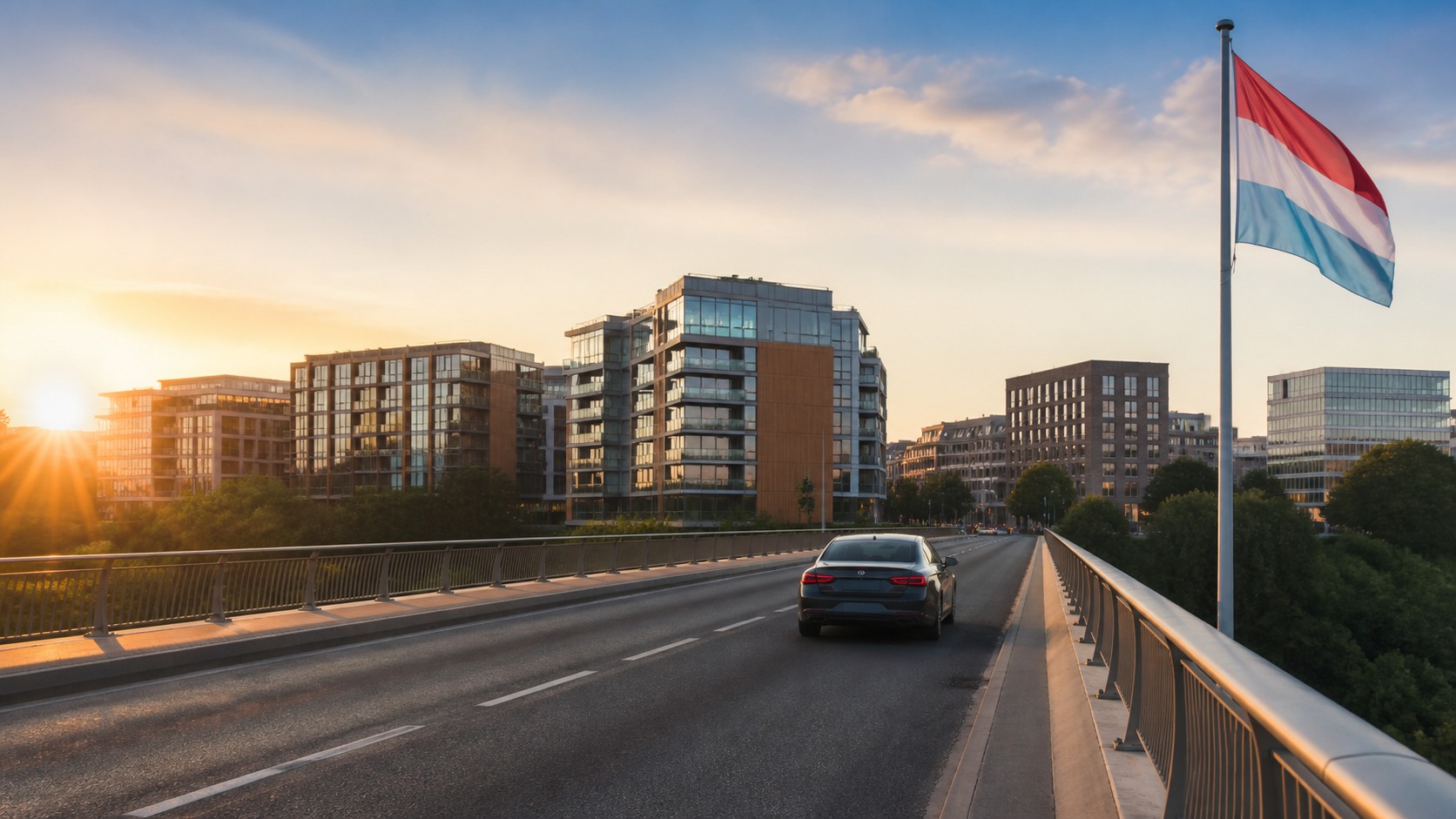
Can a Frontalier Legally Buy in Luxembourg? Yes — Without Restriction
Let me clear away the most common worry first, because it stops people who have no reason to be stopped. Luxembourg imposes no nationality requirement and no residence requirement on property ownership. You do not need to be a Luxembourg resident, you do not need a Luxembourg address, and you do not need to hold EU citizenship to buy an apartment or a house here. A French frontalier living in Metz, a Belgian in Arlon, a German in Konz — all have exactly the same right to acquire Luxembourg real estate as a resident does. There is no equivalent of the restrictions some countries place on foreign or non-resident buyers.
This matters because it means the question is never "am I allowed?" — the answer is always yes — but rather "does it make financial sense, and can I finance it?" Those are the real gatekeepers. And they are where cross-border buyers genuinely differ from resident buyers, not in law but in practice. The bank's willingness to lend, the deposit it expects, and the tax treatment of the property are all shaped by the fact that you live on the other side of a border. So the rest of this guide is about practice, not permission.
The Cross-Border Reality: Who Buys, and Why
Cross-border workers are not a single profile, and the reason for buying shapes everything that follows. Broadly, I see three motivations among the frontaliers who come to me. The first group wants to stop being frontaliers — they are tired of the A31 or the E25 at 7am, and they want to move into Luxembourg itself, close to work, and reclaim two hours of their day. For them, a Luxembourg home is a lifestyle decision as much as a financial one, and it usually means it will become their principal residence.
The second group has no intention of moving. They are settled in France, Belgium or Germany, often with a house already paid down and children in local schools, but they earn a Luxembourg salary and want to put some of it into Luxembourg bricks and mortar as an investment — a rental apartment in Esch-sur-Alzette or Differdange, say, that they let out while continuing to live across the border. The third group is somewhere in between: buying now with a view to moving in a few years, or buying for a child studying in Luxembourg. Each of these buyers faces the same law but a genuinely different calculation on tax, financing and returns — which is why "can frontaliers buy?" is really several questions wearing one coat.
Mortgage Access: How Luxembourg Banks Treat Cross-Border Buyers
Here is where the practical differences start to bite. Luxembourg banks — Spuerkeess (BCEE), BGL BNP Paribas, BIL, ING, Raiffeisen, Post Finance — do lend to non-resident and cross-border buyers, and lend regularly. But they generally apply somewhat more conservative conditions than they would to a comparable resident, for the simple reason that a borrower living abroad is marginally harder to pursue if things go wrong, and cross-border income and expenses are harder for them to verify. In 2026, with mortgage rates easing back into roughly the 3% region after the sharp climb of 2022–2023, financing is meaningfully more accessible than it was two years ago — but the cross-border premium in conditions has not disappeared.
In practice, the differences show up in three places. First, the deposit: where a resident owner-occupier might finance a large share of the price, a cross-border buyer — especially for an investment property — is often asked for a larger down payment, commonly in the region of 20–30% of the price plus the acquisition costs on top. Second, the debt-servicing assessment: banks look hard at your total commitments on both sides of the border, including the mortgage on your existing home, and apply the same broad discipline of keeping housing costs within roughly a third of net income. Third, some banks are simply more comfortable with cross-border files than others, and it genuinely pays to approach more than one. A borrower who banks where they already hold their salary account will often get a smoother hearing.
| Financing factor | Resident owner-occupier | Cross-border buyer (typical) |
|---|---|---|
| Deposit expected | Often 10–20% + costs | Commonly 20–30% + costs |
| Indicative rate (2026) | ~3% region | ~3% region, sometimes a touch higher |
| Income verification | Domestic, straightforward | Cross-border income + foreign commitments reviewed |
| Debt-to-income discipline | ~1/3 of net income | ~1/3, both borders counted |
| Bank appetite | Broad | Varies by bank — shop around |
The figures above are indicative ranges, not fixed rules — every bank sets its own policy and every file is assessed individually. But the shape of the picture is stable: a cross-border buyer should plan for a larger deposit and a more thorough income review, and should treat mortgage pre-approval as the very first step, before falling in love with any property.
Tax and Residence: What Cross-Border Owners Need to Understand
Tax is where cross-border buyers most often get incomplete advice, so let me set out the architecture plainly. As a frontalier, your Luxembourg employment income is generally taxed in Luxembourg under the bilateral tax treaties Luxembourg holds with France, Belgium and Germany — that part you already know from your payslip. What changes when you buy Luxembourg property depends entirely on how you use it.
If you buy a Luxembourg property and let it out, the rental income is Luxembourg-source income and is, as a rule, taxable in Luxembourg, with your country of residence then applying the treaty mechanism to avoid double taxation. If you buy a Luxembourg property to live in — meaning you actually move your residence into Luxembourg — you cease to be a frontalier and become a resident, with all the tax-class and deduction consequences that follow. And if you buy purely as an investment while continuing to live across the border, you keep your frontalier status for your employment income but take on a Luxembourg non-resident tax obligation on the property's rental yield. None of this is a reason not to buy; it is a reason to model the after-tax numbers honestly before you commit, ideally with a tax adviser who works both sides of your particular border. The interplay between two national tax systems is precisely where general internet advice goes wrong.
The Bëllegen Akt: When the Registration-Duty Credit Applies to You
Buying in Luxembourg carries acquisition costs on top of the price — principally the registration and transcription duties, which together come to around 7% of the price (with an additional municipal surcharge in Luxembourg City for certain transactions), plus notary fees. For owner-occupiers, Luxembourg offers a valuable relief known as the Bëllegen Akt — a tax credit that offsets a substantial part of these registration duties. In recent years the government has significantly increased the amount of this credit as part of measures to support the housing market, which has made owner-occupied purchases noticeably cheaper to complete.
Here is the crucial point for frontaliers: the Bëllegen Akt credit is reserved for buyers who occupy the property as their principal residence. A frontalier who buys a Luxembourg home and genuinely moves into it can claim it. A frontalier who buys a Luxembourg apartment as an investment while continuing to live in France, Belgium or Germany generally cannot — the credit is not designed for buy-to-let. This single distinction can swing the total acquisition cost by tens of thousands of euros, and it is exactly the kind of detail that changes whether a deal makes sense. If your plan is to move into the property, the owner-occupier reliefs are a real part of the return; if your plan is to let it out, budget for the full duties. Do not assume a credit you will not receive. The notary fees calculator is a good way to see the true all-in cost of a purchase before you commit.
Buy in Luxembourg or Buy Across the Border? The Real Trade-Off
This is the question that actually keeps cross-border buyers awake, and it deserves an honest answer rather than a sales pitch. The blunt reality is that property inside Luxembourg is considerably more expensive per square metre than the neighbouring towns across each border. A comparable amount of money buys substantially more floor space and garden in Thionville, Arlon or Trier than it does in Luxembourg City or its inner suburbs. For a family whose priority is space, that gap is the whole reason they became frontaliers in the first place.
But price per square metre is not the whole ledger. Luxembourg property sits in a market underpinned by relentless population growth — the Grand Duchy keeps adding residents year after year — chronic housing undersupply, and a deep, liquid resale market. Historically that has translated into strong long-term capital appreciation and reliable rental demand, particularly for well-located apartments near employment hubs and transport. Property across the border can be cheaper to buy but sits in different local markets with their own, often more modest, growth and liquidity dynamics. There is also the currency-of-life factor: if you eventually want to live and retire in Luxembourg, owning here builds your position in the market you actually intend to stay in.
| Consideration | Buy in Luxembourg | Buy across the border |
|---|---|---|
| Price per m² | High — premium market | Substantially lower |
| Space for the money | Less floor area and garden | More space, often a real garden |
| Long-term appreciation | Historically strong, demand-driven | Varies by local market |
| Resale liquidity | Deep, active market | More local, more variable |
| Commute | Short or none if you move in | The daily cross-border commute stays |
| Owner-occupier reliefs | Bëllegen Akt if principal residence | Local rules of that country |
My honest counsel is that there is no universal winner here — it depends on what you are optimising for. If your priority is maximum living space today and you are content to keep commuting, across the border usually wins on pure square metres. If your priority is long-term wealth building, integration into the Luxembourg market, and eventually ending the commute, buying in Luxembourg has structural advantages that a lower entry price across the border does not replace. The worst outcome is choosing on price per square metre alone without weighing appreciation, liquidity and your own ten-year plan.
Preparing a Strong Cross-Border Purchase File
Once you have decided Luxembourg is the right side of the border for you, the execution is very manageable — but non-resident buyers benefit from a little more preparation. The sequence I recommend is deliberate rather than complicated:
- Secure mortgage pre-approval first. Approach at least two Luxembourg banks — starting with the one that holds your salary account — and get a written financing capacity before you view. This tells you your true budget and makes your offer credible.
- Clarify your intent honestly. Will this be your principal residence or an investment? The answer drives your tax position, your eligibility for the Bëllegen Akt, and your deposit — so decide it before you shop, not after.
- Model the all-in cost. Price plus registration duties, notary fees and any works — and, for owner-occupiers, net of the Bëllegen Akt credit. Know the true number.
- Take cross-border tax advice. One conversation with an adviser who understands both your residence country and Luxembourg will save far more than it costs.
- Work with someone who knows both sides. A multilingual agent who regularly serves cross-border buyers can anticipate the friction points that catch first-time non-resident purchasers.
Key Takeaways
- Frontaliers can buy property in Luxembourg without any nationality or residence restriction — the legal right is never the obstacle.
- Luxembourg banks lend to cross-border buyers but typically expect a larger deposit (often 20–30%) and scrutinise commitments on both sides of the border.
- Tax treatment depends entirely on use: letting the property triggers a Luxembourg rental-income obligation; moving in makes you a resident. Model both countries together.
- The Bëllegen Akt registration-duty credit applies only to principal residences — an investment-only frontalier purchase does not qualify.
- Buying across the border wins on space and price; buying in Luxembourg wins on long-term appreciation, resale liquidity and ending the commute. Choose on your ten-year plan, not on price per m² alone.
Frequently Asked Questions
Do I need to be a Luxembourg resident to buy property here?
No. Luxembourg places no residence and no nationality requirement on property ownership. A cross-border worker living in France, Belgium or Germany has exactly the same right to buy as a resident. Residence affects your financing and tax position, not your legal ability to own.
Will a Luxembourg bank give me a mortgage as a frontalier?
Yes, Luxembourg banks regularly finance cross-border buyers. They usually apply more conservative conditions than for residents — commonly a larger deposit and a closer review of your total commitments on both sides of the border. Approaching more than one bank, ideally including the one that holds your salary account, is well worth the effort.
How much deposit will I need as a cross-border buyer?
It varies by bank and by whether the property is your home or an investment, but cross-border buyers should generally plan for a deposit in the region of 20–30% of the price, plus the acquisition costs on top. Owner-occupiers moving into the property may access more favourable terms than pure investors.
Can I claim the Bëllegen Akt tax credit if I keep living across the border?
Generally no. The Bëllegen Akt registration-duty credit is reserved for buyers who occupy the property as their principal residence. If you buy a Luxembourg property as an investment while continuing to live in France, Belgium or Germany, you should budget for the full registration duties without the credit.
Where will I pay tax on rental income from a Luxembourg property?
Rental income from a Luxembourg property is, as a rule, Luxembourg-source income taxable in Luxembourg, with your country of residence applying the relevant tax treaty to avoid double taxation. Because two tax systems interact, a short consultation with a cross-border tax adviser is strongly advisable before you buy.
Is it smarter to buy in Luxembourg or across the border?
It depends on your priorities. Across the border typically buys more space for the money; Luxembourg typically offers stronger long-term appreciation, a deeper resale market and the option to end your commute. If you intend to live and stay in Luxembourg over the long run, buying here builds your position in the market you actually plan to remain in.
If I buy a home in Luxembourg and move in, do I stop being a frontalier?
Yes. Moving your residence into Luxembourg makes you a Luxembourg resident rather than a cross-border worker, which changes your tax class, your deductions and your eligibility for owner-occupier reliefs. Many frontaliers buy precisely in order to make this transition and end the daily commute.
Are cross-border purchases more complicated to complete?
Not fundamentally. The Luxembourg purchase process — offer, compromis, notarial deed — is the same for everyone. The extra work for non-residents is mainly in financing preparation and cross-border tax planning, both of which are very manageable with the right preparation and advisers.
Thinking of Buying in Luxembourg as a Cross-Border Worker?
Whether you want to end the commute or invest your Luxembourg salary in Luxembourg bricks and mortar, I help cross-border buyers navigate financing, tax and the buy-here-versus-across-the-border decision with clarity — in your own language.
WhatsApp Daniela Explore Investment Options
Multilingual support in English, French, and Italian. 13+ years in the Luxembourg market.
Conclusion
Cross-border workers can absolutely buy property in Luxembourg — the law puts no barrier in your way at all. What separates a good cross-border purchase from a poor one is not permission but preparation: securing the right financing as a non-resident, understanding how two tax systems will treat your property, knowing when the owner-occupier reliefs apply to you, and choosing between Luxembourg and across the border on the basis of your real ten-year plan rather than the headline price per square metre. Get those four things right and buying in Luxembourg as a frontalier can be one of the smartest long-term financial moves you make. If you would like a clear, honest conversation about where you sit and what makes sense for your situation, I am always glad to have it — in English, French or Italian.
Explore Property Investment in Luxembourg · Browse Available Properties · Request a Free Valuation