A large share of the new-build apartments changing hands in Luxembourg today are never actually finished when the buyer signs. They are bought from a plan, a scale model, and a show-flat render — sometimes from nothing more than a fenced-off plot in Belval, Kirchberg or Esch-sur-Alzette. This is the Vente en l'État Futur d'Achèvement, or VEFA: the legal framework that lets you buy a home the developer has not yet built, pay for it in stages as the walls go up, and take ownership progressively as construction advances. For a first-time buyer it can feel unnerving — you are handing over hundreds of thousands of euros for something that exists only on paper.
In my thirteen years on the Luxembourg market, I have guided many buyers through VEFA purchases — from studios in Cloche d'Or to family duplexes in the Nordstad — and I have also seen the handful of cases where things went wrong: a developer who ran into difficulty, a delivery two years late, a finished apartment that did not match the sales brochure. The reassuring truth is that Luxembourg's VEFA regime is one of the more protective in Europe, built around a mandatory completion guarantee and staged payments tied to verified progress. But those protections only work if you understand them, read the contract properly, and know which questions to ask before you sign the reservation. This guide is the conversation I have with every buyer considering a new-build, laid out from first principles.
- What VEFA actually is and how buying off-plan differs from buying an existing home
- The full VEFA process — from reservation contract to notarised deed to final delivery
- How staged payments work and what percentage is due at each construction milestone
- The completion guarantee (garantie d'achèvement) and the other warranties that protect you
- The real risks — delays, developer default, non-conformity — and how each one is mitigated
- A practical checklist and the VEFA-versus-existing-property trade-off
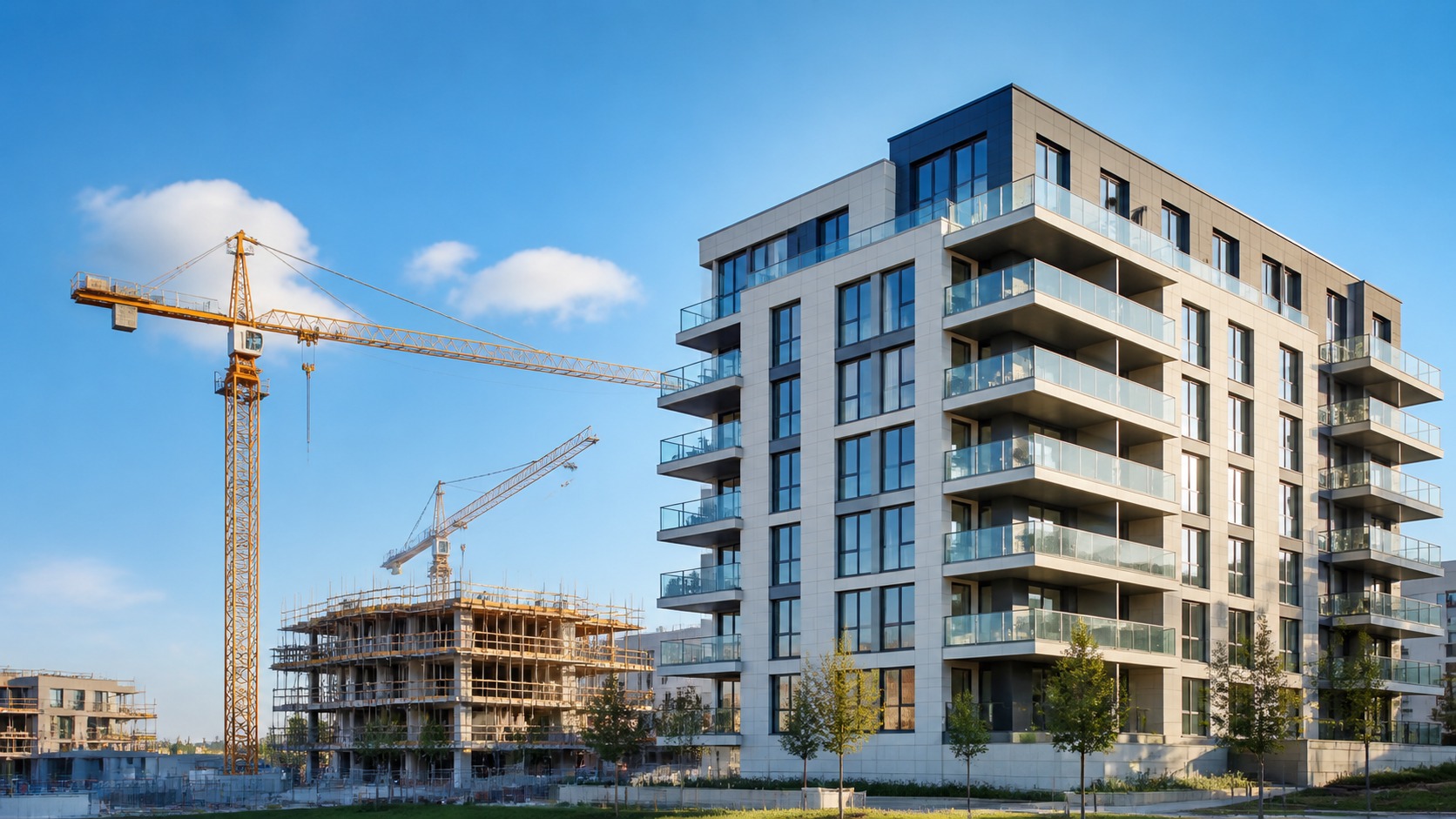
What VEFA Actually Means — Buying a Home Before It Exists
VEFA stands for Vente en l'État Futur d'Achèvement — literally, "sale in the future state of completion." It is the legal mechanism, rooted in the Luxembourg Civil Code, through which a buyer acquires a property that is either under construction or not yet started. The defining feature is that ownership transfers progressively: as soon as the notarised deed is signed, you become the owner of the land share and of whatever has already been built, and you automatically become the owner of everything the developer constructs thereafter, as it is constructed. You are, in a real legal sense, the owner of a building that is still going up.
This is fundamentally different from buying an existing home, where you inspect a finished property, agree a price, and take ownership of exactly what you saw. With VEFA you are buying a promise backed by a plan — a cahier des charges (technical specification), architectural drawings, a description of finishes and materials, and a delivery date. The developer is legally bound to deliver that specific property, to that specific standard, by that agreed deadline. Almost every new-build apartment sold before completion in Luxembourg uses this framework, precisely because it comes with mandatory buyer protections that an ordinary sale does not.
The appeal is real. New-build homes come with a fresh energy certificate — typically class A or AA under current construction norms — which matters enormously to Luxembourg buyers and to banks offering favourable "green mortgage" conditions. You get modern insulation, low running costs, a ten-year structural warranty, and the ability to personalise finishes while the building is still going up. And because you pay in stages, you are not carrying the full financing cost from day one.
The VEFA Process Step by Step
The journey from show-flat to keys follows a defined sequence, and understanding it removes most of the anxiety. Here is how a typical Luxembourg VEFA purchase unfolds.
1. The reservation contract (contrat de réservation). Once you have chosen your lot, the developer offers a reservation contract. This reserves the specific apartment for you, fixes the price, and describes the property and its finishes. In exchange you pay a reservation deposit — capped by law and typically in the region of 2% of the sale price, held in escrow. Critically, this deposit is refundable in defined circumstances: if your mortgage is refused, if the final deed is not offered within the agreed period, or if the final price exceeds the reservation price beyond a set threshold. Read this contract carefully; it sets the terms of everything that follows.
2. Securing the mortgage. With the reservation signed, you finalise your financing. Luxembourg banks are comfortable with VEFA and release funds in tranches that mirror the construction stages, so you do not draw the whole loan at once. This is also where interest-only arrangements during construction come into play — you typically pay interest only on the sums released so far, which keeps your outlay manageable while the building rises.
3. The notarised deed of sale (acte de vente). This is the decisive legal step. Before a Luxembourg notary, you sign the authenticated deed that transfers ownership. From this moment you own the land share and the works already completed, and you become owner of future works as they progress. The notary verifies that the mandatory completion guarantee is in place — without it, the deed should not proceed. The staged payment schedule is written into this deed.
4. Staged payments as construction advances. You pay in instalments tied to verified milestones — foundations, roof-tight, and so on — each certified before payment falls due. We look at the exact schedule in the next section.
5. Delivery and handover (réception). When the property is finished, the developer invites you to take delivery. You inspect the apartment against the specification and note any defects or non-conformities in a procès-verbal de réception (handover report). You may withhold a portion of the price — typically the final tranche — until reserved defects are corrected. Then the keys are yours.
How Staged Payments Work — The Milestone Schedule
One of the strongest built-in protections of VEFA is that you never pay ahead of construction. Luxembourg law regulates the maximum proportion of the price that can be called at each stage, so your money follows the bricks rather than leading them. If the developer stops building, your remaining money stays with you. The exact percentages are set out in your deed, but a representative schedule looks like this.
| Construction milestone | Typical cumulative % of price due |
|---|---|
| Signature of notarised deed (land share) | Land value + a first tranche |
| Foundations completed | around 30% |
| Structural walls / floors done | around 50% |
| Roof watertight (hors d'eau) | around 65–70% |
| Windows and partitions (hors d'air) | around 80% |
| Completion of works | around 95% |
| Delivery / handover | final ~5% (withhold-able for defects) |
These figures are illustrative — every project's deed states its own precise percentages, and they are legally capped to prevent a developer from front-loading payments. The principle to hold onto is that each call for funds should be justified by a certified stage of completion, usually confirmed by the project architect. If you are ever asked to pay significantly ahead of visible progress, that is a red flag worth pausing on. Your bank, which releases the tranches, is also a check on this: it will not release funds for a stage that has not been reached.
Note also that the taxes and fees sit on top of this schedule. On a VEFA purchase, registration and transfer duties apply to the land portion, while the construction portion carries VAT — and Luxembourg's reduced VAT rate for a principal residence can materially lower the total. Modelling the full cost, including notary fees, before you commit is essential; a rough calculation up front avoids an unpleasant surprise at the deed.

The Guarantees That Protect You
This is where VEFA earns its reputation as a protective framework. Several layers of guarantee sit around your purchase, and knowing them turns "buying something that doesn't exist" from a leap of faith into a managed transaction.
The completion guarantee (garantie d'achèvement). This is the cornerstone. It is a financial guarantee — usually provided by a bank or insurer — that the property will be finished even if the developer defaults. If your developer becomes insolvent halfway through, the guarantor steps in to fund the completion of the works, or to reimburse sums already paid. A VEFA sale should not proceed to notarised deed without this guarantee in place, and the notary's role includes verifying it. When people ask me what single thing makes off-plan buying safe in Luxembourg, this is the answer.
The ten-year structural warranty (garantie décennale). For ten years after delivery, the developer and the building professionals are liable for any defect that compromises the solidity of the structure or renders the property unfit for its purpose — foundation problems, structural cracks, serious water ingress. This is backed by mandatory professional insurance, so the protection survives even if the individual firm disappears.
The two-year functional warranty (garantie biennale). For two years, the working elements that are separable from the structure — shutters, boilers, taps, non-structural fittings — are covered against malfunction.
The one-year "perfect completion" warranty (garantie de parfait achèvement). For the first year, the developer must repair any defect you noted at handover or that appears during that year, however minor. This is why documenting everything meticulously in the handover report matters so much.
Taken together, these guarantees mean that the buyer of a well-structured VEFA is protected against the two things they fear most: the developer failing to finish, and the finished building being defective. The protections are real, but they are not automatic in the sense of requiring no attention — you activate the parfait achèvement warranty by documenting defects, and you rely on the completion guarantee being properly in place, which is why professional oversight at signing matters.
The Real Risks — and How Each Is Managed
No purchase is risk-free, and it would be dishonest to present VEFA as if it were. The honest picture is that the risks are real but largely manageable, and the framework anticipates most of them. Here are the ones that genuinely matter.
Delivery delays. This is by far the most common problem. Construction in Luxembourg can be delayed by weather, labour shortages, supply-chain issues, or permitting complications, and a delivery date that slips six to twelve months is not unusual. The protection is contractual: your deed should specify a delivery deadline and, ideally, penalties (indemnités de retard) payable by the developer for delay beyond an agreed grace period. Read the delay clause carefully before signing — a vague or missing penalty provision is a genuine weakness. Practically, if you are renting while you wait, budget for a delay so that a slip does not create a housing crisis for your family.
Developer default or insolvency. The nightmare scenario — and precisely the one the completion guarantee exists to neutralise. If the developer fails, the guarantor funds completion or reimburses you. This is why you must confirm the guarantee is in place at the deed, and why buying from an established developer with a track record of delivered projects matters. Ask to see completed developments; a serious developer will happily show you them.
Non-conformity at delivery. The finished apartment differs from what was specified — a different flooring, a smaller terrace, a downgraded kitchen. This is why the cahier des charges is the document that matters: it is the legally binding description of what you are owed. At handover, you inspect against it and record every discrepancy in the procès-verbal. You are entitled to withhold the final payment tranche until reserved defects are corrected — a powerful lever, so never waive it.
Price adjustments. Some VEFA contracts allow price revision indexed to construction cost indices. Understand whether your price is firm or revisable, and if revisable, what index governs it and whether there is a cap. In a period of volatile construction costs this clause can matter a great deal.
Market movement during the build. Between reservation and delivery — which can be two years or more — the market can move. In today's Luxembourg market, roughly 10–15% below the 2022 peak with volumes recovered and mortgage rates eased, most buyers are purchasing for the long term and to live in, which cushions this risk. But if you are buying as a short-term investment, understand that you are exposed to the market at delivery, not at reservation.
How to Protect Yourself — A Practical Checklist
Everything above distils into a set of concrete actions. If you do these, you convert VEFA from a source of anxiety into a genuinely advantageous way to buy a home in Luxembourg.
- Research the developer. Look at their completed projects, their financial standing, and their reputation. Ask other buyers if you can. An established developer with delivered buildings is your single best protection.
- Read the cahier des charges line by line. This technical specification — materials, finishes, dimensions, equipment — is what the developer is legally bound to deliver. The brochure is marketing; the specification is the contract.
- Confirm the completion guarantee is in place before the notarised deed. Ask the notary to verify it explicitly. No guarantee, no signature.
- Scrutinise the delay clause. Is there a firm delivery deadline? Are there penalties for late delivery? What is the grace period? A missing or toothless clause is a real weakness.
- Understand the payment schedule and the price-revision terms. Confirm the percentages are milestone-linked and that you know whether your price is firm or indexed.
- Have a professional review the contracts. A notary or an independent property advisor reviewing the reservation and deed before you sign is inexpensive insurance against expensive mistakes.
- Inspect rigorously at handover. Bring a checklist, compare against the specification, and record every defect in the procès-verbal. Withhold the final tranche until reserved defects are fixed.
If you would like an experienced eye on a specific project before you commit, that is exactly the kind of review I do with buyers as part of a property purchase consultation — reading the contract, assessing the developer, and helping you understand what you are genuinely signing up for.
VEFA vs Buying an Existing Property
Off-plan is not automatically the right choice — it is a trade-off, and the right answer depends on your priorities, your timeline, and your appetite for the uncertainty of a build. Here is how the two compare on the dimensions that matter.
| Factor | VEFA (off-plan) | Existing property |
|---|---|---|
| Move-in timing | Wait for construction (often 18–36 months) | Usually within a few months |
| Energy performance | New standard, typically class A/AA | Variable; often needs upgrading |
| Personalisation | Choose finishes during the build | Buy as-is; renovate afterwards |
| Structural warranty | Ten-year décennale from delivery | None (unless recent build still covered) |
| Payment structure | Staged, following construction | Full price at the deed |
| Main risks | Delay, non-conformity, developer default | Hidden defects, older systems, energy retrofit |
| What you inspect | Plans, specification, show-flat | The actual property |
In broad terms, VEFA suits buyers who value a modern, energy-efficient home, who can wait for construction, and who want the reassurance of new-build warranties and staged payments. An existing property suits buyers who need to move quickly, want to see exactly what they are getting, and are comfortable managing the condition and energy profile of an older home — often at a lower price per square metre in an established neighbourhood. Neither is universally better; the right choice is the one that fits your life.
Key Takeaways
- VEFA lets you buy a new-build home before it is finished, with ownership transferring progressively as construction advances and payments following certified milestones.
- You never pay ahead of the building: staged payments are legally capped per milestone, so your remaining money stays protected if construction stops.
- The completion guarantee (garantie d'achèvement) ensures the property gets finished even if the developer defaults — confirm it is in place before the notarised deed.
- New-builds carry a ten-year structural warranty, a two-year functional warranty, and a one-year perfect-completion warranty.
- The most common real risk is delay — read the penalty clause and budget for a slip; the most important document is the cahier des charges, not the brochure.
- Off-plan versus existing is a genuine trade-off between waiting for a modern, warranted home and moving quickly into a known property.
Frequently Asked Questions
Is buying off-plan in Luxembourg safe?
Yes, provided the standard protections are in place. Luxembourg's VEFA framework is one of the more protective in Europe: staged payments mean you never pay ahead of construction, the mandatory completion guarantee ensures the building is finished even if the developer fails, and a ten-year structural warranty covers you after delivery. The key is to confirm the completion guarantee at the notarised deed and to buy from an established developer.
What is the completion guarantee and why does it matter?
The garantie d'achèvement is a financial guarantee, usually from a bank or insurer, that the property will be completed even if the developer becomes insolvent. If the developer fails mid-construction, the guarantor funds the finishing of the works or reimburses sums paid. It is the single most important protection in a VEFA purchase, and the deed should not proceed without it.
How much deposit do I pay to reserve an off-plan apartment?
The reservation deposit is capped by law and is typically in the region of 2% of the sale price, held in escrow. It is refundable in defined circumstances — for example if your mortgage is refused or if the final deed is not offered within the agreed period. The remainder is then paid in stages tied to construction milestones after the notarised deed.
What happens if the developer delivers late?
Delays are the most common issue with off-plan purchases. Your protection is contractual: a well-drafted deed specifies a delivery deadline and penalties (indemnités de retard) payable by the developer beyond an agreed grace period. Before signing, scrutinise the delay clause — a vague or missing penalty provision is a genuine weakness. Practically, budget for a possible slip of six to twelve months if you are renting meanwhile.
Can I get my money back if my mortgage is refused?
Yes. A properly drafted reservation contract makes the deposit refundable if your financing falls through, among other defined circumstances. This is one of the specific clauses to check before you sign the reservation — confirm that mortgage refusal is a valid ground for return of the deposit.
What do I do if the finished apartment doesn't match what was promised?
At handover you inspect the property against the cahier des charges, the legally binding technical specification, and record every discrepancy in the handover report (procès-verbal de réception). You are entitled to withhold the final payment tranche until reserved defects are corrected, and the one-year perfect-completion warranty obliges the developer to fix defects noted at delivery. Never waive the right to withhold the final tranche.
Is VEFA cheaper than buying an existing property?
Not necessarily on headline price, but the cost structure differs. New-builds benefit from Luxembourg's reduced VAT rate on the construction portion when the home is a principal residence, which can lower the total, and they save you the cost of an energy retrofit. Existing properties often have a lower price per square metre, especially in established neighbourhoods, but may need renovation and energy upgrades. Model the full cost of each, including taxes and works, before deciding.
Do I pay the full price when I sign the deed?
No. That is a defining advantage of VEFA. After the notarised deed, you pay in instalments tied to certified construction milestones — foundations, roof-tight, and so on — with a final tranche of around 5% held back until handover and releasable only once reserved defects are corrected. Your bank releases mortgage funds in matching tranches.
Considering an Off-Plan Purchase in Luxembourg? Let's Review It Together
Before you sign a reservation, an experienced eye on the developer, the contract and the completion guarantee can save you far more than it costs. I help buyers understand exactly what they are committing to — and whether a given VEFA project is genuinely a good deal.
WhatsApp Daniela Explore Buyer Services
Multilingual support in English, French, and Italian. 13+ years in the Luxembourg market.
Conclusion
Buying off-plan in Luxembourg is not the leap of faith it first appears to be. Behind the show-flat and the render sits a mature legal framework built to protect the buyer: staged payments that follow the bricks, a completion guarantee that finishes the building if the developer cannot, and a cascade of warranties that cover you for a decade after the keys are handed over. The risks — delay above all — are real but manageable, and almost every one is mitigated by reading the right documents and asking the right questions before you sign. VEFA rewards the prepared buyer with a modern, energy-efficient home bought on favourable terms. If you approach it with your eyes open and a professional beside you, off-plan can be one of the smartest ways to buy in today's Luxembourg market.
Explore Property Investment · Browse Available Properties · Request a Free Valuation