When a young family asks "where should we buy?", they are almost never really asking about square metres or price per square metre. They are asking a much bigger question: where will our children walk to school safely, where can they play outside, how long will the morning commute steal from family life, and can we afford it without stretching to breaking point. In 2026 — with the Luxembourg market sitting roughly 10 to 15 percent below its 2022 peak, transaction volumes recovered, and mortgage rates eased back into a more workable range — families finally have room to choose deliberately again rather than simply grabbing whatever they can get.
Some choices age well and others quietly become a source of daily frustration. The commune you buy in shapes your family's rhythm for 10 years or more — the school your child attends, the friends they make on the street, the tram or bus you catch at 7:40 every morning. This guide is not a ranking with a single winner, because there is no single winner. It is an honest, lifestyle-led comparison of the communes I recommend to families, organised by what actually matters: schools, green space, commute, and price band. My goal is to help you find the commune that fits your situation, not the one that photographs best.
- The four factors that actually decide whether a commune works for a family — and how to weigh them
- A commune-by-commune comparison across the premium ring, the green belt, and the value belt
- How Luxembourg's school system (public, European, and international) shapes where you should live
- Realistic 2026 price bands for family houses in each commune, and what your budget actually buys
- The commute truth: which communes give you a genuine 20-minute door-to-desk and which only look close on a map
- A practical framework for matching a commune to your family's stage, budget, and priorities
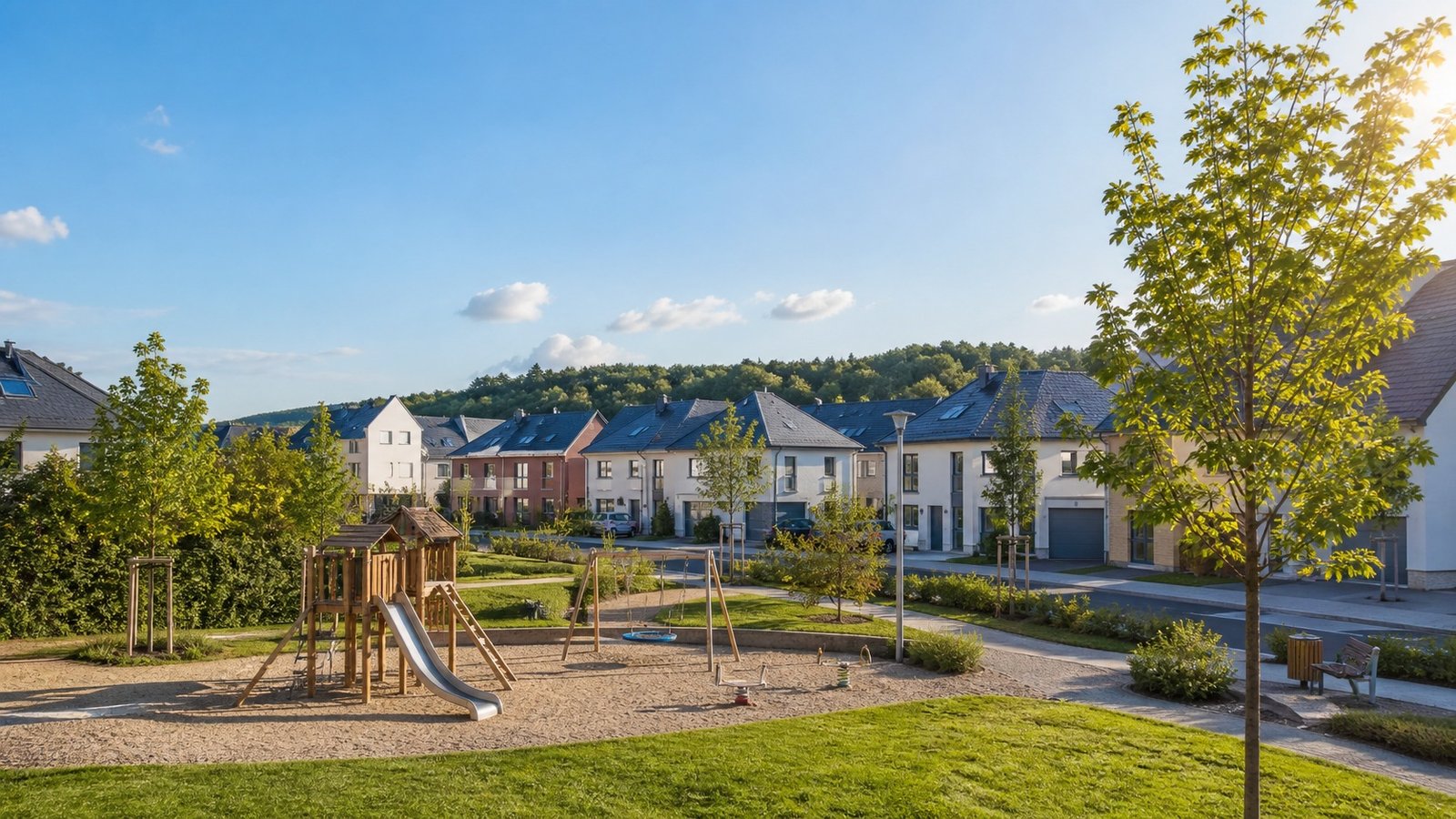
What Actually Makes a Commune Work for a Family
Before I name a single commune, let me share the framework I use with every family. There are four factors, and the mistake most buyers make is over-weighting one and ignoring the others. The first is schooling — not just "is there a school", because in Luxembourg every commune runs a fundamental school, but which school system fits your children's language profile and your longer-term plans. The second is green space and child-friendliness: safe streets, playgrounds, forest access, sports clubs, and the intangible sense that children can have a childhood outdoors. The third is commute, which in Luxembourg is rarely about distance and almost always about the specific road or rail line you depend on. And the fourth is price band — what a genuine family house, not a compromise, actually costs.
The families who are happiest five years after buying are the ones who were honest about which of these four they could not compromise on. A dual-career couple both working in Kirchberg will value a fast, reliable commute far above an extra bedroom. A family with three young children and one parent at home will value green space and school quality above shaving ten minutes off a commute they rarely make. There is no universally correct answer — there is only the answer that fits your family. What follows is my honest read of the communes that consistently deliver, grouped by character and price.
The Premium Inner Ring: Strassen, Bertrange, Mamer
These three communes form the affluent western belt immediately outside Luxembourg City, and they are where I send families who want the shortest possible commute combined with excellent amenities and are prepared to pay for it. Strassen sits so close to the city that it functions almost as an extension of it — you can be in the business districts of Kirchberg or the city centre in fifteen to twenty minutes, and the commune has invested heavily in its schools, sports infrastructure, and the leafy residential streets that families prize. It is not cheap: a proper family house in Strassen in 2026 typically sits in the region of €1.4 to €2 million, and building plots are scarce and coveted.
Bertrange offers a similar profile with a slightly more suburban, spread-out feel and the practical advantage of major retail and the Belle Étoile shopping centre on its doorstep. Its schools are well-regarded, green space is generous, and access to the A6 motorway makes it convenient for families where one parent commutes toward Belgium or the west. Mamer, a little further out, is the one I recommend to internationally-minded families, because it hosts one of the campuses associated with the European School system and has a strong, well-connected community feel. Mamer gives you a marginally more relaxed pace and slightly more house for your money than Strassen — realistically in the region of €1.1 to €1.6 million for a family home — while keeping a genuine 20 to 25 minute commute into the city on a good day.
The Northern Green Belt: Walferdange, Steinsel, Niederanven
North and north-east of the city lies a band of communes that I think of as the sweet spot for families who prioritise green space and calm without sacrificing a workable commute. Walferdange sits in the Alzette valley and has one thing most Luxembourg communes cannot offer: a direct train station on the northern line, putting the central station roughly ten minutes away by rail. For a dual-career family that wants to avoid the daily fight with traffic, that rail link is genuinely valuable. Walferdange is also home to significant green and educational infrastructure and has a settled, established community. Family houses here realistically sit in the region of €1.1 to €1.6 million.
Steinsel and Niederanven are the more residential, greener, quieter options — the kind of communes where children ride bikes and forests start at the edge of the neighbourhood. Steinsel is compact and well-organised, with strong schools and a reputation as one of the most comfortable family communes in the country; expect the region of €1.2 to €1.7 million for a house. Niederanven is larger and more varied, benefits from proximity to Kirchberg and the airport, and suits families where a parent works on the eastern side of the city or travels frequently. The trade-off in this belt is honest: you are relying on road access rather than rail (Walferdange excepted), and the roads into the city can congest at peak hours. But for the green-space dividend these communes deliver, many families consider that a fair exchange.
The Southern Value Belt: Bettembourg, Dudelange, Roeser
Not every family can — or should — stretch to €1.5 million, and this is where the south of the country becomes genuinely compelling. The communes of the former industrial south have transformed over the past 20 years, and in 2026 they offer families the best combination of space, price, and rail connectivity in the country. Bettembourg is a personal favourite recommendation for value-focused families: it has its own train station on the main southern line (frequent trains, roughly 15 to 20 minutes to the central station), a large adventure park that children adore, good schools, and family houses realistically in the region of €800,000 to €1.1 million — a different universe from the western ring.
Dudelange, the country's fourth-largest town, offers real urban amenities — cinema, sports facilities, a lively town centre, a nature reserve on the doorstep — at prices that let families buy a proper house with a garden for what a two-bedroom apartment might cost in Belair. Rail connections are good, though the commute is longer at roughly 25 to 30 minutes to the city. Roeser sits between the south and the city and is the quieter, more rural-feeling option in this group, with a village character, good green space, and prices in the region of €950,000 to €1.3 million that reflect its closer position to Luxembourg City. For families willing to trade a slightly longer commute for dramatically more house and garden, the southern belt is, in my professional opinion, the most under-appreciated family opportunity in the 2026 market.
Family Commune Comparison at a Glance (2026)
The table below summarises how the communes I have discussed compare on the four factors that matter most. Price bands are typical ranges for a genuine family house (roughly 4-plus bedrooms, garden) based on 2026 market conditions; treat them as indicative rather than guaranteed, because condition, plot size, and energy class move individual properties substantially within each band.
| Commune | Typical House Price (2026) | Commute to City Centre | Rail? | Family Character |
|---|---|---|---|---|
| Strassen | €1.4M – €2M+ | 15–20 min | No (bus/tram nearby) | Premium, urban-adjacent |
| Bertrange | €1.3M – €1.8M | 15–25 min | No | Suburban, retail on doorstep |
| Mamer | €1.1M – €1.6M | 20–25 min | Yes (western line) | International, European School |
| Walferdange | €1.1M – €1.6M | 10–15 min by rail | Yes (northern line) | Established, valley green |
| Steinsel | €1.2M – €1.7M | 15–25 min | No | Quiet, green, family-first |
| Niederanven | €1.2M – €1.8M | 15–25 min | No | Green, near Kirchberg/airport |
| Roeser | €950K – €1.3M | 15–20 min | Yes (nearby stations) | Village feel, rural calm |
| Bettembourg | €800K – €1.1M | 15–20 min by rail | Yes (southern line) | Value, park, well-connected |
| Dudelange | €750K – €1.05M | 25–30 min | Yes (southern line) | Urban amenities, best value |
Remember that public transport across the whole country is free, which changes the commute calculation meaningfully — a family in Bettembourg or Dudelange pays nothing to put both parents and the children on the train, whereas a road-dependent commute from the green belt carries fuel, parking, and time costs that rarely appear on a listing.
The School Question: Why It Should Come First
In Luxembourg, schooling deserves to be the starting point of the commune conversation, not an afterthought, because the school system is genuinely unusual and it interacts directly with where you should live. Every commune operates a free fundamental school (ages 4 to 12) taught primarily in Luxembourgish and German, with French introduced progressively. For families whose children are in — or will enter — this system, the quality and reputation of the local commune school matters enormously, and communes like Strassen, Steinsel, and Walferdange have built strong reputations that are, quietly, part of what their property prices reflect.
But Luxembourg also hosts a remarkable range of alternatives, and these reshape the map for international families. The European Schools (with campuses including Kirchberg, Mamer, and Bertrange/Mondorf) serve EU-institution families and follow the European Baccalaureate; living near a campus, or on its dedicated bus routes, is a genuine consideration. There are also established international and private schools — offering British, French, and International Baccalaureate curricula — clustered mainly around the city and its western communes, plus a growing set of public international schools that teach in English and other languages at little or no cost. My advice to every international family is the same: decide the school first, then let that decision narrow the communes, rather than falling in love with a house and discovering afterwards that the daily school run is forty-five minutes each way. For a fuller picture of how location and lifestyle interact, my guide to Luxembourg City neighbourhoods is a useful companion read.
The Commute Truth: Distance Lies, the Line Tells the Truth
The single most common mistake families make is judging commute by the distance on a map. In Luxembourg, distance is almost meaningless — what matters is the specific rail line or road you will depend on, and how it behaves at 8am on a Tuesday in November. A commune that looks "far" on paper but sits on a frequent rail line can deliver a more reliable, less stressful commute than a closer commune whose only route is a road that seizes up at peak. This is precisely why I rate Walferdange, Bettembourg, and Mamer so highly for commuting families: the train removes the variable that ruins mornings.
The country's ongoing investment in tram extensions, rail capacity, and park-and-ride facilities continues to reshape which communes are genuinely convenient, and free nationwide public transport has made the train a real default rather than a fallback. My practical counsel: before you commit to any commune, do the actual journey you will make every day, at the actual time you will make it, on a normal weekday — not on a quiet Sunday viewing. A house is a fifteen-year decision; the commute is a twice-daily reality. Get the second one wrong and the first one will never quite feel right.
How to Choose the Right Commune for Your Situation
Let me translate all of this into a decision you can actually make. Rather than asking "which is the best commune", ask which of the four factors your family genuinely cannot compromise on, and let that lead. Here is the shorthand I use:
- If commute reliability is non-negotiable (two careers, fixed office hours, young children needing pickup), prioritise a rail commune — Walferdange, Mamer, Bettembourg, or Roeser — and accept the price or space that comes with it.
- If green space and childhood-outdoors matter most and budget allows, the northern belt — Steinsel, Niederanven, Walferdange — is hard to beat.
- If schooling drives the decision, particularly the European or international systems, let the campus location set your search radius before anything else — Mamer, Bertrange, and the western communes come into focus.
- If value and space are the priority and you can accept a 20-to-30-minute rail commute, the southern belt — Bettembourg, Dudelange, Roeser — offers the most house and garden per euro in the 2026 market.
- If you want the shortest possible commute and money is not the binding constraint, the premium ring — Strassen and Bertrange — remains the benchmark.
Most families do not fit one box cleanly, and that is exactly the conversation worth having with someone who knows the streets rather than just the statistics. A free valuation and search consultation is where I usually start — understanding your budget, your work locations, your children's ages and school plans, and then matching those honestly against the communes that will still feel right in 10 years.
Key Takeaways
- There is no single "best" family commune in Luxembourg — only the best fit for your family's balance of schools, green space, commute, and budget.
- The premium western ring (Strassen, Bertrange, Mamer) buys the shortest commute and top amenities, at €1.1M to €2M+ for a family house.
- The northern green belt (Walferdange, Steinsel, Niederanven) offers calm, forests, and strong schools, with Walferdange adding a valuable rail link.
- The southern value belt (Bettembourg, Dudelange, Roeser) delivers the most space and garden per euro, with excellent free rail connectivity, from around €750K.
- Judge commute by the rail line or road you will actually use at peak — not by distance on a map — and decide your children's school before you fall in love with a house.
Frequently Asked Questions
Which is the best commune for families in Luxembourg in 2026?
There is no universal answer — it depends on your priorities. For the shortest commute and top amenities, Strassen and Bertrange lead. For green space and calm, the northern belt of Steinsel, Niederanven, and Walferdange excels. For value and space, the southern communes of Bettembourg and Dudelange are hard to beat. The right commune is the one that matches your family's non-negotiable factor, whether that is schooling, commute, green space, or budget.
Where can families get the most house for their money near Luxembourg City?
The southern belt offers the best space-per-euro in the 2026 market. Dudelange and Bettembourg let families buy a proper house with a garden for what a two-bedroom apartment might cost in central city neighbourhoods, and both sit on frequent, free rail lines to the centre. The trade-off is a commute of roughly 15 to 30 minutes rather than 15, which many families consider a fair exchange.
How important is the local school when choosing a commune?
Very. Every commune runs a free fundamental school, but reputations vary and are quietly reflected in property prices. For international families, the location of European or international school campuses should set your search radius before you look at houses at all — a beautiful home undone by a forty-five-minute daily school run is a common and avoidable regret.
Are the southern communes a good long-term investment for families?
In my professional opinion, the southern belt is one of the most under-appreciated family opportunities in the 2026 market. Continued rail investment, free public transport, and strong local amenities support both quality of life and long-term value, while entry prices remain materially below the western ring. For families planning a stay of 10 years or more, that combination is compelling.
Is it better to prioritise a rail commune or a shorter driving distance?
In Luxembourg, I almost always favour a reliable rail commune over a shorter but road-dependent one. Distance on a map is a poor predictor of morning stress; the specific line or road you depend on at peak is what determines your daily reality. Communes with their own stations — Walferdange, Mamer, Bettembourg — remove the traffic variable that most often ruins family mornings.
What budget do I realistically need for a family house in a good commune?
It varies enormously by location. The premium western ring typically starts around €1.1 to €1.4 million and rises well beyond €2 million in Strassen. The green belt sits broadly between €1.1 and €1.8 million. The southern value belt starts around €750,000 to €800,000 for a genuine family house. Condition and energy class move individual properties substantially within these bands, so treat them as a starting frame, not a fixed rule.
Should we rent first to test a commune before buying?
For families new to Luxembourg or uncertain about work locations, renting for six to twelve months in a candidate area is often money well spent. It lets you test the real commute, the school run, and the neighbourhood feel before committing to a fifteen-year purchase decision. Once you know the commune fits, buying with confidence is far easier.
Looking for the Right Family Home in Luxembourg? Let's Find It Together
Choosing the right commune is a decision that shapes your family's daily life for years to come. I help families match their budget, work locations, and school plans to the communes that will still feel right in 10 years — honestly and without pressure.
WhatsApp Daniela Browse Family Homes
Multilingual support in English, French, and Italian. Affiliated with RE/MAX One.
Conclusion
Choosing where to raise your family in Luxembourg is one of the most consequential decisions you will make here, and it deserves more than a scroll through listings sorted by price. The good news is that the 2026 market — softer than the 2022 peak, with recovered volumes and eased rates — genuinely gives families room to choose well. Decide which of the four factors your family cannot compromise on, weigh the communes honestly against that, and do the real commute before you sign anything. Whether your answer is the premium ring, the green belt, or the value-rich south, the right commune is out there — and the difference between a good choice and a merely adequate one is measured not in euros but in the quality of 10 years of ordinary family mornings.
Request a Free Consultation · Browse Available Properties · Luxembourg City Neighbourhoods Guide