One of the most common misconceptions about the Luxembourg property market is that it moves as a single block. The headlines that announce "Luxembourg prices up 4 percent this quarter" or "Luxembourg market recovers" obscure the more useful truth: at any given moment, parts of the country are rising sharply while other parts are flat or even slowly declining. The national average is the arithmetic of seven or eight quite different micro-markets, each driven by its own structural forces. For buyers trying to time an entry, for investors trying to spot value, and for owners wondering whether to sell or hold, the question that actually matters is not "is Luxembourg rising?" but "where in Luxembourg is rising, and why?"
After thirteen years tracking the country's micro-markets — apartment-by-apartment, commune-by-commune — I can tell you that 2026 is one of the most asymmetric years I have seen. Six specific micro-markets are showing genuine, structurally-supported price growth. The rest of the country is flat to modestly rising in line with general inflation. This guide identifies the six hotspots, explains the structural drivers behind each, and gives you the framework to read the signals yourself. The goal is not to chase yesterday's winners — by the time price growth is in the headlines, the easy money is already gone — but to understand which fundamentals make some areas continue rising while others plateau.
- The six Luxembourg micro-markets showing genuine price growth in 2026 — with hard numbers
- The structural drivers behind each hotspot (tram, infrastructure, demographics, supply)
- How to identify a rising area before the prices fully reflect the change
- Which hotspots are early-stage and which are already partly priced in
- A real Luxembourg case study showing the timing math in action

The Micro-Market Reality of Luxembourg in 2026
National-average price reporting is statistically honest but practically misleading. When STATEC reports a 3 to 4 percent national price rise, that number is the weighted average of communes growing at 6 to 8 percent and communes growing at 0 to 1 percent. The Luxembourg market is small enough that even modest local supply or demand shocks move individual communes materially against the national trend. For someone buying a specific apartment in a specific commune, the national average tells you almost nothing about the trajectory of your particular asset.
What does tell you something useful is the analysis of local fundamentals: planned infrastructure (especially tram extensions), new developments delivering supply, demographic shifts, employment changes, and the quality of comparable transaction data. The six hotspots below all share at least two of these drivers. When two or more structural drivers reinforce each other in a single micro-market, price growth becomes durable rather than speculative.
Hotspot 1: Cloche d'Or & Gasperich
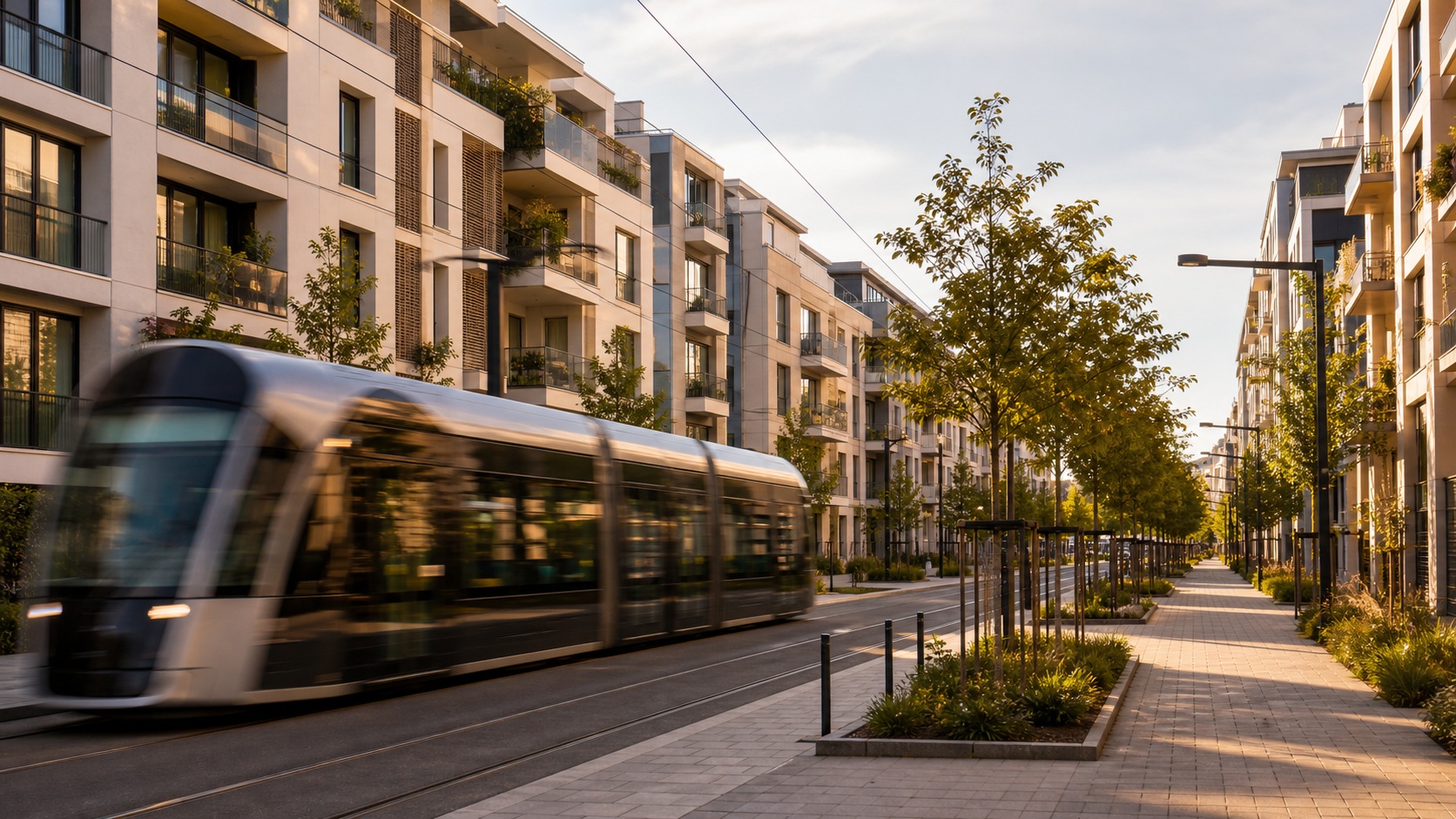
If I had to identify a single area that best represents the Luxembourg growth story in 2026, it would be the Cloche d'Or and Gasperich corridor. Prices in this area have risen from approximately €8,400 per square metre in 2023 to €9,800–€10,800 per square metre in early 2026 — a roughly 20 percent rise over three years. And in my view the growth is not finished. Two structural drivers continue to reinforce each other: the tram extension to Cloche d'Or that opened in 2024 has materially changed accessibility, and the continuing development pipeline of mixed-use commercial-residential projects is bringing a new employment-and-housing density that few European capitals can match.
What is interesting about Cloche d'Or is that the price growth has been broad-based rather than concentrated in a single building or street. New construction, older stock, small apartments, family-size apartments — all have moved roughly together. That is a sign of structural demand pressure rather than a localised supply shock. The remaining growth runway is probably another 15 to 20 percent over the 2026–2030 horizon, with the strongest expectations for the streets immediately around the tram stops and the planned new commercial centres.
Hotspot 2: Belair & Limpertsberg
The prime residential communes of Belair and Limpertsberg are the second clear growth story in 2026, but the dynamic is different from Cloche d'Or. These are already-expensive neighbourhoods (€11,000–€13,500 per square metre) that have moved back through their 2022 peaks during 2025 and are now setting new highs in 2026. The driver here is not infrastructure or development; it is fundamental scarcity of comparable stock. Belair adds perhaps 20 to 30 new properties to the market in a typical year. When the financial-sector hiring cycle accelerates — as it has done since late 2024 — and a new generation of high-income professionals enters the purchasing market, that scarcity compounds into measurable price pressure.
In my experience, the buyers who are now winning in Belair and Limpertsberg are the ones who move quickly on properties that genuinely fit their criteria, even when the asking price feels uncomfortable. The "I'll wait for a correction" buyers have spent the last three years watching their target neighbourhoods rise away from them. Belair is not where you find value in 2026 — but it is where you find durable demand and the lowest probability of post-purchase price disappointment.
Hotspot 3: Belval & Esch Periphery
The Belval expansion continues to be one of the most underrated growth stories in the country. The university campus, the research institutes, the technology incubators, and the steady flow of young professionals coming to work in the southern economic zone have pushed apartment prices in Belval and the surrounding parts of Esch-sur-Alzette and Differdange up from approximately €5,800 in 2023 to €6,500–€7,200 today — a 15 to 20 percent rise in three years from a much lower starting base.
What makes this area particularly interesting from an investment perspective is the yield profile. Gross rental yields on Belval-area apartments are currently 4.2 to 4.8 percent, compared with 3.0 to 3.5 percent on equivalent Luxembourg City properties. For investors who want both yield and growth potential, this combination is rare. The growth runway here looks robust through 2028 at minimum, driven by the continued expansion of the Belval campus, the planned high-speed rail upgrades to Luxembourg Gare, and the gradual repositioning of Esch-sur-Alzette from "secondary city" to "satellite financial centre."
Hotspot 4: Hollerich & the Luxembourg City Redevelopment Zone
Hollerich is one of those communes that fifteen years ago would not have appeared on any list of desirable Luxembourg City neighbourhoods. Today it is one of the most interesting transformation stories in the country. The redevelopment of the area around the train station and the planned mixed-use projects connecting Hollerich to Gare and to the broader central business district have made Hollerich a serious contender for buyers who want central-Luxembourg-City accessibility without paying Belair or Limpertsberg prices. Apartment prices have risen from roughly €7,800 in 2023 to €9,200–€9,800 today.
The growth catalyst here is the redevelopment density. Each new project that delivers in Hollerich raises the quality of the average neighbourhood property, which raises the floor on prices for everything around it. I expect another 10 to 15 percent of growth over the 2026–2030 horizon as the redevelopment matures and the area's reputation catches up with the reality of what it has become.
Hotspot 5: Bonnevoie (Tram Extension Beneficiary)
Bonnevoie has been gradually shedding its old reputation as a transitional working-class neighbourhood and emerging as one of the most genuinely interesting value plays in the centre of Luxembourg City. Apartment prices have risen from approximately €7,200 in 2023 to €8,400–€8,900 today. The driver is the tram extension that has progressively improved Bonnevoie's connectivity to Kirchberg, the Gare, and now Cloche d'Or, combined with a steady stream of renovations and small-scale new construction that has improved the average quality of housing stock.
What I find compelling about Bonnevoie in 2026 is that the area is at the stage where prices are clearly rising but the perception lag has not fully caught up. Buyers who looked at Bonnevoie three years ago and dismissed it would not necessarily recognise the area today — but the prices on athome.lu still partly reflect the old reputation rather than the new reality. That gap is closing, and the closure is the source of the growth.
Hotspot 6: Ettelbruck & the Northern Rail Corridor
This is the most speculative hotspot on the list, and I include it with that caveat clearly stated. Ettelbruck is the northern rail node serving Wiltz, Clervaux, and the broader Ardennes. The planned high-speed rail upgrades along the northern corridor — still subject to political and budget uncertainty — could dramatically improve commute times from the north to Luxembourg City. If those upgrades land roughly on schedule, Ettelbruck and the surrounding communes could revalue meaningfully over 2027–2030, with growth potential in the 6 to 8 percent annual range from a currently low base of €4,500–€5,200 per square metre.
If the upgrades slip — and infrastructure projects in Luxembourg have a mixed track record on schedule — then Ettelbruck stays roughly where it is, with modest 2 to 3 percent annual growth from population pressure alone. This is the kind of bet that suits a specific buyer profile: patient, comfortable with timing uncertainty, and able to hold through a wider growth range. It is not a bet I would recommend to someone with a three-year time horizon.
The Six Hotspots — at a Glance
| Hotspot | 2023 €/sqm | 2026 €/sqm | 3-year change | Primary driver |
|---|---|---|---|---|
| Cloche d'Or & Gasperich | 8,400 | 9,800–10,800 | +20% | Tram + dev. pipeline |
| Belair & Limpertsberg | 10,800 | 11,000–13,500 | +12–18% | Scarcity + hiring |
| Belval & Esch periphery | 5,800 | 6,500–7,200 | +15–20% | Belval expansion + yields |
| Hollerich | 7,800 | 9,200–9,800 | +18–22% | Redevelopment density |
| Bonnevoie | 7,200 | 8,400–8,900 | +18–24% | Tram + reputation lag |
| Ettelbruck / North | 4,200 | 4,500–5,200 | +7–24% (variable) | Speculative rail upgrade |

How to Identify a Rising Area Before the Headlines Catch Up
Reading rising-area signals is part discipline, part local knowledge. The structural indicators I watch most closely are these:
- Planned infrastructure — particularly tram extensions and rail upgrades. Infrastructure-led revaluation typically begins 18 to 24 months before the project opens and continues for 2 to 3 years after.
- Development pipeline density — when an area is delivering a steady stream of new construction projects, the floor on average property quality rises, which lifts prices for the whole neighbourhood.
- Employment-centre proximity — areas within 25 minutes of major employment hubs (Kirchberg, Cloche d'Or, Belval) have structural demand support that less-connected areas lack.
- Reputation lag — the most useful asymmetry in real estate is when an area's current reality has improved faster than the market's perception of it. Bonnevoie and Hollerich both fit this pattern.
- Comparable transaction velocity — when properties in an area are clearing faster (under 45 days) than the local average, that is a leading indicator of price growth in the next 12 months.
A Real Case Study: A Bonnevoie Buyer Who Read the Signals Right
An anonymised example: a client of mine purchased a 75 sqm two-bedroom apartment in Bonnevoie in early 2023 for €565,000 (€7,533 per sqm). At the time, the building was solid but the street was unremarkable. We discussed the case: tram extension imminent, neighbouring renovations underway, the long-term trajectory of Luxembourg City buyer migration toward Bonnevoie all visible in the data. He was nervous about the area's reputation; the math was clear.
In early 2026, a slightly smaller comparable apartment in the same building cleared at €640,000. His unit, with the renovations he has done in the meantime, would conservatively transact at €685,000–€720,000 today. That is roughly a 25 percent gain in three years, against a national average rise of approximately 8 to 10 percent over the same period. The win was not because he bought at the bottom of the market; he did not. The win was because he bought into a rising micro-market with two reinforcing structural drivers, while everyone else was still anchored to the area's old reputation.
Key Takeaways
- Luxembourg national price averages obscure substantial micro-market variation — six specific areas are rising materially faster than the rest.
- Cloche d'Or, Belair, Belval-area, Hollerich, and Bonnevoie are the five highest-conviction growth hotspots in 2026; Ettelbruck is the speculative northern bet.
- Tram extensions and infrastructure-led revaluation remain the single most reliable predictor of localised price growth.
- Reputation lag — when an area's reality has improved faster than the market's perception — is the highest-conviction asymmetry available to patient buyers.
- Three to five years is the right time horizon for capturing structural growth without being held hostage to short-term volatility.
Frequently Asked Questions
Is the whole of Luxembourg rising in 2026?
Not uniformly. The national average shows modest 3 to 4 percent annual growth, but that hides substantial micro-market variation. Six specific areas are rising at 5 to 8 percent annually; the rest of the country is flat to 2 percent annually, which is close to general inflation. National-average reporting is statistically honest but practically misleading for specific property decisions.
Is it too late to buy in Cloche d'Or or Belair?
Not necessarily. Cloche d'Or still has a 15 to 20 percent growth runway over the 2026–2030 horizon. Belair has less explosive growth potential but is structurally scarcity-supported, which makes it durably resistant to corrections. The right question is not "have I missed it" but "does the future risk-adjusted return match my time horizon and risk tolerance."
Which area has the best yield-plus-growth combination?
Belval and the Esch periphery offer the strongest combined yield-plus-growth profile in 2026. Gross rental yields are 4.2 to 4.8 percent (compared to 3.0 to 3.5 percent in central Luxembourg City), while growth potential is comparable. For investors prioritising total return rather than capital growth alone, this is the most interesting area in the country right now.
How do I get accurate transaction data for these areas?
The Observatoire de l'Habitat publishes commune-level reports, STATEC issues quarterly indices, and a professional valuation gives you the closest thing to actual transaction data for your specific micro-market. Portal asking prices (athome.lu, immotop.lu) reliably overstate clearing prices by 8 to 15 percent and are not a reliable trend indicator on their own.
Should I be worried about a correction in the hot areas?
A modest correction is always possible — 2023 showed how quickly Luxembourg prices can move when interest rates shock the market. But the structural drivers behind the six hotspots are durable enough that any correction would likely be shorter and shallower than the 2023 episode. Buyers with a five-year+ horizon should not be paralysed by correction risk in these areas.
What about areas not on this list?
Most of Luxembourg's other communes are growing in line with or slightly below national average — solid but unspectacular. That is not a bad outcome for a primary-residence buyer; "in line with average" still produces meaningful long-term value in a structurally supply-constrained market. The hotspots above are about outperformance, not about avoiding loss.
How quickly do these dynamics change?
Structural growth drivers play out over 3 to 5 years. By the time a hotspot is in headlines, the easy capture is usually past. The win comes from reading the structural signals (infrastructure, development pipeline, employment-centre dynamics) 18 to 24 months ahead of the price reflection. A free valuation conversation is the cleanest way to discuss specific properties against this framework.

Want to Position Yourself in a Rising Luxembourg Area?
A free conversation about your specific budget, time horizon, and goals can match you to the hotspot — or the under-the-radar pocket within one — where your money is most likely to work. No commitment, no sales pitch.
WhatsApp Daniela Get My Free Analysis
Multilingual support in English, French, and Italian. 13+ years tracking Luxembourg's micro-markets.
Conclusion
The Luxembourg market is not a single market — it is a constellation of micro-markets, each driven by its own structural forces. In 2026, six of those micro-markets are rising materially faster than the rest of the country, and the structural drivers behind each one are durable enough to support continued outperformance over the 2026–2030 horizon. For buyers, the right question is which hotspot fits their specific situation — budget, family, time horizon, risk tolerance. For sellers in these areas, the right question is whether to accept the current bid or hold for further appreciation. Both questions are answerable, but only against a specific property and a specific buyer profile. If you want a clear, professional read on where your particular situation fits in the 2026 hotspot map, the conversation costs nothing and the clarity is grounded in thirteen years of tracking these communes street by street.
Request a Free Luxembourg Property Valuation · Explore Investment Strategy · Full 2026–2030 Market Forecast