Ten years ago, the energy class on a Luxembourg property listing was a footnote — a letter buried at the bottom of the advertisement that almost no buyer read closely. Today it is one of the first three things a serious buyer checks, sitting alongside location and price. The 2026 market has quietly split into two tiers: energy-efficient homes in classes A and B that attract multiple offers and command a visible premium, and older, poorly-insulated homes in classes E, F and G that sit on the portals for months and sell only after a discount that reflects the renovation the buyer will inherit. If you own a property in the lower tier, the question is no longer whether energy performance matters to your sale price — it is whether you renovate before you sell, and how much of that cost the Klimabonus and related subsidies will hand back to you.
In my thirteen years on the Luxembourg market, I have watched this shift accelerate from a soft preference into a hard financial reality. Buyers are not being sentimental about the environment when they avoid a class F house — they are being rational about their heating bills, their mortgage conditions, and the retrofit invoice waiting for them. The good news for sellers is that Luxembourg's public subsidy framework, anchored by the Klimabonus scheme, is genuinely generous, and the renovations it supports frequently return more in resale value than they cost even after the grant. This guide walks you through which upgrades add the most value, how the subsidy logic works, and how to sequence a pre-sale renovation so it pays you back rather than draining you. It is the conversation I have with sellers who call me and say, "The agent told me my house is a class F — what does that actually mean for my price?"
- How the energy-class premium works in the 2026 Luxembourg market — and how wide the A/B-to-F gap has become
- What the Klimabonus scheme covers and the logic behind Luxembourg's renovation subsidies
- Which energy renovations deliver the highest return on resale value — and which rarely pay back
- How to sequence a pre-sale renovation so the grant and the sale price both work in your favour
- A realistic worked example of a class F house taken to class C before sale
- The mistakes sellers make with energy renovations and subsidy paperwork
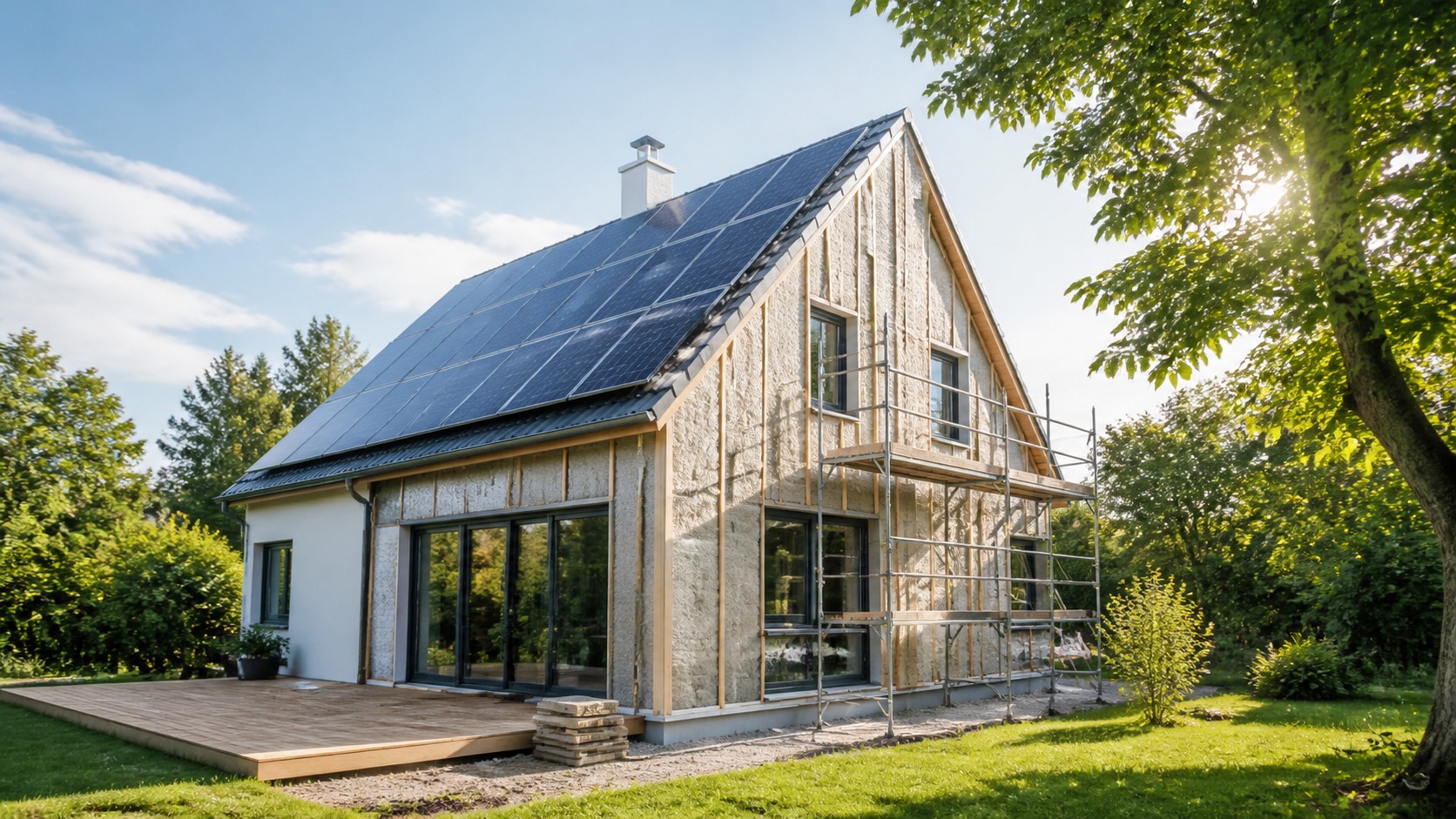
Why the Energy Class Now Decides Your Sale Price
Every property offered for sale or rent in Luxembourg must carry a valid energy performance certificate — the certificat de performance énergétique (CPE), known in German as the Energiepass. It grades the building on two axes, thermal insulation and primary energy demand, and reduces them to a class from A (excellent) to I (very poor). For years this certificate was a formality. It is now a price-setting instrument, and the reason is simple: buyers have learned that the class letter is a proxy for the two costs that hurt most after purchase — the monthly heating bill and the eventual renovation invoice.
Three forces have hardened this into a genuine premium. First, energy prices since 2022 taught an entire generation of buyers what a poorly-insulated house costs to heat through a Luxembourg winter. Second, banks financing purchases increasingly look favourably on energy-efficient homes, and some offer preferential "green" mortgage conditions for high-performing properties, which improves the affordability calculation for the buyer of an A or B home. Third, Luxembourg's building regulations have steadily raised the standard for new construction, so newer stock sets a reference point that makes older, unrenovated houses look expensive by comparison. The combined effect is that in 2026 the market pays a real, measurable premium for energy performance — and applies a real, measurable discount to the properties that lack it.
What surprises many sellers is the direction of causation. They assume a poor energy class simply "knocks a bit off" the price. In practice it does something more damaging: it shrinks the buyer pool. Younger buyers, buyers financing at the edge of their budget, and buyers who have done their homework on retrofit costs simply filter class F and G properties out of their search entirely. Fewer buyers means fewer competing offers, and fewer competing offers means a weaker final price — quite apart from the explicit renovation discount. A poor energy class costs you twice.
The Size of the Energy-Efficiency Premium in 2026
Let me put realistic numbers on the gap, with the honest caveat that these are ranges I observe in practice, not precise universal constants — every property is specific to its location, condition and layout. But the pattern is consistent enough to plan around. Between a top-tier class A or B property and a comparable class F or G property of the same size and location, the price gap in the current market typically runs in the region of 10% to 20% of value. On a home worth €900,000 in good energy condition, that is a spread of roughly €90,000 to €180,000 attributable to energy performance alone.
| Energy class | Buyer perception in 2026 | Typical price effect vs. a class C baseline |
|---|---|---|
| A / A+ | Highly sought; low running costs; green-mortgage friendly | Premium, in the region of +5% to +10% |
| B | Strongly reassuring; broad buyer appeal | Modest premium, roughly +2% to +6% |
| C / D | Acceptable; the market's practical middle ground | Baseline reference |
| E | Cautious; buyers mentally price the upgrade | Discount, roughly -3% to -8% |
| F / G | Narrow buyer pool; renovation burden priced in fully | Discount, in the region of -8% to -18% |
| H / I | Sells largely on land or gut-renovation value | Substantial discount; often valued as a project |
These figures are indicative rather than guaranteed, and the discount on a poor class is not linear — it accelerates at the bottom, because the buyer pool for a class G house is not just smaller but qualitatively different. You are no longer selling to the family who wants to move in and live; you are selling to a renovator or an investor who will strip the property back and who prices ruthlessly. Moving a house out of the F–G band and into C or better does not merely add the arithmetic difference in the table. It re-opens the property to the far larger pool of move-in buyers, and that expansion of demand is where much of the value actually comes from.
What the Klimabonus Scheme Actually Covers
Luxembourg's energy-renovation support is organised under the Klimabonus umbrella — the successor and evolution of the earlier PRIMe House framework — administered through the Ministry of the Environment, Climate and Sustainable Development and its energy agency, Klima-Agence. The philosophy behind it is straightforward: the state co-finances a meaningful share of the cost of measures that reduce a building's energy demand and carbon footprint, both because those measures serve national climate targets and because they lower the long-term running cost of the housing stock. For a seller, the practical effect is that the renovations most likely to raise your resale value are frequently the same ones the state will part-fund.
The scheme covers the core envelope and systems upgrades that move a building up the energy scale. In broad terms, and without quoting exact amounts that change with each budget cycle, the supported measures typically include:
- Thermal insulation of the building envelope — external wall insulation, roof and top-floor-ceiling insulation, and insulation of the base slab or cellar ceiling. These are usually the highest-impact measures for moving a class letter.
- Replacement of windows and exterior doors with high-performance glazing, generally as part of a broader insulation project rather than in isolation.
- Renewable and low-carbon heating systems — notably heat pumps (air-source and geothermal) replacing oil or gas boilers, as well as connection to district heating networks where available.
- Solar thermal and photovoltaic installations, which reduce bought-in energy and improve the primary-energy side of the certificate.
- Controlled mechanical ventilation with heat recovery, which supports both comfort and performance in a well-insulated building.
- An energy advisory step — an accredited energy consultant's assessment (the conseil en énergie) that plans the works coherently, which is itself supported and is often a condition of the more substantial grants.
The support is generally structured as a grant covering a percentage of eligible costs, with the more ambitious and deeper renovations — those that achieve a strong post-works energy class — attracting proportionally more support than isolated single measures. Enhanced rates have at various points been available for households on lower incomes, and complementary financing tools such as the state-backed climate loan (the prêt climatique) can spread the balance at favourable conditions. Because the precise percentages, ceilings and eligibility conditions are periodically revised, the single most important step before committing to any works is to confirm the current terms directly with Klima-Agence and to engage an accredited energy adviser who will both design the project and manage the subsidy application. I never quote a client a fixed grant figure from memory; the framework moves, and the adviser's role is precisely to lock down what applies on the day.
Which Renovations Deliver the Highest Resale Return
Not every energy renovation pays back equally at resale, and this is where sellers most often misallocate money. The instinct is to reach for the visible upgrade — a shiny new heating system, solar panels on the roof — when the highest-return work is frequently the least glamorous. Here is how I rank the measures by their contribution to sale value, with the crucial reminder that the right sequence for your property depends on its specific starting condition.
Insulation of the roof and top-floor ceiling is almost always the best first euro spent. It is comparatively inexpensive, hugely effective at reducing heat loss (heat rises), rarely disruptive, and it moves the certificate meaningfully. For a seller it is the definition of high-return, low-visibility work: the buyer will not admire it, but the energy class it helps produce is what draws them in.
External wall insulation is the heavyweight. It is the single most powerful lever for moving a poorly-rated house up several classes, but it is also the most expensive and the most disruptive, and it changes the building's external appearance. Where the numbers work — typically on a house deep in the F–G band where the class jump re-opens the move-in buyer pool — it can be transformative. Where a house is already class D or E, the cost of full wall insulation often exceeds the incremental value it adds, and lighter measures make more sense.
A heat pump replacing an old oil or gas boiler improves both the running cost and the primary-energy rating, and it aligns the property with where regulation and buyer preference are clearly heading. It carries strong subsidy support. It is a genuine value-add, though on its own it will not rescue a house whose envelope is leaking heat — a heat pump in an uninsulated shell is expensive to run and undersells its promise.
High-performance windows matter, but principally as part of an insulation strategy rather than a standalone fix. New windows in an otherwise uninsulated wall deliver less than buyers expect. Sequenced alongside envelope work, they complete the picture.
Photovoltaic panels improve the certificate and offer the buyer a visible, comprehensible benefit — lower electricity bills — which supports the emotional side of a sale. Their pure financial payback at resale is more variable, but as part of a coherent A/B-class package they reinforce the premium positioning.

How to Sequence a Pre-Sale Renovation So It Pays You Back
The difference between an energy renovation that adds value and one that merely spends money is almost always sequencing and restraint. The disciplined path I recommend to sellers has a clear order, and it starts with information rather than with a builder's quote.
- Start with a fresh CPE and an accredited energy adviser. Before you spend anything on works, you need to know your true current class and — more importantly — the cheapest route to the class jump that matters. An accredited adviser models which combination of measures moves you from, say, F to C for the least outlay, and this same adviser is your gateway to the Klimabonus application.
- Target the class threshold, not perfection. The value premium is not smoothly continuous; it steps up at the points where buyer perception shifts — most sharply on the way out of the F–G band and into the reassuring C-or-better territory. Spending to reach a strong C is usually far more cost-effective than chasing a marginal A that few buyers will pay the full theoretical premium for.
- Do the envelope before the systems. Insulate first, then size the heating system to the improved building. Installing a heat pump before insulating means paying for a larger unit than the finished house needs — and underselling the heat pump's efficiency.
- Secure the subsidy before the works, not after. The Klimabonus process has application steps and documentation requirements that must be respected in the correct order; engaging accredited professionals and confirming eligibility before committing to the works is what protects your entitlement.
- Keep every invoice and certificate for the buyer. A renovation dossier — the new CPE, the works invoices, the equipment certificates, the guarantees — is itself a selling asset. It tells the buyer the work was done properly and to standard, which is worth real money in their confidence and their offer.
The restraint matters as much as the sequence. I have seen sellers over-renovate — pouring money into an A-class specification on a house whose location will never command the top-tier price — and recover only part of the outlay. The goal of a pre-sale energy renovation is not the greenest possible house; it is the class jump that unlocks the widest buyer pool for the least cost. That is a narrower, more disciplined target, and it is the one that actually pays.
A Worked Example: From Class F to Class C Before Sale
Let me make this concrete with an illustrative example — figures rounded for clarity and specific to the situation, not a universal template. Consider a 1970s detached house in a solid commune just outside Luxembourg City, structurally sound but never meaningfully renovated: single-skin walls, an uninsulated roof space, original windows, and an ageing oil boiler. Its CPE comes back as class F. Comparable renovated houses of the same size in the same commune, in class C, are transacting in the region of €1,050,000. Our unrenovated class F house, priced honestly, would attract offers around €900,000 to €920,000 — and from a narrow pool of buyers, most of them renovators pricing the works pessimistically.
The owner engages an accredited energy adviser, who models the cheapest credible route to class C: full roof insulation, external wall insulation on the most exposed elevations, replacement of the worst windows, and a heat pump replacing the oil boiler. The gross cost of this package comes in, for illustration, in the region of €90,000. Against that, the Klimabonus grants and the supported advisory step return a meaningful share of the eligible cost — the exact figure depending on the measures and the terms in force, which the adviser confirms — bringing the net cost down materially. The works take a few months and are timed to complete ahead of a spring relaunch.
| Scenario | Energy class | Realistic sale outcome | Net cost of works |
|---|---|---|---|
| Sell as-is | F | ~€900,000–€920,000, narrow buyer pool | €0 |
| Renovate, then sell | C | ~€1,030,000–€1,050,000, broad buyer pool | ~€90,000 gross, materially less after Klimabonus |
The arithmetic tells one story and the market tells a richer one. On paper, the class jump adds roughly €120,000 to €140,000 of sale value against a gross works cost of around €90,000 — a positive return even before the subsidy, and a distinctly attractive one after it. But the number that does not appear in the table is the widened buyer pool: the renovated house sells to any family that wants to move in, competes for their offers, and is far less likely to stall on the portals. In my experience it is that expansion of demand, more than the raw price arithmetic, that makes the renovate-then-sell path the right one for a house deep in the F–G band. For a house already at D or E, the same maths often points the other way, and honest disclosure with an adjusted price is the better route.
The Mistakes Sellers Make With Energy Renovations
The energy-renovation path rewards discipline and punishes improvisation. The errors I see most often are consistent, and every one of them is avoidable.
Committing to works before securing the subsidy. The Klimabonus framework has a required order of steps, and engaging the right accredited professionals and confirming eligibility must come before the works begin. Sellers who hire a builder, complete the job, and only then look into grants frequently forfeit support they would otherwise have received. Always sequence the paperwork ahead of the hammer.
Renovating without a class target. Spending money on measures without modelling which class they will actually produce is how sellers end up having paid for an improvement that lands just short of the threshold that would have shifted buyer perception. The adviser's model is not bureaucracy; it is the difference between a renovation that pays and one that disappoints.
Over-renovating for the location. A top-tier energy specification on a house whose neighbourhood caps its ceiling price will not recover its full cost. Match the ambition of the renovation to what the location can ultimately command.
Doing systems before envelope. Installing a heat pump into an uninsulated house is the classic sequencing error — an expensive machine working against a leaking shell, delivering neither the running-cost saving nor the certificate improvement the seller imagined.
Losing the paperwork. The dossier of invoices, certificates and the fresh CPE is part of what you are selling. Buyers pay more, and negotiate less, when the quality of the work is documented and verifiable. A renovation with no paper trail invites the buyer's scepticism and their lower offer.
Key Takeaways
- The 2026 Luxembourg market pays a real premium for energy performance and applies a real discount to poor classes — the A/B-to-F/G gap typically runs in the region of 10% to 20% of value.
- A poor energy class costs you twice: an explicit renovation discount, and a shrunken buyer pool that weakens every offer.
- The Klimabonus scheme co-finances the core envelope and systems upgrades — insulation, high-performance windows, heat pumps, solar — that move a property up the energy scale, with deeper renovations attracting proportionally more support.
- Roof and wall insulation deliver the highest resale return; systems like heat pumps and solar reinforce the premium but should follow the envelope, not precede it.
- Sequence matters: fresh CPE and accredited adviser first, target the class threshold rather than perfection, secure the subsidy before the works, and keep every document for the buyer.
- Renovate-then-sell usually wins for a house deep in the F–G band; for a house already at D or E, honest disclosure with an adjusted price is often the better route.
Frequently Asked Questions
What is the Klimabonus and who administers it?
Klimabonus is Luxembourg's framework of state subsidies for energy renovation and low-carbon heating, administered through the Ministry of the Environment, Climate and Sustainable Development together with the national energy agency, Klima-Agence. It co-finances measures such as insulation, high-performance windows, heat pumps and solar installations. Because the exact rates and conditions are revised periodically, confirm the current terms with Klima-Agence and an accredited energy adviser before committing to any works.
Do I need a valid energy certificate to sell my property in Luxembourg?
Yes. Every property offered for sale or rent must carry a valid CPE (certificat de performance énergétique / Energiepass), and it must be disclosed to buyers. Beyond the legal requirement, the class it shows is now a genuine price-setting factor, so a valid, honest certificate is also in your commercial interest.
Is it worth renovating before selling, or should I sell as-is and let the buyer renovate?
It depends on your starting class. For a house deep in the F–G band, a targeted renovation to class C or better usually adds more value than it costs — partly through the higher price, and substantially through the far wider buyer pool it unlocks. For a house already at D or E, the incremental cost of major works often exceeds the value they add, and honest disclosure with an adjusted price is frequently the better route. Get a fresh CPE and an adviser's model before deciding.
Which single renovation adds the most value?
There is no universal answer, but roof and top-floor-ceiling insulation is almost always the best first euro spent — inexpensive, highly effective at cutting heat loss, and meaningful for the class letter. External wall insulation is the most powerful lever for a badly-rated house but also the costliest and most disruptive. The right measure depends on your property's specific weaknesses, which is exactly what an accredited energy assessment identifies.
How much of the renovation cost does the Klimabonus cover?
The support is structured as a grant covering a share of eligible costs, with deeper renovations that achieve a strong post-works class attracting proportionally more support than isolated single measures. Because the precise percentages, ceilings and eligibility conditions change with each budget cycle, I do not quote fixed figures — the accredited adviser managing your application will confirm exactly what applies to your project on the day.
Can I combine the Klimabonus with a loan?
Yes. Luxembourg offers complementary financing, including a state-backed climate loan (prêt climatique) that can spread the balance of renovation costs at favourable conditions alongside the grant. Your energy adviser or bank can walk you through how the grant and the financing fit together for your particular project.
Will a green mortgage really help my buyer?
Increasingly, yes. Banks financing purchases look favourably on energy-efficient homes, and some offer preferential conditions for high-performing properties. For the buyer of your renovated A or B home, that can improve their affordability and their willingness to meet your asking price — which is part of why the energy premium is real rather than theoretical.
How long before listing should I complete the renovation?
Aim to complete the works, obtain the new CPE, and assemble the documentation dossier before you launch the listing, so the property is presented from day one as the class it has become. Timing the completion to land ahead of a strong listing window — typically mid-January to early April, or mid-September to mid-November — lets you launch fresh into peak buyer activity rather than mid-works.
Wondering Whether to Renovate Before You Sell?
A free, written valuation grounded in real transaction data will tell you what your property is worth today in its current energy class — and what a targeted, Klimabonus-supported renovation could realistically add before you sell.
WhatsApp Daniela Get My Free Valuation
Multilingual support in English, French, and Italian. 13+ years in the Luxembourg market.
Conclusion
Energy performance has moved from the footnote of a Luxembourg listing to the front of the buyer's mind, and it now sets prices with a directness that would have seemed improbable a decade ago. For a seller with a well-rated home, that is pure upside — the market rewards you for it. For a seller with a class E, F or G property, it is a decision to be made deliberately rather than avoided: renovate to unlock the wider buyer pool with the Klimabonus sharing the cost, or disclose honestly and price for the class you have. There is no single right answer, only the answer that fits your specific property, its location, and its starting condition. What is never right is refusing to look at the number. Get a fresh certificate, get an accredited adviser's model, and decide with the facts in front of you. If you would like a clear read on where your property sits today and what the renovation maths looks like for your particular case, that conversation costs nothing and the clarity is genuine.
Request a Free Luxembourg Property Valuation · Explore Property Investment · Browse Available Properties