When an Italian family decides to move to Luxembourg, the first question is rarely about the house. It is about the children. Where will they go to school? Will they keep their Italian? Will they make friends, understand the teacher, feel at home? The same anxieties surface at every kitchen table: the fear that a move will cost the children their language, their confidence, or their sense of belonging. It rarely does — but only when the schooling and the neighbourhood are chosen with the family, and not just the salary, in mind.
Luxembourg is, quietly, one of the most welcoming places in Europe for an Italian family. There is a European School system that teaches Italian as a full mother-tongue section, a European Accredited School closer to the city, a lively network of Italian associations, a consulate that runs its own language and culture programme, and — this is the part people underestimate — an entire generation of long-established Italian-Luxembourgish families whose grandparents arrived in the 1950s and 1960s. You are not the first Italians here. You are joining a community that has been part of this country's fabric for seventy years. This guide is the conversation I have with every Italian family before they buy: how schooling really works, where the Italian community actually lives, and how to choose a neighbourhood that lets your children thrive in three languages without losing their fourth.
- How the Luxembourg public school system works — and why the trilingual model matters for Italian children
- The European School Italian mother-tongue section, and who is entitled to a place
- International and private options for families who want an English or Italian curriculum
- Where Luxembourg's Italian community actually lives, and which communes suit families best
- The Italian associations, consular courses, and cultural anchors that keep the language alive
- How to match your school choice to your neighbourhood and property budget
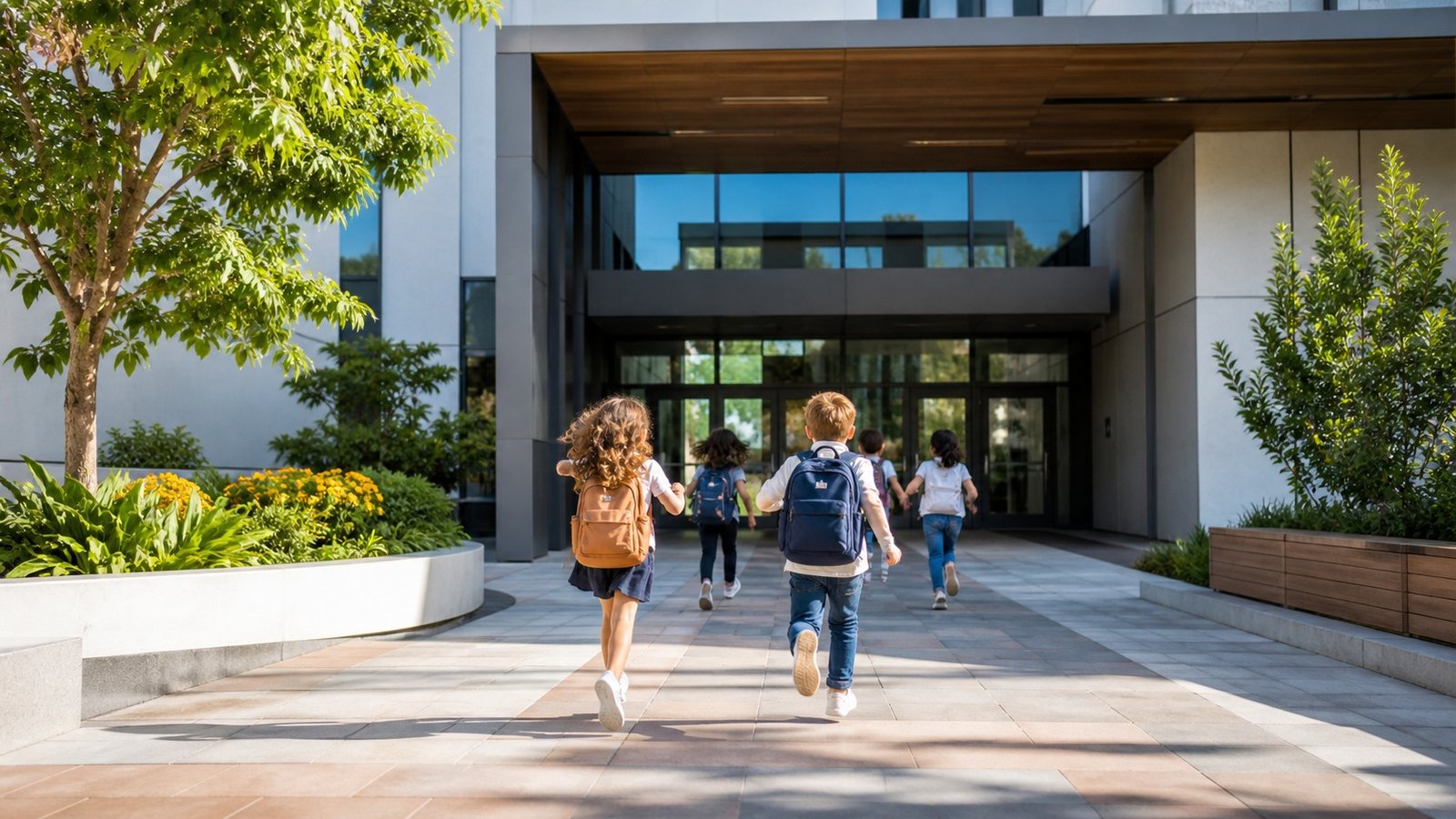
The Luxembourg Public School System — and What It Means for an Italian Child
Luxembourg's public school system is free, of high quality, and unlike anything most Italian families have encountered. Its defining feature is language. Children in the traditional public track are taught to read first in German (from around age six), add French a little later, and use Luxembourgish as the everyday spoken language of the playground and the early classroom. Italian is nowhere in that sequence. For a family arriving with an eight-year-old who speaks Italian and perhaps some English, the traditional public school is a genuinely demanding path — rewarding for younger children who arrive before the reading years, much harder for a pre-teen dropped into German-language literacy from a standing start.
This is the single most important thing I tell Italian families: the age of your child at the moment of arrival matters more than almost anything else. A three- or four-year-old entering the free public éducation précoce and préscolaire will absorb Luxembourgish and German the way children absorb everything at that age — effortlessly, and often to the point of correcting their parents within two years. A ten- or twelve-year-old faces a much steeper climb, because the system expects German-language literacy the child has never built. Neither situation is hopeless, but they call for very different choices, and pretending otherwise does families no favours.
The Luxembourg state has, to its credit, invested heavily in help for newly arrived children. There are dedicated reception classes (classes d'accueil), intensive language support, and a growing number of public and state-subsidised schools that teach partly in French and English rather than German — the so-called international public schools, which have transformed the options for families who cannot realistically enter the German-first track. For many Italian families, these French-and-English public schools are the single best-value solution in the entire country: high quality, genuinely free, and linguistically far kinder to a child arriving mid-childhood.
The European School and Its Italian Mother-Tongue Section
For many Italian families, the crown jewel is the European School system, which teaches Italian as a full mother-tongue language section. Luxembourg hosts two European Schools — one historically in Kirchberg and a second in Mamer, west of the city — and between them they run an Italian section (sezione italiana) where children are taught the core curriculum in Italian by Italian-qualified teachers, following a programme that leads to the European Baccalaureate, a diploma recognised across the EU and by Italian universities.
This is, for a child who arrives already literate in Italian, close to ideal. They continue their education in their mother tongue, keep pace with Italian grammar and literature, and simultaneously acquire French, English and German as school languages to a very high standard. The European Baccalaureate they graduate with opens doors to universities in Italy, across Europe, and beyond. Italian children can move here in their early teens, enter the Italian section, and graduate fully trilingual without ever losing the ability to write a proper Italian essay — something that would have been almost impossible in the traditional public track.
There is, however, a crucial eligibility distinction that catches families out. European School places are allocated in categories. Children of staff of the EU institutions (Category I) have guaranteed, largely fee-free access. Everyone else — Category III, which includes most privately employed Italian professionals — may apply for remaining places, pays fees, and is subject to availability, which for popular sections and year groups can be tight. If you work for an EU institution, the Italian section is almost certainly your answer. If you do not, it is worth pursuing but should never be your only plan.
International and Private Schools: The English and Italian Curriculum Routes
Beyond the public and European systems, Luxembourg has a substantial private and international school sector, and for some Italian families it is the right fit — particularly those who arrive on a defined contract, who think in English at work, or who want the continuity of a single curriculum in case the family moves country again in a few years.
The offering includes British-curriculum schools leading to IGCSE and A-levels, schools offering the International Baccalaureate, French-programme private schools, and a small number of institutions with a specifically international, English-medium ethos. Fees vary widely by school and age group but, to be realistic, families should budget in the region of €15,000 to €30,000 per child per year for the established private international schools, with the upper end for senior years. That is a serious commitment — often the difference between a smaller apartment near the city and a house with a garden a little further out — and it deserves to be weighed against the fact that Luxembourg's free public and low-cost European options are genuinely excellent.
Below is a simplified comparison of the main schooling routes as an Italian family typically weighs them. Treat the figures as indicative ranges for 2026, not fixed prices — every school sets its own fees and every child's needs differ.
| School route | Main languages | Indicative annual cost | Best suited to |
|---|---|---|---|
| Traditional public school | Luxembourgish, German, French | Free | Young children (under ~6) arriving early |
| International public school | French & English (German optional) | Free | Children arriving mid-childhood; best overall value |
| European School (Italian section) | Italian + FR/EN/DE | Free (Cat. I) / fees for others | Italian-literate children; EU-institution families |
| Private / international school | English or French curriculum | ~€15,000–€30,000 | Fixed-term contracts; globally mobile families |

Keeping Italian Alive: Consular Courses and Mother-Tongue Support
Even for children in the Italian section of a European School, keeping the language rich and correct takes deliberate effort once they are surrounded by French and English all day. For children in public or international schools who are not receiving Italian instruction, it takes real intention — and this is where Luxembourg's Italian infrastructure quietly earns its keep.
The Italian Consulate in Luxembourg, together with Italian cultural bodies, has long supported Italian-language and culture courses (historically known in Italian community circles as the corsi di lingua e cultura italiana) aimed precisely at children of Italian families abroad, so that a child growing up in French and Luxembourgish does not lose the ability to read, write and think in Italian. These courses are typically run outside normal school hours and are designed to complement, not replace, mainstream schooling. For a family whose children attend a public school, they are often the difference between a child who merely speaks kitchen Italian and one who can sit a formal exam or study at an Italian university one day.
Beyond formal courses, the practical advice I give every Italian family is the same one linguists give: protect the home language ferociously. Speak Italian at home, read Italian books, keep Italian television and podcasts in the house, and let the grandparents in Italy hold long video calls. Children in Luxembourg comfortably carry four languages when the home language is defended. It only withers when parents, wanting to help the child integrate, switch to French at home — a well-meant mistake that can cost a family their children's fluent Italian.
The Italian Community: Seventy Years Deep
Italians are not newcomers to Luxembourg — they are one of its founding immigrant communities. From the 1890s and especially through the post-war years, Italians came to work the steel mills of the south, and their descendants are woven through Luxembourgish society today: in politics, business, the professions, and — reliably — in the country's best restaurants and bakeries. Italian remains one of the most commonly heard languages in the Grand Duchy, and Italian nationals and dual citizens number in the tens of thousands. When you arrive, you are not starting a community. You are joining an old and confident one.
That depth translates into practical warmth. There are Italian associations across the country — regional clubs (Calabrian, Sicilian, Pugliese and others), cultural circles, professional networks, and parish communities where Italian is spoken. The southern towns in particular — Esch-sur-Alzette, Dudelange, Differdange, Bettembourg — carry a strong, lived-in Italian identity that dates to the steel era, with delicatessens, cafés and social clubs that have been family-run for generations. In Luxembourg City itself, the Italian presence is more professional and dispersed but no less real, anchored by the consulate, the Italian cultural institute's activities, and a dense network of Italian-owned businesses.
For a newly arrived family, this matters enormously. It means your children will have Italian-speaking friends, that a Sunday can be spent among people who understand exactly why you cook the way you do, and that the loneliness that shadows so many international moves is far shorter here. Families who arrive knowing no one can find, within a season, that their weekends are fuller than they were in Italy.
Where to Live: Matching Neighbourhood to School and Community
Once the schooling question is provisionally answered, the neighbourhood follows from it — and this is where my work as an agent and the family's real life meet. The right commune depends on which school you have secured, whether you value proximity to the Italian community, and, inevitably, your budget in a market that in 2026 sits roughly ten to fifteen percent below the 2022 peak, with transaction volumes recovered and mortgage rates eased from their highs.
If your children are entering a European School, geography is dictated by campus: families oriented to the western campus gravitate to Mamer, Capellen, Strassen and Bertrange, which offer houses with gardens and short commutes; families tied to the Kirchberg side look at Kirchberg itself, Weimershof, Neudorf and the eastern city. If you have chosen an international public or private school, the calculus opens up considerably. And if belonging to the historic Italian community is a priority — particularly for families with roots in the south of Italy — the southern communes offer both affordability and cultural familiarity that the capital cannot match.
| Area | Character for Italian families | Indicative house price | School fit |
|---|---|---|---|
| Mamer / Capellen / Bertrange | Green, family-friendly, international | In the region of €1.1m–€1.7m | Western European School |
| Strassen | Central, well-connected, mixed | In the region of €1.0m–€1.5m | Flexible — near several options |
| Kirchberg / eastern city | Urban, professional, apartments | Apartments ~€850k–€1.4m | Kirchberg European School; EU staff |
| Esch / Dudelange / Differdange (south) | Strong Italian roots, best value | Houses ~€650k–€950k | Public & international public schools |
The southern communes deserve a special word. For an Italian family watching the budget — and most families are — Esch-sur-Alzette and its neighbours offer a house with a garden for what a cramped apartment costs in Belair, a deep-rooted Italian community, an easy fifteen-to-twenty-five-minute train to the capital, and the country's most improved international public schooling on the doorstep. For many of the families I advise, the south is not the compromise it is sometimes assumed to be. It is the smart choice.
Daily Life: Food, Faith, Football and Belonging
Integration is not only schools and square metres. It is the texture of a week. And here Luxembourg gives Italian families an unusually soft landing. Good Italian ingredients are everywhere — not tourist-grade approximations but the real thing, because the community that sells them has been eating it for three generations. Italian delicatessens, proper espresso bars, family trattorie and Italian bakeries are woven through the south and well represented in the capital. Sunday football, whether followed on Italian channels or played on local pitches, has a natural home. Parish life, for families who value it, includes communities where Mass and social life run partly in Italian.
What surprises many arriving families is how little they have to give up. The distance to Italy is short — a flight to Milan, Rome or the south is a couple of hours, and many families drive down for the long summer break. Grandparents visit for weeks at a time. The children grow up genuinely Luxembourgish and genuinely Italian, switching between a Luxembourgish playground, a French classroom, an English friendship group and an Italian dinner table without ever experiencing it as a strain. That easy plurality — being fully of two worlds rather than caught between them — is, to my mind, the finest thing Luxembourg offers an Italian family.
Key Takeaways
- The age of your child at arrival is the single biggest factor in school choice: young children thrive in the free public system; older children usually do better in international public or European Schools.
- The European School's Italian mother-tongue section is close to ideal for Italian-literate children — but eligibility and section availability must be confirmed before you choose where to live.
- Luxembourg's free international public schools (French and English) are often the best-value solution for children arriving mid-childhood.
- Keeping Italian alive takes deliberate effort — consular language-and-culture courses plus a fiercely protected Italian-speaking home.
- The Italian community is seventy years deep and fully integrated, strongest in the southern communes, which also offer the best property value.
- Choose the school first, then the neighbourhood, then the house — never the other way round.
Frequently Asked Questions
Can my child study in Italian in Luxembourg?
Yes. The European School system runs an Italian mother-tongue section where the core curriculum is taught in Italian, leading to the European Baccalaureate. Access is guaranteed and fee-free for children of EU-institution staff; other families may apply for available places and pay fees. Outside that, consular Italian language-and-culture courses support children in mainstream schools.
Is the Luxembourg public school system good for an Italian child?
It is excellent and free, but its traditional track teaches literacy first in German, then French, with Luxembourgish spoken throughout — demanding for a child arriving after around age six with no German. Younger children absorb it beautifully. For older arrivals, Luxembourg's free international public schools (French and English) are usually a far gentler and equally high-quality route.
How much do private international schools cost in Luxembourg?
Budget in the region of €15,000 to €30,000 per child per year for the established private international schools, with senior years at the upper end. It is a significant commitment, and worth weighing carefully against the genuinely excellent free public and low-cost European options before assuming private is necessary.
Where do most Italian families live in Luxembourg?
The historic heart of the Italian community is in the south — Esch-sur-Alzette, Dudelange, Differdange, Bettembourg — dating to the steel era, with strong cultural roots and the best property value. Professional Italian families also settle around the capital and near the European School campuses in the west (Mamer, Capellen, Strassen, Bertrange) and east (Kirchberg).
Will my children lose their Italian if we move to Luxembourg?
Not if you protect it. Children here comfortably carry four languages when Italian is defended at home — spoken exclusively at home, reinforced with Italian books, media and long calls to grandparents, and supported by consular courses or an Italian school section. Italian typically fades only when parents switch to French at home in a well-meant but counterproductive effort to help integration.
How far is Luxembourg from Italy for visiting family?
Close enough that it rarely feels like emigration. Direct flights reach Milan, Rome and other Italian cities in roughly two hours, and many families drive to the north or centre of Italy over the long summer break. Grandparents visiting for extended stays is a normal rhythm of Italian family life here.
Is there Italian cultural and community life beyond school?
Very much so. Luxembourg has regional Italian associations (Calabrian, Sicilian, Pugliese and others), cultural circles, professional networks, Italian parishes, delicatessens, cafés and social clubs — densest in the southern towns but well represented in the capital. For a newly arrived family it means Italian-speaking friends and a genuine community from the first months.
Should I buy a house before or after sorting out schools?
After. Confirm your school place and, for a European School, which campus, before committing to a property — because the wrong assumption about school location can turn a short walk into a daily cross-town commute. Sort the school, then choose the neighbourhood that serves it, then find the house.
Moving Your Family to Luxembourg? Let's Find the Right Home Near the Right School
Choosing a neighbourhood around a school, a commute and an Italian community is exactly the kind of decision I help families get right. As a native Italian speaker, I can walk you through the schools, the communes and the properties that fit your life — not just your budget.
WhatsApp Daniela Browse Family Homes
Multilingual support in English, French, and Italian. Affiliated with RE/MAX One.
Conclusion
Moving an Italian family to Luxembourg is not a leap into the unknown — it is a step into a country that has quietly kept a place for Italians for seventy years. The schools are among the best in Europe, the language paths are real and navigable, and the community that greets you is old, warm and fully at home. The families who settle happiest are the ones who plan in the right order: understand the schooling for their children's ages, protect the Italian at the dinner table, choose the neighbourhood that serves the school and the community, and only then find the house. Do it in that order, and your children will grow up carrying Italy with them while becoming completely at home in the Grand Duchy. That is not a compromise. It is the best of both.
Browse Family Homes in Luxembourg · Get a Free Property Valuation · Explore Investment Options