When buyers tell me they want to "buy something affordable in Luxembourg", I have learned to ask them what they mean. Affordable relative to Belair, where prices comfortably exceed €11,000 per square metre? Or affordable in absolute terms, with a total budget under €500,000? Both definitions are valid, but they point to very different parts of the country. In a market where the national average price per square metre stands at around €8,329 in early 2026 and Luxembourg City prime neighbourhoods routinely transact above €10,000 per square metre, there are still communes where well-located, properly-built properties trade between €4,800 and €6,500 per square metre. These are not the famous addresses on the front page of athome.lu — but for buyers who care more about real value than postcodes, they are some of the smartest property decisions available in Luxembourg today.
This guide is the result of thirteen years walking the south, the Moselle valley, the north, and the western corridor with buyers who needed Luxembourg to work for them at a price point Luxembourg City alone could never deliver. I will take you through seven communes where 2026 prices, commute times, growth potential, and quality of life genuinely line up. For each, you will find the current price band, the typical property profile, the realistic commute to the financial district, and an honest assessment of where the value sits — and where the catch is. Budget areas in Luxembourg are not a compromise; they are a different optimisation. If you understand what you are optimising for, the budget map of the Grand Duchy opens up in ways most buyers never realise.
- What "budget" really means in the Luxembourg 2026 market — and what it does not
- Seven communes where prices remain below €6,500/sqm with quality housing stock
- Realistic commute times, transport infrastructure, and lifestyle trade-offs for each
- What €450,000 to €550,000 actually buys you in each area
- Which budget areas have the strongest five-year growth profiles
- The three mistakes buyers most often make when shopping the budget map
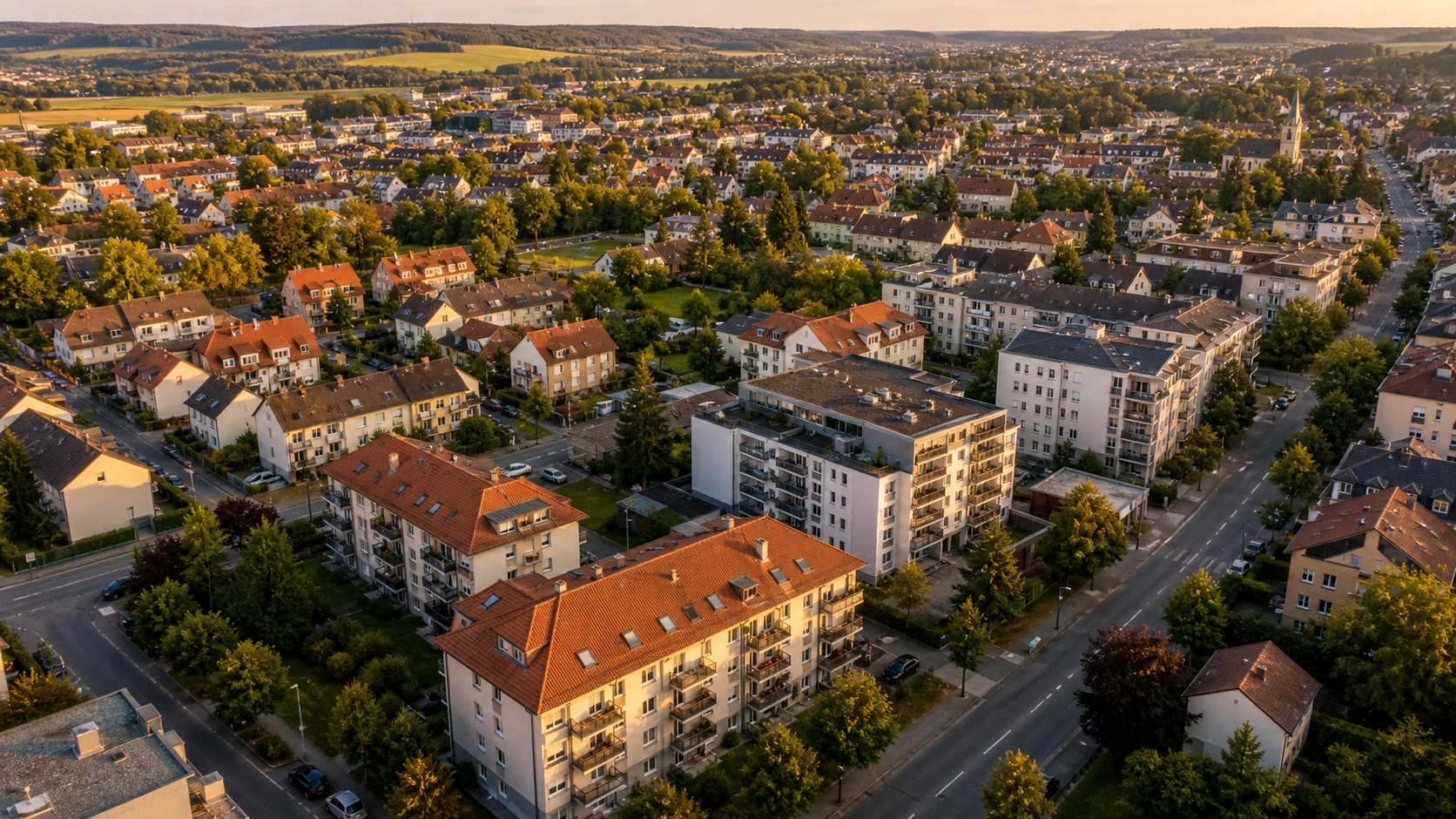
What "Budget" Actually Means in Luxembourg 2026
Before we get to the communes, a brief reality check. "Budget" in the Luxembourg context does not mean cheap in any absolute sense. The communes I will walk you through still transact between €4,800 and €6,500 per square metre — twenty to forty percent below national average, but still well above what comparable property would cost in surrounding regions of France, Belgium, or Germany. What you are buying is a Luxembourg postcode, the legal and tax framework of a Luxembourg resident, and access to the country's wage levels, mortgage products, and public infrastructure. That premium is real, and it is not going to vanish.
What "budget" actually means in 2026 is this: communes where the price-quality frontier remains genuinely favourable for buyers willing to accept either a longer commute, a less prestigious address, or a property that needs modest cosmetic work. None of these are bad trades. In my experience, buyers who lock themselves into Luxembourg City or its immediate ring frequently overpay by twenty to thirty percent for what is essentially the same housing quality available fifteen to twenty minutes further out. The communes below are where that arbitrage still exists.
Dudelange — €5,200–€5,800 / sqm
Dudelange is the country's fourth-largest commune and, in my view, the most underrated value play in the Luxembourg south. Apartment prices currently sit between €5,200 and €5,800 per square metre — roughly thirty-five percent below the national average. Family houses trade between €750,000 and €1,150,000 depending on size and condition, which sounds significant until you compare with equivalent houses in Hesperange (often above €1,500,000) or Strassen (above €1,800,000).
What you get for the price: a well-served small town with its own train station on the Luxembourg–Bettembourg–Thionville line (reaching Luxembourg Gare in eighteen minutes by direct train), a complete commercial centre, decent schools, and the regenerated Italian-heritage cultural identity that gives Dudelange a character most suburbs simply do not have. The Italian community presence is strong, which makes the commune particularly comfortable for Italian-speaking buyers — a niche I work with frequently.
The catch: Dudelange is not on the Luxtram network and will not be for the foreseeable future. Connectivity is rail-and-car, not tram. For buyers who work in Kirchberg or Cloche d'Or, this means a connection at Luxembourg Gare. For buyers who can work hybrid or whose office is in the south of the country, this is not a constraint.
Differdange — €5,200–€5,800 / sqm
Differdange sits at the western edge of the southern industrial belt and offers prices nearly identical to Dudelange but with a slightly different lifestyle profile. The town is anchored by the regenerated Differdange Castle area and the proximity of the Belval university campus and business district just one stop away by train. Apartment prices range from €5,200 to €5,800 per square metre; family houses sit between €700,000 and €1,000,000 for a typical mid-renovation three-bedroom.
What I find most compelling about Differdange in 2026 is the demographic trajectory. The Belval expansion — university, research, and emerging tech businesses — is pulling young professional renters who eventually become buyers. This commune has seen one of the strongest rental yield improvements in the country over the last three years (from approximately 3.8% to 4.6% gross on standard apartments), which is the kind of pattern that typically precedes capital growth. For investors, this is one of the most interesting yield-plus-growth profiles in Luxembourg right now.
Train connectivity to Luxembourg Gare is good — 22 to 28 minutes depending on service. The catch is the same as Dudelange: no tram, so the final-mile to Kirchberg or Cloche d'Or requires a transfer.
Esch-sur-Alzette — €5,800–€6,500 / sqm
Esch is Luxembourg's second city and the gateway to the Belval economic zone. Prices have risen meaningfully over the last three years — from around €5,300 in 2023 to €5,800–€6,500 today — but Esch still offers a different proposition from Luxembourg City. You get a real city centre with proper urban density, a complete transport hub (train, bus, soon-extended tram), one of the strongest student and young-professional rental markets in the country, and proximity to the French border for cross-border buyers.
The Esch market splits clearly into two segments. Central Esch (Brill, Centre, around the train station) commands €6,200–€6,800 and has limited supply. Peripheral Esch (Lallange, Neudorf, the southern slopes) is meaningfully cheaper at €5,400–€5,900 and offers houses with gardens at prices Luxembourg City cannot match. For buyers willing to live in peripheral Esch, this is one of the strongest value-to-quality propositions available in the country.
The catch for Esch is that the tram extension to the city — long planned — is still years from operational reality. When it arrives, Esch property values will revalue meaningfully. The question is whether you want to buy before or after that revaluation, and the answer depends on your time horizon.
The Bettembourg–Roeser Corridor — €5,500–€6,200 / sqm
The corridor running through Bettembourg, Roeser, Crauthem, Berchem and the surrounding communes is one of the quietest value plays in the country and one I recommend often to families. Apartments sit at €5,500 to €6,200 per square metre; family houses with proper gardens trade between €850,000 and €1,250,000 for a comfortable four-bedroom — versus €1,400,000+ for equivalent stock in Hesperange or Howald.
The Bettembourg train station is the corridor's anchor. From Bettembourg, you reach Luxembourg Gare in eight to twelve minutes on direct trains running every fifteen to twenty minutes throughout the day. This is genuinely better commuter connectivity than parts of Luxembourg City itself, where bus-and-walk routes can take longer. For families with school-age children, the corridor's schools are well-regarded, the green space is abundant, and the community has the small-town character that Luxembourg City suburbs no longer offer.
This is also Daniela Pelliccia's home territory — Roeser-based, with deep familiarity with every commune in the corridor. If you are a buyer evaluating this area, a conversation about specific streets and properties can save you considerable time.
Wasserbillig and the Moselle Communes — €4,800–€5,500 / sqm
The Moselle valley — Wasserbillig, Mertert, Grevenmacher, Wormeldange, Remich — offers the lowest entry prices in Luxembourg for buyers willing to commit to a more rural lifestyle and a longer drive to the financial district. Apartment prices range from €4,800 to €5,500 per square metre, the lowest in the country for permanent residence stock. Family houses with riverfront views or vineyard proximity can trade between €650,000 and €950,000 — territory that simply does not exist within the central Luxembourg ring.
What you are buying is a different version of Luxembourg: the wine country, the German-language fluency that defines the east, the slower pace, and genuinely some of the most beautiful natural settings in the country. The catch is the commute. Wasserbillig to Kirchberg is forty to fifty-five minutes by car in peak hours, or about forty minutes by train via Luxembourg Gare. For buyers who work hybrid two or three days a week, this is acceptable. For five-day-a-week central commuters, it is brutal.
The Moselle communes also have a secondary-residence market that affects prices — German and Luxembourg buyers using these properties as weekend getaways. If you are buying as a primary residence, factor in the fact that some of your neighbours will not be there year-round.
Pétange — €5,400–€6,000 / sqm
Pétange sits at the western corner of the south where Luxembourg meets Belgium and France, and it offers one of the most interesting cross-border buyer profiles in the country. Apartment prices range from €5,400 to €6,000 per square metre; family houses trade between €750,000 and €1,100,000. The town's character is mixed — part industrial heritage, part residential commuter belt — but the train connectivity (Pétange to Luxembourg Gare is roughly 22 minutes on direct services) is solid.
What makes Pétange distinctive is the strong French and Belgian frontalier population, which gives the town a different cultural mix from other budget communes. The schools handle multiple languages competently, the commercial centre is functional, and the surrounding green belt is genuinely attractive. For buyers with family or work ties across the Belgian or French borders, Pétange offers a logistically clean position.
Wiltz and the Northern Communes — €4,500–€5,200 / sqm
If you are willing to commit to a genuinely rural northern Luxembourg lifestyle, the Ardennes communes — Wiltz, Clervaux, Ettelbruck, and surrounding villages — offer the lowest entry prices in the country. Apartments at €4,500 to €5,200 per square metre, family houses with substantial land at €550,000 to €850,000 for properties that would clear €1.5 million south of the capital.
I am candid with buyers about this option: the commute is real. Wiltz to Luxembourg City is forty-five minutes to an hour by car and longer by public transport. For buyers who can work primarily remote, who value substantial property and natural surroundings, and who genuinely enjoy small-town life, the value here is extraordinary. For buyers who need to be in Kirchberg by 8:30 AM five days a week, this is not the answer.
The Ettelbruck rail node is the brightest hope for the northern communes. With high-speed rail upgrades planned, commute times will improve meaningfully over the 2026–2030 horizon, which is the kind of infrastructure-led revaluation that can transform property values within five years.
Budget Areas at a Glance — 2026
| Commune | €/sqm | Commute to Lux Gare | Best for |
|---|---|---|---|
| Dudelange | 5,200–5,800 | 18 min train | Italian-community buyers, families |
| Differdange | 5,200–5,800 | 22–28 min train | Yield-focused investors |
| Esch-sur-Alzette | 5,800–6,500 | 15–20 min train | Urban-density seekers, students |
| Bettembourg–Roeser | 5,500–6,200 | 8–12 min train | Families with children |
| Wasserbillig / Moselle | 4,800–5,500 | 40 min train | Hybrid workers, lifestyle buyers |
| Pétange | 5,400–6,000 | 22 min train | Cross-border (BE/FR) buyers |
| Wiltz / North | 4,500–5,200 | 50–70 min mixed | Remote workers, large-property seekers |
What €450,000 to €550,000 Actually Buys You in 2026
To make this concrete, here is what a €450,000–€550,000 budget realistically buys across the seven areas:
- Dudelange: A renovated 75–85 sqm two-bedroom apartment in a quiet street, or an unrenovated small terraced house needing €50,000 of work.
- Differdange: A modern 80–95 sqm two- or three-bedroom apartment near the train station or castle, often with a small balcony or terrace.
- Esch peripheral: A 75–90 sqm two-bedroom apartment in good condition, or a small townhouse needing modest renovation.
- Bettembourg/Roeser: An 80–95 sqm apartment in a recent build, or the deposit + 25% of a family house in this corridor.
- Wasserbillig/Moselle: A 95–115 sqm two- or three-bedroom apartment, sometimes with river views and outdoor space.
- Pétange: An 85–100 sqm apartment in good condition, or a small townhouse with garden in the older part of town.
- Wiltz/North: A 100–130 sqm three-bedroom apartment, or a small detached house with garden in a village.
Notice the pattern: as the price per square metre falls, the size you can afford increases meaningfully. €500,000 buys you 70 sqm in central Luxembourg City — the same money buys you 110 sqm in the Moselle. That delta is not a small consideration for growing families.
Which Budget Areas Have the Strongest Five-Year Growth Profiles?
For buyers thinking beyond pure affordability, here is my honest ranking of growth potential in these seven areas over the 2026–2030 horizon:
- Esch-sur-Alzette — Tram extension when it arrives will revalue the city meaningfully. 4–6% annual growth over five years is plausible.
- Differdange — Belval expansion continues to drive demand. 3.5–5% annual growth likely.
- Bettembourg–Roeser corridor — Strong fundamentals already partly priced in, but family-buyer demand continues to outpace supply. 3–4.5% annually.
- Wiltz/North — Speculative bet on rail-infrastructure upgrade. If the upgrades land, growth could be 5–7% annually; if delayed, growth stays at 2–3%.
- Dudelange — Solid 3–4% annual growth driven by demographic and commute fundamentals.
- Pétange — 2.5–3.5% annual growth. Quiet but steady.
- Wasserbillig/Moselle — Lowest growth rate (2–3% annually), but offset by the lowest entry price.
The Three Mistakes Budget-Area Buyers Most Often Make
Mistake one: underestimating the commute. A twenty-minute train ride looks innocent on paper, but factor in walking to the station, waiting, the train itself, and walking from Luxembourg Gare to your office — and you are at fifty to sixty minutes one way. For a five-day office worker, that is two hours a day, ten hours a week, of life consumed by commuting. Make sure the trade is one you will actually accept.
Mistake two: assuming budget areas have weaker amenities. They do not, generally. Dudelange, Esch, and Bettembourg have complete commercial centres, decent schools, and proper community infrastructure. Some are genuinely more liveable than parts of central Luxembourg City, where amenities are concentrated in specific pockets.
Mistake three: over-leveraging because "the property is cheap". A €500,000 property is still a €500,000 property, with its own transaction costs (8–11%), maintenance burden, and exposure to local micro-market dynamics. The Bëllegen Akt tax credit, the deposit requirement, the mortgage approval criteria — none of these change because the property is in a budget commune.
Key Takeaways
- "Budget" in Luxembourg 2026 means €4,500–€6,500 per square metre — twenty to forty percent below national average, but still well above surrounding regional pricing.
- The seven communes covered here offer genuine value-to-quality trades for buyers willing to accept longer commutes, less prestigious addresses, or modest renovation.
- The Bettembourg–Roeser corridor offers the best combination of commute, family-friendliness, and price for young families.
- Esch-sur-Alzette has the strongest five-year growth profile, driven by eventual tram-extension revaluation.
- The Moselle communes offer the lowest entry prices but the longest commutes.
Frequently Asked Questions
What is the cheapest commune in Luxembourg to buy a property in 2026?
For permanent residence properties, the northern communes (Wiltz, Clervaux, parts of Ettelbruck) offer the lowest entry prices at €4,500–€5,200 per square metre. The Moselle communes (Wasserbillig, Mertert) are similar at €4,800–€5,500. Both come with materially longer commutes than the southern and central budget options.
Is buying in a budget area a bad investment?
Not necessarily. Areas like Differdange and Esch-sur-Alzette currently offer some of the strongest yield-plus-growth profiles in the country. The structural housing deficit affects budget areas as much as prime ones. The investment question is not "premium vs budget" — it is "which area's fundamentals align with my time horizon."
How long does a typical commute take from these areas to Kirchberg?
Bettembourg to Luxembourg Gare is 8–12 minutes by train, then 12–18 minutes by tram to Kirchberg — total roughly 25–35 minutes door-to-door. Esch is 30–40 minutes total. Dudelange 35–45 minutes. Wasserbillig 50–70 minutes. Wiltz 60–80 minutes. These are realistic peak-hour estimates.
Can foreigners buy in these communes?
Yes. Luxembourg has no restrictions on foreigner property purchases nationally — the rules are the same for residents and non-residents. Mortgage access for non-residents is meaningfully tighter than for residents (typically 60–70% LTV maximum versus 80%+ for residents), but the legal right to buy is identical.
What about the Bëllegen Akt tax credit — does it apply to budget areas?
Yes, the Bëllegen Akt registration tax credit (currently up to €40,000 per person, €80,000 per couple) applies to any primary residence purchase in Luxembourg regardless of commune. On a €500,000 budget-area purchase, this credit substantially reduces effective acquisition costs and is one of the most important seller- and buyer-side variables to understand.
Should I buy now or wait for prices to fall further?
In my judgement, the 2026 market is balanced rather than overheated, and prices in the budget areas covered above are unlikely to fall meaningfully from current levels. The structural housing deficit affects every Luxembourg commune. The "wait for a correction" strategy has cost more buyers money than it has saved over the last decade. Buy when the specific property and price are right for you, not on macro timing.
Where can I find genuinely accurate prices for these areas?
The Observatoire de l'Habitat publishes commune-level price reports, STATEC indices give national context, and a professional valuation gives you the closest thing to actual transaction data. Portal asking prices (athome.lu, immotop.lu) reliably overstate clearing prices by 8–15%. A free valuation conversation is the cleanest way to anchor your budget against reality.
Shopping the Luxembourg Budget Map? Let's Find the Right Match
Every budget commune in Luxembourg has its own personality, its own commute profile, and its own micro-market dynamics. A free conversation about your specific budget, family situation, and work location can save you weeks of fruitless portal browsing and point you straight at the streets that actually match your needs.
WhatsApp Daniela Get My Free Analysis
Multilingual support in English, French, and Italian. 13+ years walking these communes with buyers.
Conclusion
Budget areas in Luxembourg are not a compromise — they are a different optimisation. If you understand what you are optimising for (commute time, property size, lifestyle, community character, growth potential), the seven communes above can offer genuinely better value than central Luxembourg City alternatives. The right answer depends entirely on your specific situation. If you want a clear, professional read on which of these areas actually fits you — and which streets within them are the smart entry points in 2026 — the conversation costs nothing and the clarity is grounded in thirteen years of walking these towns with buyers.
Find Your Luxembourg Property · Request a Free Valuation · All Best Areas Guide